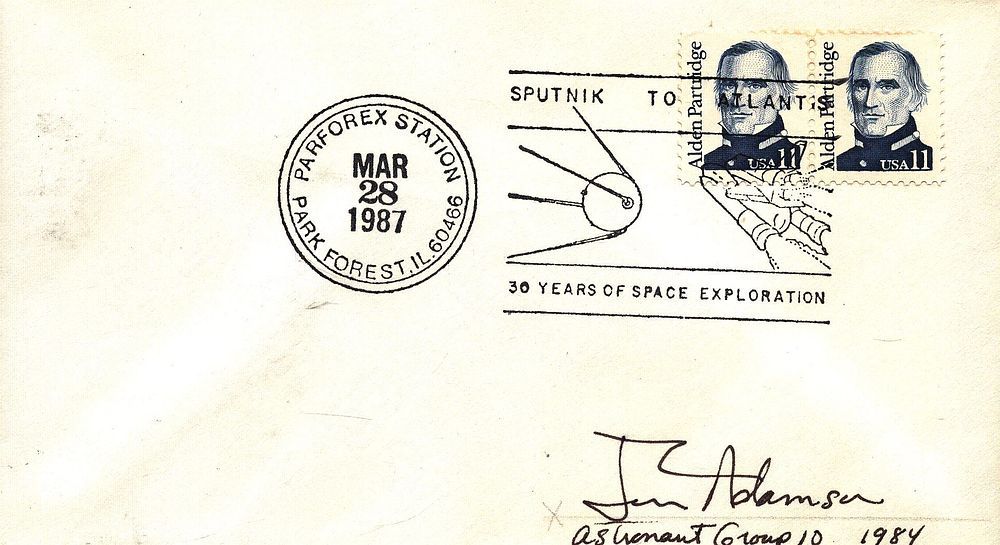
Bidspirit auction | Astronaut Jim Adamson signed Sputnik
Astronaut Jim Adamson signed Sputnik to Atlantic 30 Years of Space NASA FDC. Adamson was employed at the Lyndon B. Johnson Space Center from 1981 to 1992. During the Operational Flight Test phase of the Shuttle Program, he served as a research test pilot and aerodynamics officer in Mission Control. Following completion of the operational test flights he became guidance navigation and control officer for Shuttle Missions 5 through 11. As research test pilot he also conducted airborne remote sensing studies in biospheric research. Selected by NASA as an astronaut in 1984, Adamson became qualified for mission assignment on Space Shuttle flights. In November 1985, he was selected to the crew of a Department of Defense mission, which was subsequently delayed due to the Challenger accident. During the Shuttle Program reconstruction period, Adamson was one of eleven astronauts selected to hold management positions within NASA. He served as Shuttle Program Office Assistant Manager for Engineering Integration. In this position he was responsible for the initial development of a reliability based maintenance program for the Space Shuttle program. He also initiated an enhancements program for Shuttle ground processing. In February 1988 Adamson was assigned to the flight crew of STS-28, the first flight of Space Shuttle Columbia following the reconstruction period. Columbia launched from the Kennedy Space Center, Florida, on August 8, 1989. The mission carried a classified Department of Defense payload and a number of secondary payloads. After 80 earth orbits in 121 hours, this five-day mission concluded with a dry lakebed landing on Runway 17 at Edwards Air Force Base, California, on August 13, 1989. Following STS-28 Adamson once again returned to management. This time he was assigned to the Kennedy Space Center as Director of Shuttle Processing Analysis. He served in this post from September 1989 until October 1990 when he was assigned to the flight crew of STS-43. During this period Adamson developed risk based processing and scheduling programs which resulted in reduction of processing times from 80 days to 50 days. The nine-day STS-43 mission aboard Space Shuttle Atlantis launched from the Kennedy Space Center on August 2, 1991, setting a new world record for payload weight lifted to orbit. The five member crew deployed a Tracking and Data Relay Satellite (TDRS-E) and conducted 32 physical and life sciences experiments. During this flight, Adamson performed the first flight test of the Orbital Digital Autopilot following Shuttle retrofit with new General Purpose Computers and new software. After 142 earth orbits in 213 hours, the STS-43 mission concluded with a landing on Runway 15 at the Kennedy Space Center on August 11, 1991.