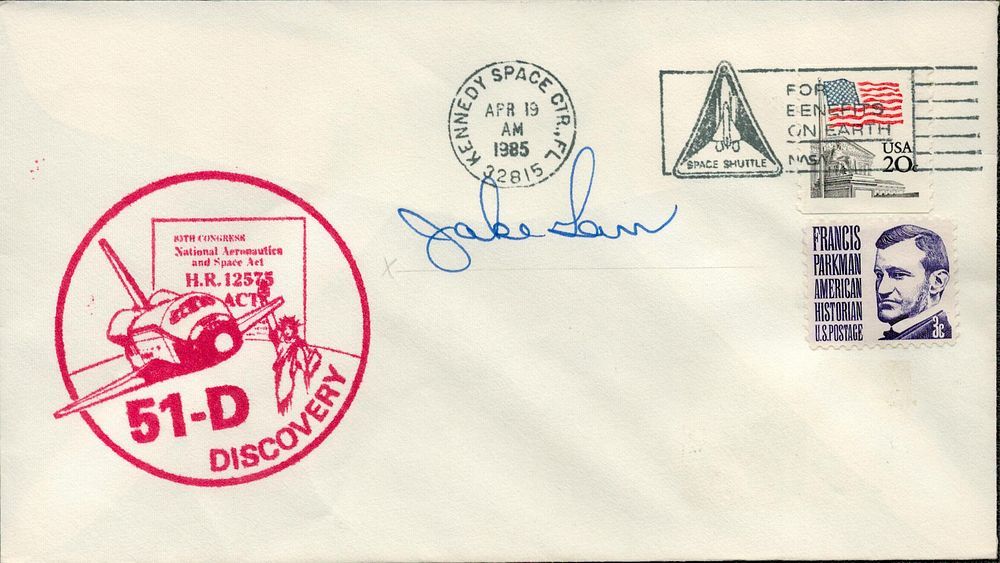
Bidspirit auction | Astronaut Jake Garn signed 51-D
Astronaut Jake Garn signed 51-D Discovery commemorative FDC. Missions: STS-51-D. Garn asked to fly on the Space Shuttle because he was head of the Senate appropriations subcommittee that dealt with NASA, and had extensive aviation experience. He had previously flown a Northrop Grumman B-2 Spirit prototype and driven a new Army tank. He began publicly asking NASA about flying on the Shuttle in 1981, and the agency had long planned to fly ”citizen passengers” such as artists, journalists, entertainers, and the Teacher in Space Project, but the November 1984 announcement that a member of Congress would go to space surprised most observers. Garn said that flying on the Shuttle would be a fact-finding trip: ”I do really think that it is a necessity that Congressmen check things out that they vote for and make certain that funds are being spent adequately. It might be necessary to have a Senator kick the tire”. STS-51-D was launched from and returned to land at the Kennedy Space Center in the U.S. state Florida in April 1985. Its primary objective was to deploy two communications satellites, and to perform electrophoresis and echocardiograph operations in space in addition to a number of other experiments. As a payload specialist, Garn's role on the mission was as a congressional observer and as a subject for medical experiments on space adaptation syndrome. At the conclusion of the mission, Garn had traveled over 2.5 million miles (4.0 million kilometers) in 108 Earth orbits, logging over 167 hours in space. The space sickness Garn experienced during the journey was so severe that a scale for space sickness was jokingly based on him, where ”one Garn” is the highest possible level of sickness. Some NASA astronauts who opposed the payload specialist program, such as Mike Mullane, believed that Garn's space sickness was evidence of the inappropriateness of flying people with little training. Garn was in excellent physical condition, however, and began flying at the age of 16. Astronaut Charles Bolden described Garn as ”the ideal candidate to do it, because he was a veteran Navy combat pilot who had more flight hours than anyone in the Astronaut Office”. Fellow 51-D payload specialist Charles Walker-who also suffered from space sickness on the flight despite having flown before-stated that: He worked out extraordinarily well, and quite frankly, I think the U.S. space program, NASA, has benefited a lot from both his experience and his firsthand relation of NASA and the program back on Capitol Hill. As a firsthand participant in the program, he brought tremendous credibility back to Capitol Hill, and that's helped a lot. He's always been a friend of the agency and its programs.