Bidspirit auction | Evidence in Cinema Volumes 1-8,
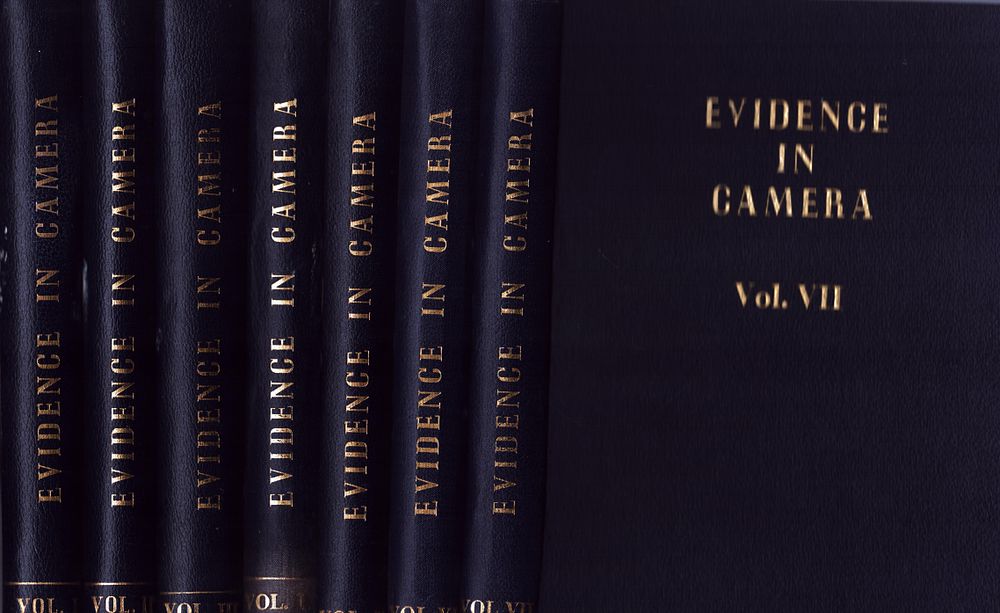
Evidence in Cinema Volumes 1-8, 1942-1945 issued by The Air Ministry. Collection of 8 hardback books. A restricted fortnightly magazine issued by Air Ministry Intelligence. It contained a selection of aerial photography taken over a two-week period to illustrate military achievements and failures. Full Set. No 1 Vol 1 (19 October 1942) to No 14 Vol VIII (5 March 1945). No complete sets exist other than this one. Extracted from pages 46-9 of The Photogenic City: Aerial Photography and Urban Visions in Europe, 1914-1945. Ph.D. Research Degree Architectural History and Theory - The Bartlett Faculty of the Built Environment University College London, March 2004: A useful source that illustrates the variety and applications of this imagery is the publication Evidence in Camera, which was issued by the Air Ministry from October 1942 to March 1945 and was designed to present the latest findings of aerial reconnaissance to military personnel. Although this publication was not graded as secret or confidential, its diffusion - which was marked “for official use only” - relied on the discretion of its readership.16 The status of this restricted document reveals some interesting aspects of how air reconnaissance photographs operated within the military discourse. The main objectives of Evidence in Camera seem to have been three: informing; instructing; and entertaining. The tone and contents of the pamphlet were considerably enriched over this period, gradually shifting from a dry presentation of photographs with minimum commentary to a more discursive use of texts and images. By 1944, images were presented in the fashion of illustrated news, with in-set descriptions of the latest war incidents; they were often accompanied by brief articles dealing with cultural and historical issues related to aerial photography. Operational photographs were often edited thematically in order to allow readers the benefit of comparison. 17 A standard feature that appeared regularly in the pages of Evidence in Camera invited the reader to guess the nature of particularly intriguing patterns recorded in reconnaissance photographs. This one-page rubric, entitled “What are these?”, presented in each issue a “puzzle picture” (or “problem picture”), usually consisting of a vertical photograph. 18 Such photographs were presumably meant to lighten the gravity of a publication that carried copious images of war and destruction; but they also revealed the curiosity of the interpreters in front of visual patterns out of the ordinary. While all aerial images presented some degree of puzzlement to their interpreters, these were singled out not so much for the factual importance of their content as for their potential entertaining value. The captions of these “puzzle pictures” suggest that intelligence staff were captivated by the aesthetic appeal of uncommon geometries, which challenged the legibility of landscapes when seen from above. For instance, a tented camp and a flooded polder appeared to be all but abstract patterns in the countryside, while an uncompleted railway viaduct was made recognisable only by the shadows cast by its free-standing piers on the ground. 19 Architectural forms also featured in several of these images, such as the vertical view of a workers' settlement in the outskirts of Lyon, which was made conspicuous by the configuration of multi-storey slabs and tower blocks; as in other similar cases, cast shadows offered a key to decipher the volumes on the ground. These visual puzzles drew the surrealist potential out of the aerial photographs of landscapes, posing a further challenge to any assumption that reconnaissance imagery was alien to aesthetic readings. 16. The Air Ministry published in each issue the warning that disclosure of any information included in the pamphlets would interfere with the government’s censorship. The standard text on the back cover re.ad: “The distribution of photographs to the general public is carried out through the Press who are supplied with photographs which have been specially selected for their general interest and have been published after careful consideration by the Security Branch and by the Ministry of Information.” 17 & 18. A case in point is the rubric entitled ‘Know your ports’, which showed images of docks and harbours in enemy and enemy occupied countries. Here, vertical and oblique pictures were Juxtaposed to facilitate recognition of port areas.