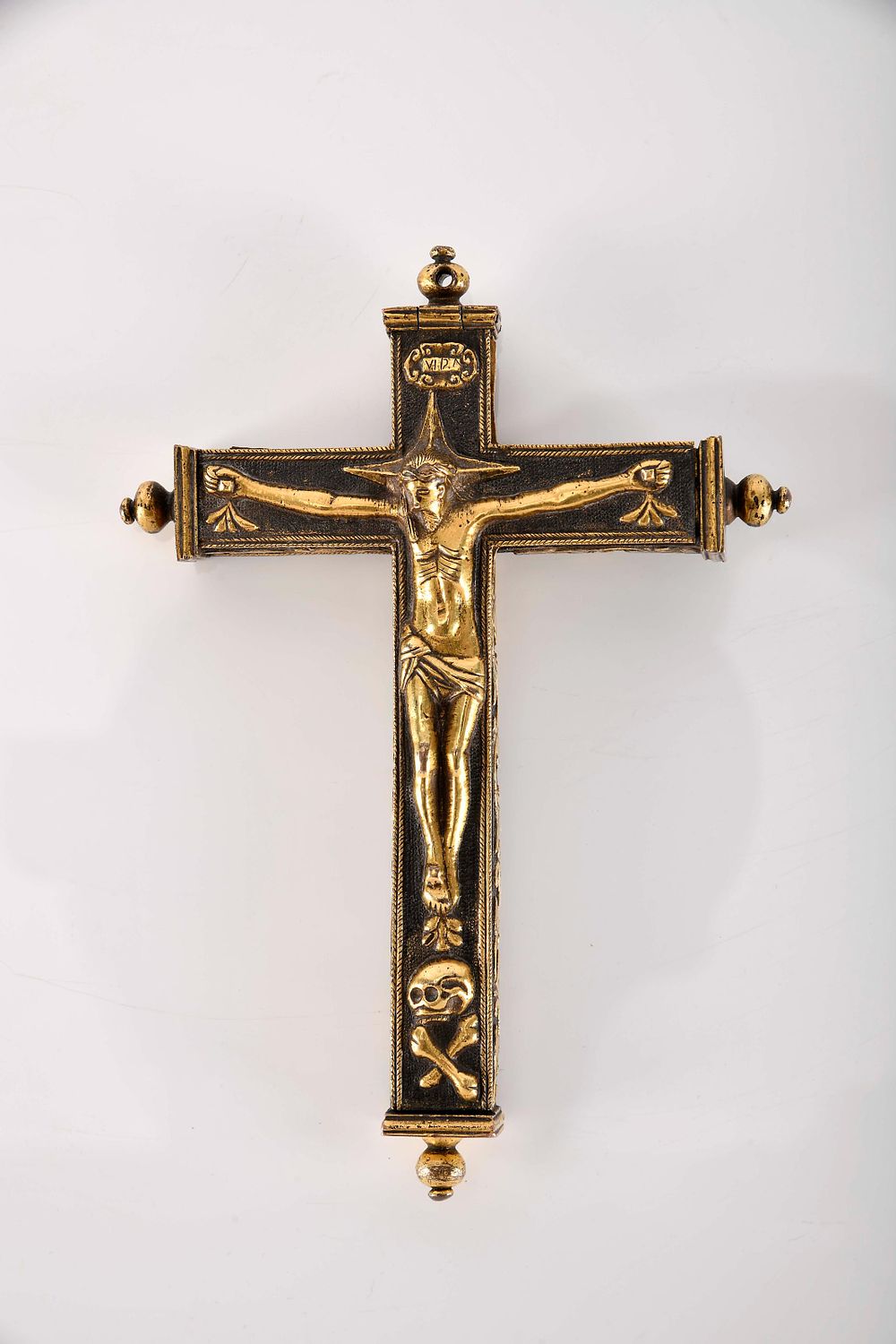
Bidspirit auction | A reliquary cross
A reliquary cross - Namban Art gilt copper alloy decoration en relief with black lacquered background: on one side ”Crucified Christ topped by a cartouche with the «Titulus Crucis» INRI and at His feet a skull and two crossed bones”; on the other side ”Our Lady of the Rosary surmounted by a crown and flanked by fluttering Angels and at her feet a friar in adoration with the inscription AVE MAE R DEI”; sides with ”Plant windings”; both sides opening containing inside a gold metal cross/plaque with a gold leaf cross covering a protection with a relic certification seal and several relics with their respective handwritten identification on strips of paper” nippo-portuguese - Momoyama period (1573-1615) suspension ring missing, wear to the gilt, interior composition apparently altered in the 19th century with the original partitions missing Dimensões (altura x comprimento x largura) - 13,7 x 9,7 x 1,8 cm Notes: vd. CRESPO, Hugo Miguel - ”Jóias da Carreira da Índia”, Exhibition Catalogue.Lisbon: Museum of the Orient, 2014-2015, pp. 62 and 195, No. 110; and ”São Roque Antiguidades - 2017”, Catalogue. Lisbon: São Roque Antiques and Art Gallery, 2017, pp. 194-196, No. 153; and RIBEIRO, José Alberto (coord.) - ”Uma História de Assombro - Portugal - Japão - Séculos XVI-XX”, Catalogue of the Exhibition on display at the King D. Luís I Painting Gallery, Ajuda National Palace. Lisbon: DGPC - Ajuda National Palace / Ministry of Foreign Affairs - Diplomatic Institute, 2018, p. 65. Namban Reliquary Crucifixes are to be found in the Museu Nacional de Soares dos Reis in Oporto, Victoria & Albert Museum in London, Tokyo National Museum in Japan, Asian Civilisations Museum in Singapura and some private collections in Portugal. This rare reliquary cross is made from shakudo, a copper alloy (with gold, silver, and arsenic), lacquered in black (urushi), fire-gilt, and of a type of Japanese ware known as sawasa. It has two cross-shaped covers, front and back, cast in relief and finely chased for added detail, articulated and the upper ends on either side by hinges, and fastened with screws at the arms of the cross. It would have been fitted with a loop for suspension passing through the top screw, and was originally fitted with several square compartments to house relics. One cover depicts the Crucified Christ with the titulum crucis above, and, at his feet, a human skull and two crossed bones symbolising the Golgotha. The other cover features the Lady of the Rosary with the Christ Child topped by a hovering crown and flanked by two flying angels surrounded by clouds. Beneath the Virgin’s crescent moon, is a three-line inscription in Latin. Written in capital letters, it reads ‘AVE // MA[T]E- // R DEI’, or, in English translation, ‘Hail, Mother of God’. Underneath the inscription St Dominic de Guzmán (1170-1221), with his typical robes, is prominently depicted. The iconography of the ‘Lady of the Rosary’ is deeply connected to the Dominican Order (Order of Preachers). It stems from the belief that the Virgin Mary appeared to the Dominican founder in 1206, at the Monastery of Our Lady of Prouille in France, and gave him the rosary as a tool for combating heresy. This tradition solidified the rosary as a central devotion for the Dominicans, who have historically promoted its use and created a specific feast day (October 7) to honour it. The association of a reliquary cross of this type with the Dominican is noteworthy and highly significant, as pieces within this group are usually associated with the Jesuits. Also noteworthy is the appearance of its interior, housing a cross-shaped inner compartment, likely added in the nineteenth century, filled with relics, all labelled, protected and featuring an apostolic seal for authentication. Modelled after an Iberian prototype, this reliquary cross—and the other surviving examples from this powerful yet turbulent period in Japan’s religious history—exemplifies the relationship between model and replica, epitomising the flow of objects and designs along transcontinental sea routes, a voyage of artistic forms that characterises the aesthetic exchanges between Portugal and Asia in the early modern period. It represents a rare and highly sophisticated production of religious and devotional objects within the sphere of Nanban art, a Japanese artistic production which, while incorporating European or Christian (kirishitan) themes, appealed both to curious, cosmopolitan natives and to the ‘Southern Barbarians’ (Nanbanjin), notably the Portuguese stationed in Asia. Serving not only as a focal point for meditation and spiritual exercises, but also as a repository of very rare and precious relics, such crucifixes reflect the devotional practices promoted by the devotio moderna, a movement that reached Asia alongside the teachings and proselytism of the Jesuits. Probably made in a single workshop, these objects were likely intended for a wealthy community of local Japanese converts,