Bidspirit auction | Kasimir Edschmid. Holocaust survivor “Das
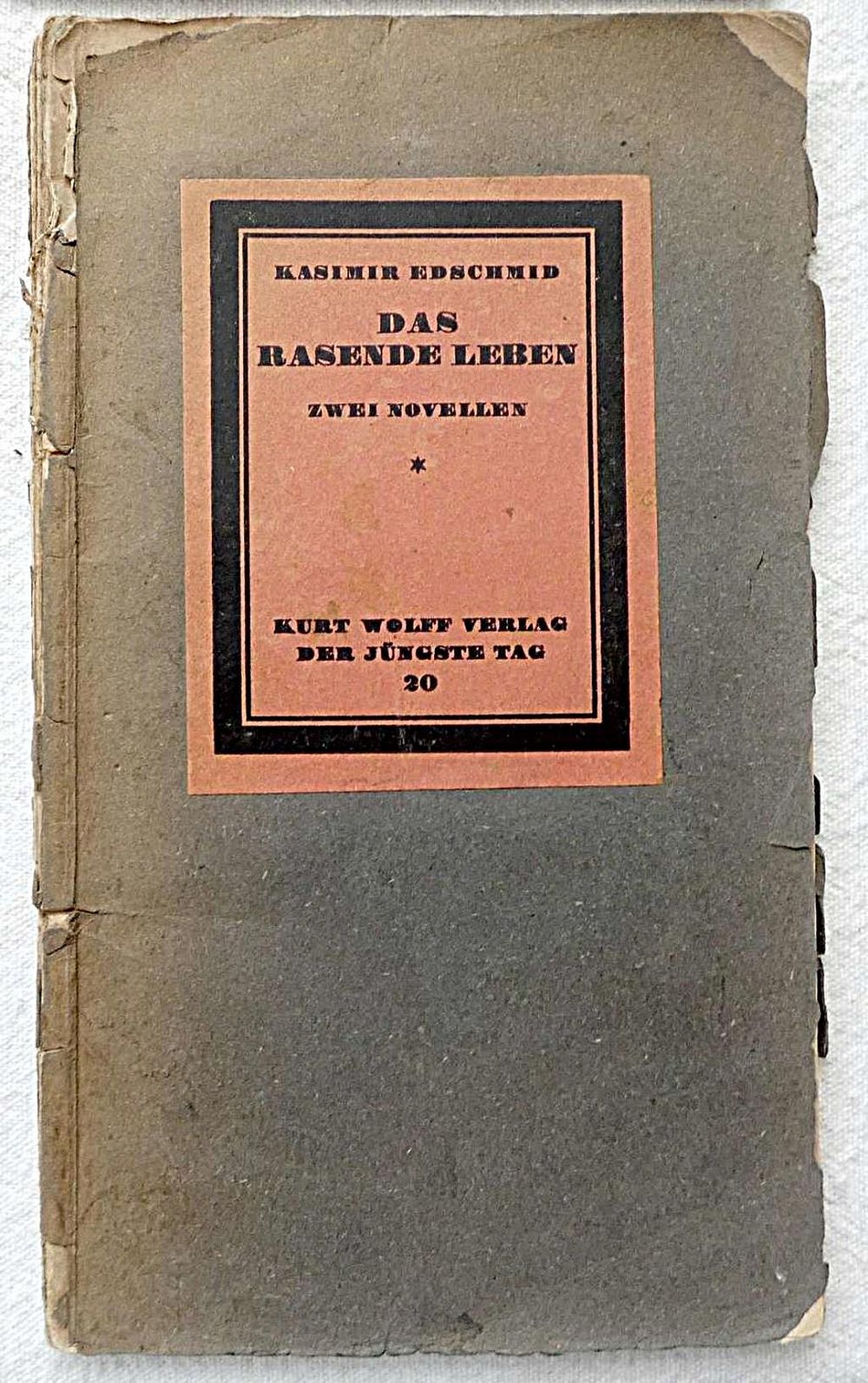
Kasimir Edschmid. Holocaust survivor “Das rasende Leben. Zwei Novellen”, 1st ed., 1915, in German Der jungste Tag ', Band 20. Kurt Wolff Verlag, Leipzig 1915., 44 pp. Softcover, 22 x 13 cm, montiertem Titelschild. Condition: Covers detached, wear, staining, chips to edges of cover; stains to most of pages, spine damaged Kasimir Edschmid, born Eduard Hermann Wilhelm Schmid (5 October 1890 in Darmstadt – 31 August 1966 in Vulpera (Switzerland)), was a German Expressionist writer. Together with Carl Gunschmann he was one of the founders of the Darmstädter Sezession in 1919. Later he turned to realism before adopting a more visionary style. He was a very prolific author, known especially for travel writing. His work was part of the literature event in the art competition at the 1928 Summer Olympics.[1] In 1933 some of his books, including ”Westdeutsche Fahrten”, were among the works burnt by the Nazis.[2][3] He spent the war in a remote mountain village in Bavaria, in innere Emigration (inner emigration). After the war he became a prominent figure in West Germany's literary establishment Der Jungste Tag war eine Broschuerenreihe, die von 1913 bis 1921 in Leipzig (und ab 1919 in München) vom Verleger Kurt Wolff und seinen Lektoren Franz Werfel und Max Brod herausgegeben wurde. Sie sollte ein Forum für Neue Dichtungen werden und wurde im Laufe der Zeit zu einem der wichtigsten Veroeffentlichungsorte expressionistischer Literatur. In der aus insgesamt 86 Banden bestehenden Reihe veroeffentlichten unter anderem Johannes R. Becher, Gottfried Benn, Paul Boldt, Kasimir Edschmid, Albert Ehrenstein, Carl Ehrenstein, Iwan Goll, Martin Gumpert, Ferdinand Hardekopf, Walter Hasenclever, Emmy Hennings, Franz Jung, Franz Kafka, Bohuslav Kokoschka, Oskar Kokoschka, Gottfried Kölwel, Otfried Krzyzanowski, Rudolf Leonhard, Ernst Wilhelm Lotz, Mynona, Hans Reimann, Eugen Roth, Ludwig Rubiner, Ruth Schaumann, René Schickele, Marcel Schwob, Hans Siemsen, Carl Sternheim, Ernst Toller, Georg Trakl, Johannes Urzidil und Berthold Viertel sowie Max Brod und Franz Werfel.