Bidspirit auction | Jean Paul “Des Rektors Florian
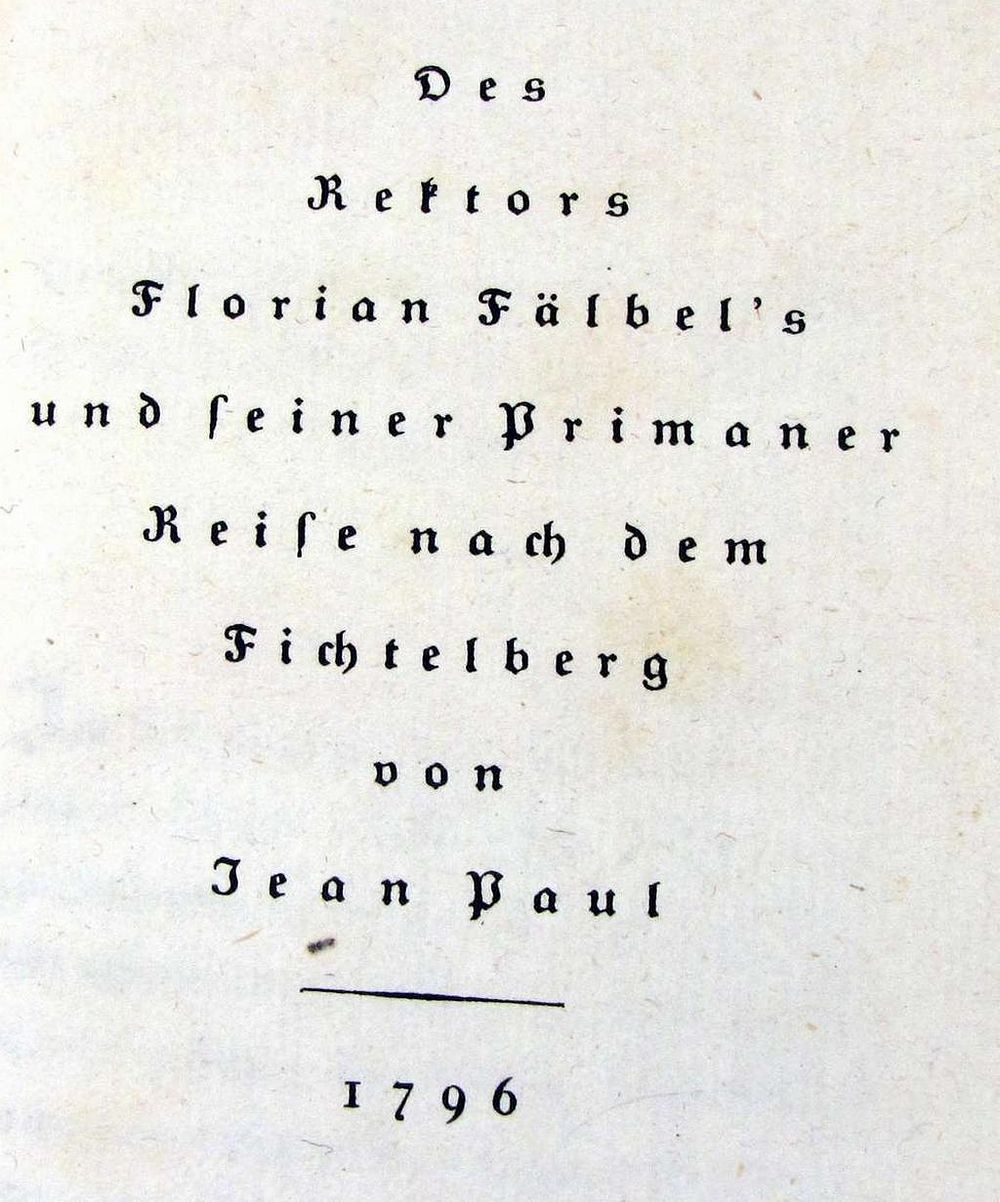
Jean Paul “Des Rektors Florian Faelbel's und seiner Primaner Reise nach dem Fichtelberg” ex.79/350, 1913 (1796), in German Breitkopf & Haertel Leipzig 1913.,113 pp. 17 x 11 cm ). Ohldr with gold-embossed narrow cover spine and colored spine label as well as marbled book covers, from a numbered edition of 350 copies here the number 79. This book was the second - the first appeared in 1796 - to be set from the Jean Paul font and printed in September 1913 by Breitkopf & Härtel in Leipzig. Condition: Cover slightly rubbed, corners slightly bumped. Endpapers slightly stained - good condition Weight: 160 gr. Dies Buch wurde als zweites — das erste erschien 1798 — aus der „Jean Paul-Schrift“ gesetzt und im September 1913 bei Breitkopf & Härtel in Leipzig gedruckt. 350 Exemplare wurden abgezogen und den Mitgliedern der „Gesellschaft der Bibliophilen“ gelegentlich ihrer Versammlung in Hamburg am 28. September 1913 vom Insel-Verlag und von der Offizin Breitkopf & Haertel zugeeignet. This book was set as the second edition — the first appeared in 1798 — using the “Jean Paul typeface” and printed in September 1913 by Breitkopf & Härtel in Leipzig. 350 copies were produced and presented to the members of the “Society of Bibliophiles” on the occasion of their meeting in Hamburg on September 28, 1913, by Insel-Verlag and by the printing house Breitkopf & Härtel. Jean Paul (born Johann Paul Friedrich Richter, 21 March 1763 – †14 November 1825) was a German Romantic writer, best known for his humorous novels and stories. Jean Paul (born March 21, 1763, in Wunsiedel; died November 14, 1825, in Bayreuth; real name Johann Paul Friedrich Richter) was a German writer. The name change stems from Jean Paul's great admiration for Jean-Jacques Rousseau. Away from the political and literary centers of his time, Jean Paul was self-taught and already possessed extensive book knowledge at the age of 15, which he compiled in notebooks of excerpts. In 1779, Jean Paul transferred to the Gymnasium in Hof, where he met his close childhood friend Johann Bernhard Hermann, the model for many of his fictional characters, such as the ”Leibgeber” in Siebenkaes. A few months later, his father died, plunging the family into severe financial hardship. At the invitation of his admirer Charlotte von Kalb, Jean Paul visited Weimar in 1796. He was received respectfully in the literary center of his time, but his relationship with classics like Goethe and Schiller remained rather cool and distant. Two years later, Jean Paul himself became a ”Weimaraner.”