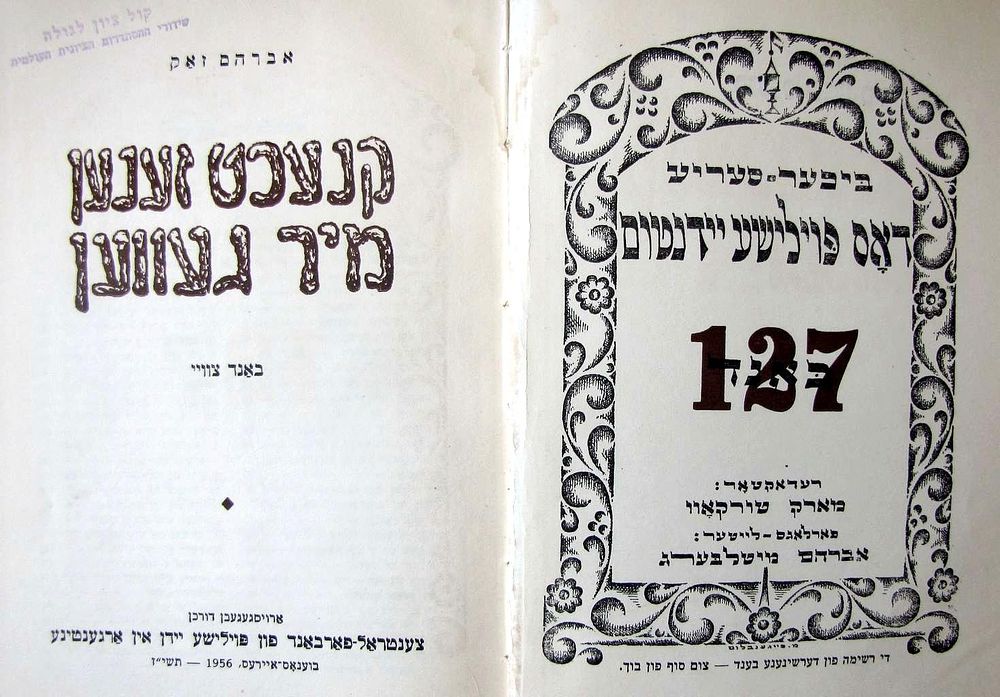
Bidspirit auction | Avraham Zak Holocaust survivor “Knekht
Avraham Zak Holocaust survivor “Knekht zenen mir geven” (We were slaves), 2nd vol., Yiddish, 1956, Argentina Buenos-Aires, band 127, 2nd vol., 1956, 342 pp. Hard cover, 20.5 x 14 cm. Damping to cover and endpapers, internally yellow paper, good condition. Weight: 530 gr. AVROM (AVRAHAM) ZAK (December 15, 1891-May 22, 1980) He was born in Amdur, Grodno district, Russian Poland. His father was a Hebrew teacher and an “official rabbi.” Until age fourteen he studied in religious elementary school, in synagogue study hall with recluses there devoted to Torah study, and in the Ruzhany Yeshiva; he later turned his attention to secular education and moved (1909) to Warsaw to prepare for the school examinations as an external student. At that time he drew close to the Zionist socialists and was a regular visitor at the home of Y. L. Perets who befriended him. In 1913 he was admitted into the Russian military and was sent to serve in Zhitomir, and from there in August 1914 he was sent to the front in Galicia, was wounded in a battle by the San River, and was provisionally released from service; he then returned to his hometown which was subsequently occupied by the German army. In 1916 he settled in Grodno, became friends there with the poet Leyb Neydus (whose biography Zak would later write and publish in Neydus’s Bukh fun poemes [Book of poems]). In late 1919 he returned to Warsaw and for many years became a member of the management committee of the Warsaw Jewish Literary Association and the Jewish section of the General Journalists’ Syndicate of Poland. With the outbreak of WWII (September 1939), he remained in Warsaw before escaping in December and settling in Soviet-occupied Grodno where he worked as a literary manager of a Yiddish theatrical group. In July 1940, together with thousands of other Jewish refugees from Poland, he was arrested by the Russian N.K.V.D. (Narodnyi Komissariat Vnutrennikh Del or People’s Commissariat for Internal Affairs [security bureau]). He was imprisoned for one year in Grodno and then deported to a concentration camp in the Taiga of the distant north, in the polar zone; in August 1941 he was released as a former Polish citizen. He went on to live in Kazakhstan, Turkmenistan, Uzbekistan, Tadzhikistan, and other Soviet Asian lands, and worked as an unskilled laborer, a night watchman, a water carrier, a shepherd on a collective farm, and other jobs of this sort. With the repatriation of Polish refugees in April 1946, he returned to Poland and settled in Lodz. For a time he served as secretary of the Yiddish Literary Association and the Yiddish Pen Club, and he gave lectures on the Polish Jewish region in Lower Silesia. He left for Paris in 1948 and there became chairman of the union of writer-survivors, vice-president of Yiddish Pen Club, part of the management of the club “Tłomackie 13,” gave talks in Paris, the French hinterland, in London, and Brussels, and he visited Israel in 1950. In 1952 he made his way to Buenos Aires, where he served as vice-chairman of the Yiddish Writers’ Union (named for H. D. Nomberg), a member of the executive of the Argentinian division of the World Jewish Culture Congress, and a delegate to the second world conference of the Culture Congress in New York in 1959.