Bidspirit auction | Die Frauen der Bibel. Drei
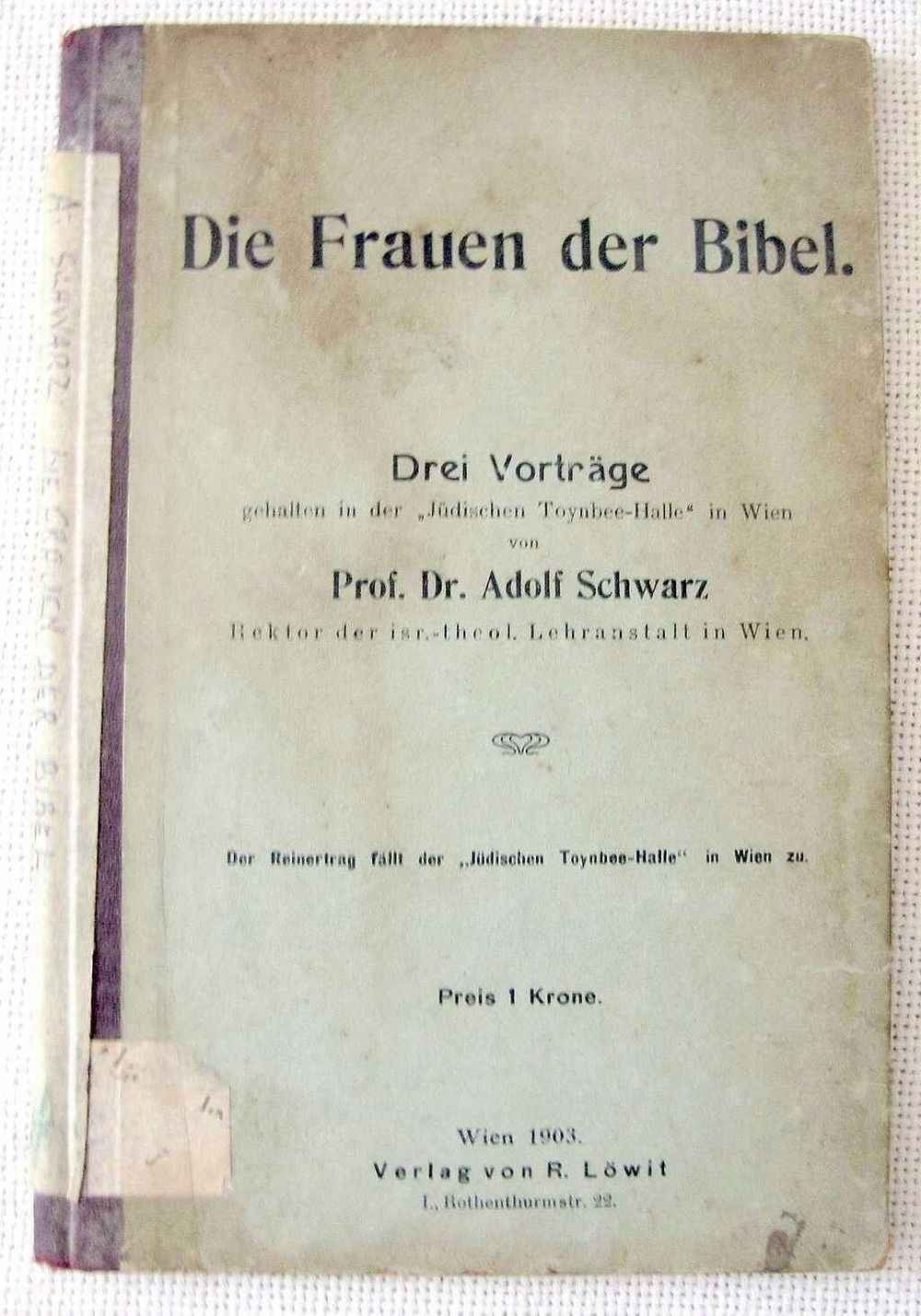
Die Frauen der Bibel. Drei Vortraege von Adolf Schwarz, 1st ed., 1903, in German Die Frauen der Bibel. Drei Vortraege gehalten in der ”Juedischen Toynbee-Halle” in Wien von Prof. Dr. Adolf Schwarz, Rektor der isr.-theol. Lehranstalt in Wien. Wien, Verlag von R. Loewit, 1903. 45 pp. Hard cover, 20 x 13.5 cm. The book is from the library of Beit Bialik – couple of stamps Condition: cover stained, discolored; dark brown stains to top of first pages; brown paper internally Adolf Schwarz (Aryeh, 1846–1931), rabbi and scholar. Born in Hungary, Schwarz studied at the Breslau Juedisch-theologisches Seminar, where he was Z. Frankel's favorite pupil and intimate friend. From 1875 he was rabbi in Karlsruhe, a post he accepted at Frankel's behest in spite of his misgivings about the use of the organ in the Karlsruhe synagogue. In 1893 he became head of the newly founded Israelitisch-theologische Lehranstalt in Vienna, where he trained several generations of modern rabbis and teachers as leaders of traditional Judaism. Schwarz enjoyed the respect and affection of his pupils and did much to raise the intellectual and moral standards of Viennese Jewry. His scholarly work was a conscious effort to continue in the paths of his teacher Frankel and was devoted mainly to the understanding of the Talmud and its methodology. His prize-winning essay on the Jewish calendar (1872), written while a student at Breslau, was followed by his studies on the Tosefta (Tosefta… Shabbat, 1879; Eruvin, 1882, Tosefta Zera'im, 1890) in which he examined its relationship to the Mishnah. At the same time he published its text in the order of the Mishnah with a Hebrew commentary, Hegyon Aryeh. In later years Schwarz continued this work, issuing editions of the tractates Ḥullin (1901), Bava Kamma (1912), and Horayot (1929). His principal contribution to talmudic scholarship was his Controversen der Schammaiten und Hilleliten (1893) which was followed by six monographs on the *hermeneutic rules: Die hermeneutische Analogie in der talmudischen Literatur (1897), Der hermeneutische Syllogismus in der talmudischen Literatur (1901), Die hermeneutische Induktion (1909), Die hermeneutische Antinomie in der talmudischen Literatur (1913), Quantitaetsrelation (1916), and Der hermeneutische Kontext (1921). A summary of these appeared in 1923 (Hauptergebnisse der wissenschaftlich-hermeneutischen Forschung, 1923). Schwarz found that a main cause of the halakhic controversies between the schools of Shammai and Hillel, apart from the weakened power of the Sanhedrin and the consequent shift from practice to theory, was a disagreement on the use of the (seven) hermeneutical rules ascribed to Hillel. Schwarz's modern approach provoked some sharp polemics from Orthodox scholars (A. Friedmann, Penei ha-Dor, 894–6). He also devoted a major study to Maimonides' Code (Der Mishneh Torah, 1905), in which he examined the logical as well as the artistic structure of the Mishneh Torah. A great number of his lectures and sermons appeared in print, as well as many articles in periodicals and some polemics against R. *Kittel. On the occasion of his 70th birthday his friends and pupils published a Festschrift (1917, with bibliography) as did his pupils ten years later (Minḥat Bikkurim, 1926). A memorial volume (Sefer Zikkaron…, 1946) commemorated the centenary of his birth Leopold Goldschmied was born in 1867 -1935 in Lučenec, in what was then Hungary. In 1897 he comes to Prostějov, where he works as a rabbi. However, he was also a writer. He is the author of the state Geschichte der Juden in Prossnitz. In: Hugo Gold: Die Juden und Judengemeinden Maehren in Vergangenheit und Gegenwart, Brno 1929, pp. 491 – 504 and many other treatises.