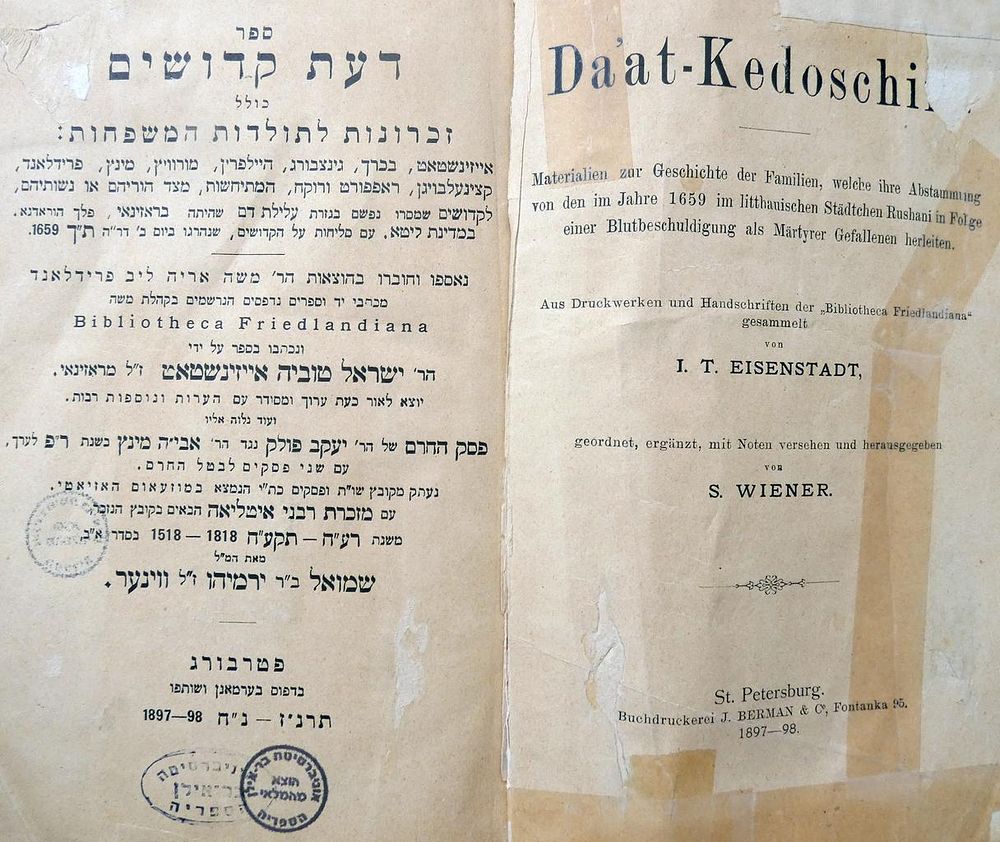
Bidspirit auction | Sefer Da’at-Kedoschim. Evidence of Jewish
Sefer Da’at-Kedoschim. Evidence of Jewish Pogrom in 1659 in the Lithuanian town of Rushani, 1897–98, in Hebrew, St. Petersburg Author and compiler I. T. Eisenstadt. Arranged, supplemented, annotated, and edited by S. Wiener. Da’at-Kedoschim. Materialien zur Geschichte der Familien, welche ihre Abstammung von den im Jahre 1659 im litthauischen Staedtchen Rushani in Folge einer Blutbeschuldigung als Märtyrer Gefallenen herleiten. Aus Druckwerken und Handschriften der „Bibliotheca Friedlandiana“ gesammelt von I. T. Eisenstadt, geordnet, ergänzt, mit Noten versehen und herausgegeben von S. Wiener. Da’at-Kedoshim. Materials on the history of the families who trace their lineage back to those martyred in 1659 in the Lithuanian town of Rushani following a blood libel. Collected from printed works and manuscripts of the “Bibliotheca Friedlandiana” by I. T. Eisenstadt, arranged, supplemented, annotated, and edited by S. Wiener. St. Petersburg, Buchdruckerei J. Berman & Co., Fontanka 95, 1897–98., 245 pp., 56 pp., 81 pp., 86 pp. New leather stamped binding and marmoreal endpapers, gold lettering to spine; size: 23.5 x 16.5 cm. Condition: ex-library stamps; wear and repair to two first leaves; yellow paper. Weight: 810 gr. The book's primary author and compiler was—listed on the title page as I. T. Eisenstadt. He: collected materials, worked with manuscripts and printed sources, studied Jewish genealogy and the history of Eastern European communities. ”gesammelt von I. T. Eisenstadt” (”collected by I. T. Eisenstadt”) However, the book was prepared for publication and edited by another person—S. Wiener. ”Organized, supplemented, annotated, and published by S. Wiener” Eisenstadt is the main author/collector of the materials, Wiener is the editor and publisher of the scholarly publication. The book is also associated with the library: Bibliotheca Friedlandiana This was a renowned collection of Jewish manuscripts and rare books from the late 19th century. Ruzhany (in Polish: Różana) was a town in the Nowogródek Voivodeship, Wołkawiski County, during the Polish-Lithuanian Commonwealth era. In Jewish administrative terms, Ruzhany, according to the decree of the Lithuanian Vaad of 1623, was part of the Brest kahal district. Thus, the Jewish A settlement existed in Ruzhany even before 1623. A staged ritual case in Ruzhany is well known. Shortly before Easter 1657, the mutilated body of a Christian child was found in the Jewish quarter, a ”victim of Jewish bloodthirstiness,” as rumor had it. The mob was ready to pounce on the Jews, but the owner of the town prevented a pogrom, declaring that the suspected Jews would be brought to trial. Two and a half years passed, and the ”case” was forgotten; it is possible that the Jews were acquitted. According to the author of the introduction to the book ”Daat Kedoschim,” the Jesuits prevented the Jews from seeking a trial at the royal court and, for their part, submitted the case to the peasants' court. According to another version, the townspeople, hostile to the Jews for economic reasons, took advantage of the absence of the town's ruler in September 1659 to lynch the Jews. Legend has it that on Rosh Hashanah, a mob attacked the Jews praying, threatening to kill them. The townspeople's court accused the entire kahal of committing ritual murder and proposed that the Jews sacrifice two members of the community. The choice fell on R. Israel b. Shalom and R. Tobia b. Joseph (perhaps they volunteered for martyrdom). They were executed on the second day of Rosh Hashanah. R. Israel's son, R. Simon, described this tragic event in a stunning selikha and also composed a memorial prayer (El Mole). To this day, the memory of the martyrs is revered among the Jews of R. Every year on the second day of Rosh Hashanah, a candle is lit in the synagogue for the repose of the souls of those martyred, and on the Day of Atonement, the aforementioned prayers are read. Popular legend has it that before their execution, both martyrs blessed the Ruzhany Jews and promised to pray to God that no more blood libels would be brought against them. In the local cemetery there is a stone monument to the martyrs (restored in 1875). — In 1765, according to official data, 154 Jews were registered in R. — Cf.: Eisenstadt-Wiener, Daat Kedoschim; S. Dubnov, ”Historical Reports”, ”Voskhod”, 1893, VII; Pinkos of the Lithuanian Vaad; Vil. central arch., book 3633 (Bershadsky's paper). M. V. 5. Now a small town in Grodno Province, Slonim District. According to the 1847 census, the ”Ruzhansk Jewish Community” consisted of 1,556 souls. According to the 1897 census, R. had 5,016 residents, including 3,599 Jews. There is a Talmud Torah (1910).