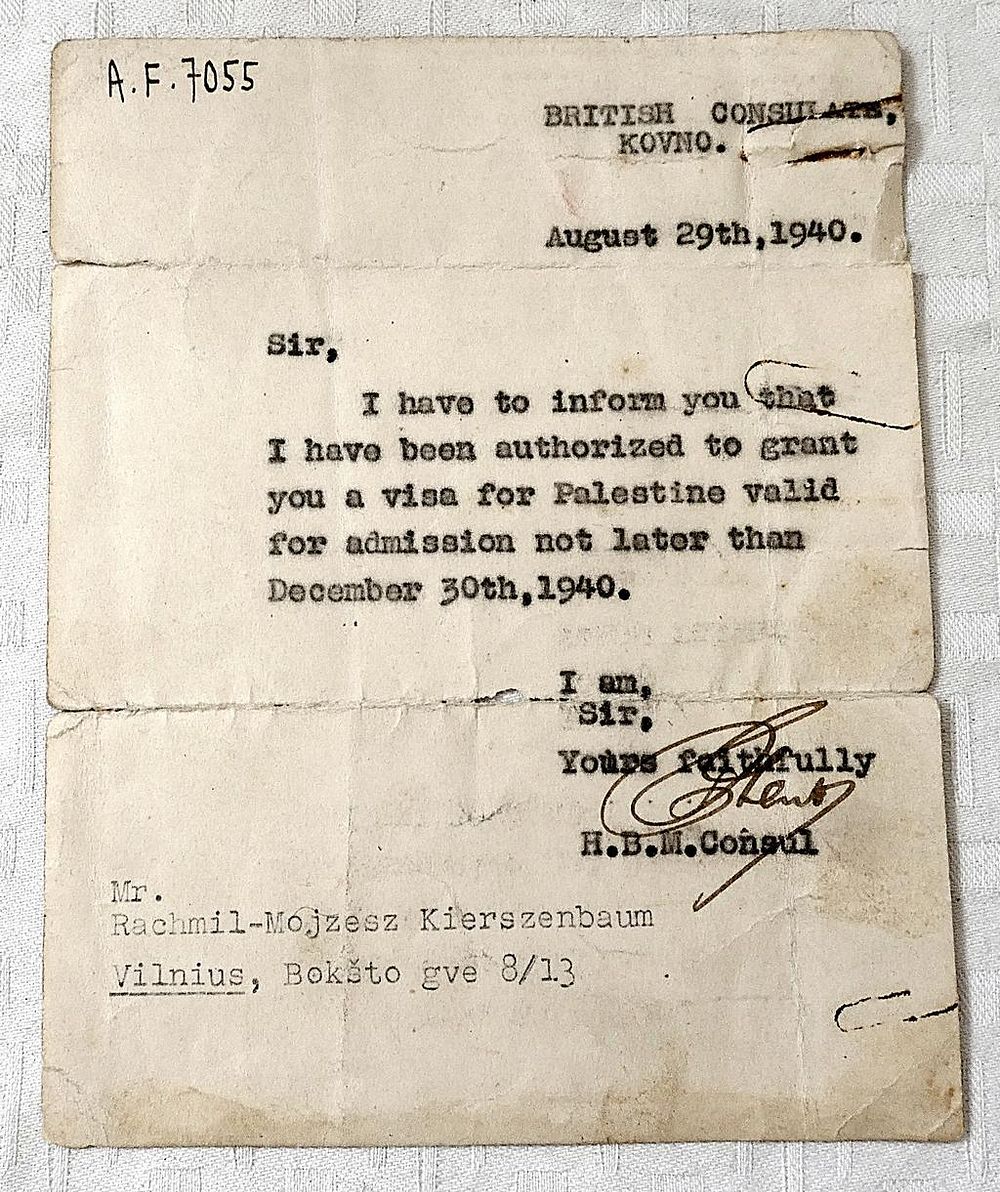
Bidspirit auction | Holocaust. Thomas Preston, British Consul
Holocaust. Thomas Preston, British Consul in Kovno, Righteous Among the Nations, his signature on a visa permit to Palestine, August 29, 1940. Visa permit to Palestine for a Jew Rachmil-Mojzesz Kierszenbaum (Moisei Kirshenbaum) Full text of the document: A.F.7055 BRITISH CONSULATE KOVNO. August 29, 1940. Sir, I have to inform you that I have been authorized to grant you a visa for Palestine valid for admission not later than December 30, 1940. I am, Sir, Yours faithfully, [signature] H.B.M. Consul (His Britannic Majesty’s Consul) Mr. Rachmil-Mojzesz Kierszenbaum Vilnius, Boksto g-vė 8/13 (Boksto Street is the old center of Vilnius (near the Old Town). This was a neighborhood with a significant Jewish population before the war.) The document was signed by the British Consul in Kovno. In 1940, Thomas Preston was the British Consul in Kaunas. On 7 December 1929, Sir Thomas Hildebrand Preston was appointed ”His Majesty's Consul for the Republic of Lithuania, including the Memel Territory (Klaipedas Krastas)”, residing at Kaunas (Kovno), the temporary capital of Lithuania. In this position he was promoted to secretary 2nd class on 10 February 1930, secretary 1st class on 17 July 1935 and counselor in the Diplomatic Service on 1 December. He was appointed Officer of the Order of the British Empire (OBE) in 1934. On 12 June 1940, he was promoted to envoy extraordinary and minister plenipotentiary. In this position, he provided 800 Jews with legal travel certificates, a few hundred of which were able to cross the Baltic Sea to neutral Sweden. He also assisted an additional 400 Lithuanian Jews to escape to Mandatory Palestine in 1940 by issuing them illegal Palestine certificates, thus enabling them to leave for the Middle East via Turkey. This was irregular, as it greatly exceeded the number approved by the British government for immigrants to Palestine. At least 400 forged copies of the Preston visas were discovered by British officials in Istanbul. Other diplomats in Kaunas that issued documents that permitted Jews to travel included Chiune Sugihara of Japan and Jan Zwartendijk, honorary consul of the Netherlands. Students of the Mir Yeshiva were among those enabled to travel. In 1940, Preston was placed on 'the Black Book' (Sonderfahndungsliste G.B. ”Special Search List Great Britain”), a list of 2820 persons who were to be arrested by the SS in the event of a German occupation of Britain. In September 1940, he was transferred to Istanbul on the dissolution of his previous post following the Soviet occupation of Lithuania and de facto loss of Lithuanian independence. From 18 June 1941 to 1948, he held the post of counselor at the British Embassy in Cairo. He retired in 1948. Historical Context This is an extremely interesting document from the period of the rescue of Jewish refugees in the summer of 1940. Similar letters from the British consulate in Kovno were issued to Jews granted entry into Mandatory Palestine. These documents were often used in conjunction with transit visas issued by Japanese diplomat Chiune Sugihara and Dutch consul Jan Zwartendijk, allowing refugees to leave Lithuania via the USSR and Japan. The file number in the upper left corner—**A.F.7055**—is likely the consulate's internal registration number. This may be helpful in further archival research on Kirshenbaum. This isn't a visa itself, but a permit/confirmation. It was used to: obtain a Soviet exit visa apply for a Japanese transit visa It's very likely that this document was used in conjunction with visas issued by: Chiune Sugihara He issued transit visas through Japan. Palestine was then under the British Mandate (see British Mandate for Palestine). But: Britain restricted Jewish immigration (White Paper 1939). Therefore, such permits were issued in a very limited manner. Why Kaunas? In the summer of 1940: Lithuania was still an exit window. The following were working there: Japanese consulate Dutch consul (Curaçao visas) British representatives Key moment Date: August 29, 1940 This was after the Soviet occupation of Lithuania (June 1940). That is, this was the very last period when it was still possible to leave. Up to 95% of the Jewish population in Lithuania was exterminated. Sir Thomas Hildebrand Preston, 6th Baronet, OBE (2 June 1886 – 30 December 1976) was a British diplomat. He was a posthumous recipient of the British Hero of the Holocaust award for saving Jewish lives in Lithuania in 1940 by issuing documents that permitted them to travel. He was consul in Ekaterinburg in Russia at the time of the murder of the Romanov family there in July 1918. Thomas Hildebrand Preston was born in Epping, Essex, the son of William Thomas Preston and of Alice Mary née Stevens. He was a grandson of Sir Jacob Henry Preston, 2nd Baronet Preston. He immigrated to New Zealand with his father who started farming at Timaru, but was educated in England at Westminster School and at Trinity Hall, Cambridge where he studied Russian.