Bidspirit auction | ”Our Little Girl” – An
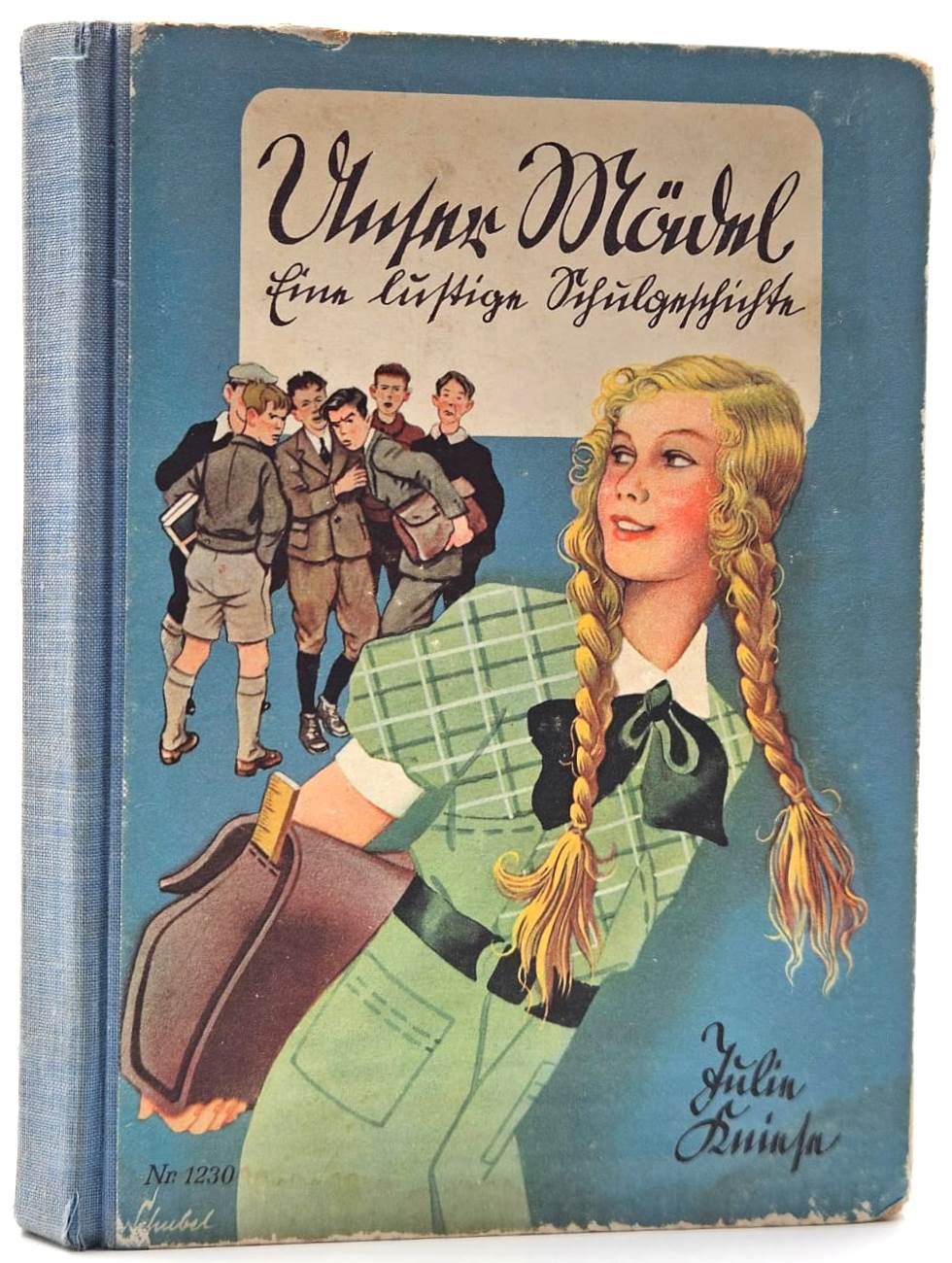
”Our Little Girl” – An Anti-Semitic Children's Book from Nazi Germany, Promoting Aryan Racial Supremacy. Stuttgart, [1936] - Unser Mädel. Eine lustige Schulgeschichte, mit 21 Bildern nach Zeichnungen von Heinz Schubel – ”Our Little Girl. A Funny School Story” by Julie Knyza, with 21 illustrations based on drawings by Heinz Schubel – A children's book written in Nazi Germany, incorporating anti-Semitic themes and conveying messages of nationalistic worship and Nazi ideology. Published by Loewes Verlag Ferdinand Carl, Stuttgart, [1936] – First edition. Dedication on the front endpaper dated 1939. The book's protagonist, whose image also appears on the cover, is a blonde, braided-haired German girl named Hannelore Golding—beautiful, intelligent, and talented—a quintessential Aryan figure according to Nazi racial theory. The book presents Golding as the ideal ”Aryan heroine”, possessing not only a perfect appearance but also impeccable skills and exemplary moral virtues. When a group of boys stands helpless as their friend's trousers tear, Hannelore does not hesitate—she immediately pulls out a needle and thread and mends them on the spot. When children mock a struggling reader, she does not join in the ridicule; instead, she patiently guides him, teaching him not to be ashamed but to learn at his own pace. When the teacher poses a question that none of the students can answer, Hannelore enters the room at that exact moment and immediately provides the correct response. When a child is stranded on an ice floe in freezing waters, she is the first to jump in and rescue him. In every situation where others fail, hesitate, or remain powerless—Hannelore Golding arrives, resolves, saves, and leads. Through the book's protagonist, ”the German Hannelore, ” the author conveys anti-Semitic messages and German patriotism. For example, in the chapter ”The Iron Cross, ” a scene illustrates the influence of Nazi ideology on the younger generation. During a classroom debate about the most admired political party in Germany, reflecting the atmosphere of Reichstag elections, strong and charged opinions are expressed. ”We are the State Party!” declared one boy. Werner Ecklein grabbed a newspaper, crumpled it, and threw it high across the classroom. ”The State Party! They are Jews, and all the filth that comes with them. We are German citizens, something better—we are the people of black, white, and red…”. ”He's right!” shouted Axel. ”But the SPD (the second-largest party in Nazi Germany, which opposed the Nazi Party) is better. They take care of the workers…”. Meanwhile, Luchmann drew a swastika on the blackboard. ”Hey, look at the Nazi over there!” shouted Werner Ecklein. Hannelore stood against the wall, observing the boys' commotion in silence. Arel approached her. ”Well, what do you say?” ”Me? I am German, ” she answered simply. ”After all, we are a German people… Why are you all shouting at each other?” ”Look at this foolish girl, ” Lau Bez sneered. ”'Germany, Germany'—she always wants to be something special.” The argument ends, and the boys leave school together with Hannelore. On their way home, they encounter a one-armed man on the street. ”Hannelore sat down, her blue eyes wide with excitement. 'He has only one arm, and he has the Iron Cross on his coat!'” The boys fell silent. ”Did you lose your arm in the war?” Hannelore asked quietly. ”Yes, ” he replied. Silence again. ”Do you have children?” ”Yes, four. And I am unemployed. My pension is not enough, ” he said. Hannelore did not dare to ask more questions. As they left the alley, Hannelore and one of the boys exchanged glances. ”I’ll tell you what, ” Hannelore said. ”You know, that was a soldier from the war in Hattenweiler Kopf. He gave his arm for our Germany, and he has the Iron Cross—the Iron Cross!—and he is in need! That is a disgrace. And if someone has the Iron Cross, everyone should salute him—he is a German hero. And yet, you argue about which party you belong to. Well, now you know!” (hinting at the Nazi Party). The boys walked side by side in silence. What could they say? Hannelore was right! The scene aims to portray Hannelore as the ideal embodiment of ”the true German, ” glorifying German nationalism and the sacrifice of soldiers while fostering admiration for Nazi ideals and overlooking real injustice. In the book’s epilogue, the author is described as: ”A beloved youth writer who captivates young readers with her stories, inspiring goodness and beauty, and instilling love for home and homeland.” The book was one of the most popular children's books in Nazi Germany and was reprinted almost annually throughout the 1930s and 1940s, continuing to be published even after the war. Copies of the book are known to have been released in the 1950s. This is the first edition, published in 1936 without a year notation, with the mention: ”Printed by the Stuttgart Club Printing Company.” In the WorldCat global library catalog,