Bidspirit auction | Historical documentation of the meeting
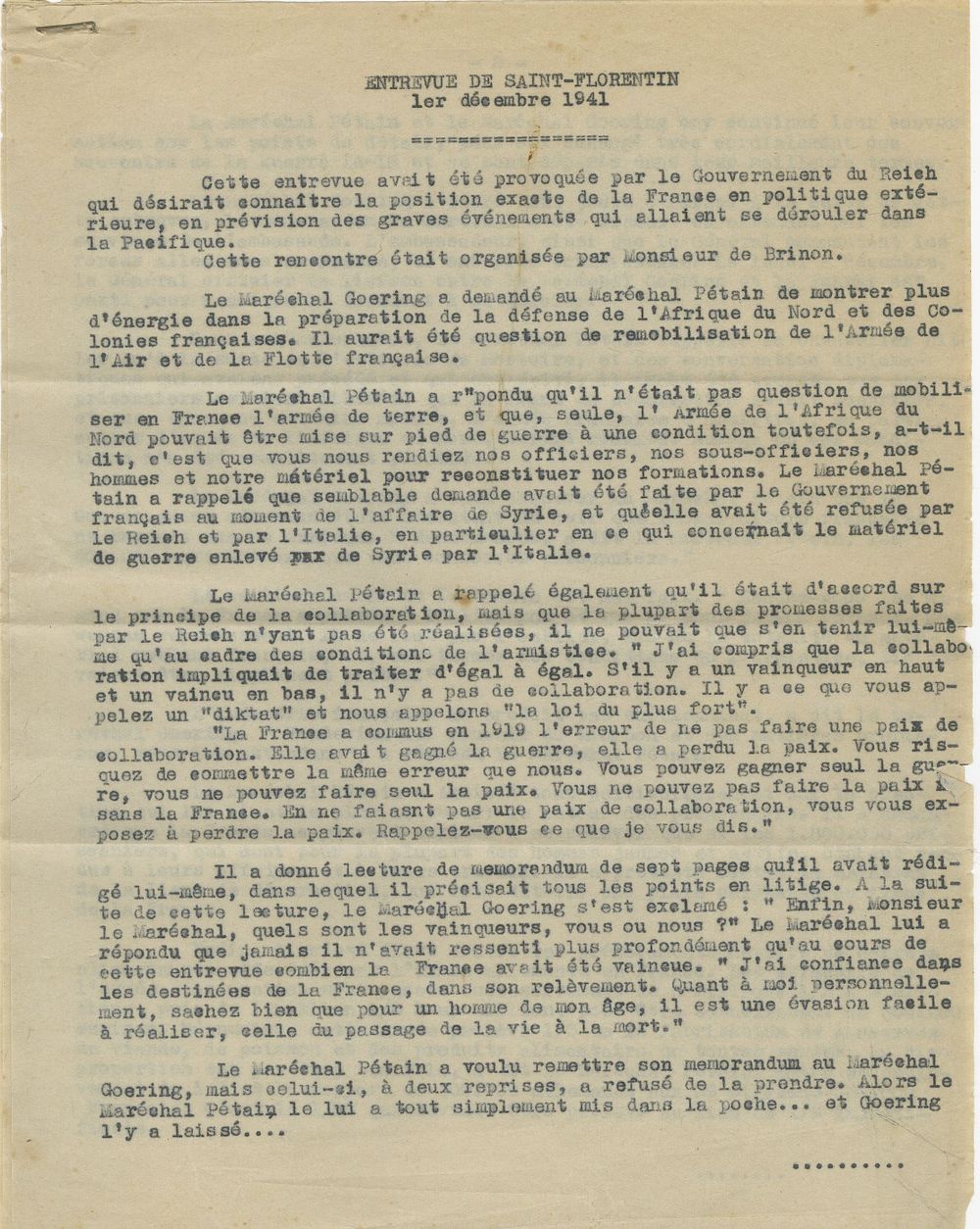
Historical documentation of the meeting between Philippe Pétain and Hermann Göring shortly before the attack on Pearl Harbor. December 1941 - Detailed account of the meeting between Luftwaffe commander and head of the German Air Ministry Hermann Göring and the head of Vichy France, Marshal Philippe Pétain, who collaborated with Nazi Germany. The meeting took place in Saint-Florentin on December 1, 1941 — describing how the submissive Pétain attempted to portray France as an equal ally to Nazi Germany, and Göring’s efforts to recruit Pétain as a compliant partner in Germany’s war efforts. Typed at the time of the event, based on the testimony of one of Pétain’s aides who was present at the meeting. Rare. The meeting took place at a critical juncture of World War II — shortly before the Japanese attack on Pearl Harbor and the entry of the United States into the war. Germany was seeking clarification regarding Vichy France’s position in the coming conflict in the Pacific and on the global stage. Above all, the Germans were attempting to assess how much further military and economic cooperation could be “extracted” from France. The meeting was arranged by Fernand de Brinon, a French lawyer and diplomat, known as one of the most prominent advocates and executors of collaboration between the Vichy government and Nazi Germany. He served as the senior representative of the Vichy regime in occupied Paris and held the post of Commissioner for Franco-German Relations. At the end of the war, de Brinon was captured by the Allies, tried for his crimes, and executed by firing squad in April 1947. From the document, it emerges how Göring demanded to know France’s position in light of the approaching developments, and proposed that France contribute more to the defense of North Africa and its colonies. He hinted at the idea of revitalizing the French air force and navy. Pétain refused any immediate plan for broad military cooperation or a re-mobilization of the French army, insisting that France retain independent control over its own resources. He complained that Germany had rejected France’s requests regarding Syria. While emphasizing that he did not oppose cooperation with Nazi Germany, he demanded that such cooperation be conducted “between equals, ” not in submission: “I understand that true cooperation is between equals. There is no victor and vanquished here, ” he said. During their conversation, Pétain handed Göring a seven-page memorandum in which he outlined his grievances, including: Broken German promises, The issue of French prisoners of war (1.8 million, mostly young men), His demand for the renewal of industrial production and economic mobility in France, The unfair proportion of resources being taken by Germany — a third of French agricultural output for the benefit of 500,000 Germans versus 39 million French citizens, Pétain attempted to hand the memorandum to Göring on two separate occasions, but Göring refused to accept it. Eventually, Pétain simply slipped the document into Göring’s pocket, where it remained. In his remarks, Pétain accused Germany of draining the French economy to the point of destruction. He added that he had never agreed to, nor considered, relinquishing Alsace-Lorraine or any other territory to Germany. He recalled that Hitler had promised there would be no territorial annexation, and that he expected Germany to honor that commitment. Göring, with his characteristic arrogance, responded: “Marshal Henri, who are the victors — you or us?” To which Pétain replied that he had never felt more defeated before Germany than in those very moments of their meeting. This is a rare piece of documentation that reflects both the collaboration and underlying tensions between Nazi Germany and the Vichy regime — the former demanding total loyalty, while the latter attempted to maintain a semblance of autonomy. The meeting took place just days before the attack on Pearl Harbor (December 7, 1941), at a pivotal moment when Germany was on the verge of declaring war on the United States. It reveals Germany’s efforts to assess the extent of Vichy France’s commitment to the war effort, particularly in relation to North Africa and its colonies. Following France’s defeat in 1940, Marshal Pétain established the Vichy regime, assuming leadership of the state under Nazi oversight. He adopted a policy of “collaboration” with the occupiers, claiming this was the only way to preserve a degree of French independence, maintain order, and protect the population. In reality, Pétain repeatedly surrendered to German pressure — accepting antisemitic legislation, the persecution of Jews, and the economic subjugation of France to Germany. Pétain portrayed himself as the protector of the people, yet in practice he willingly abandoned the values of the Republic — sovereignty, liberty, and national pride — passively accepting the terms of occupation. His rule became a symbol of moral and national defeatism. [3] leaves.