Bidspirit auction | From the Nuremberg Courtroom –
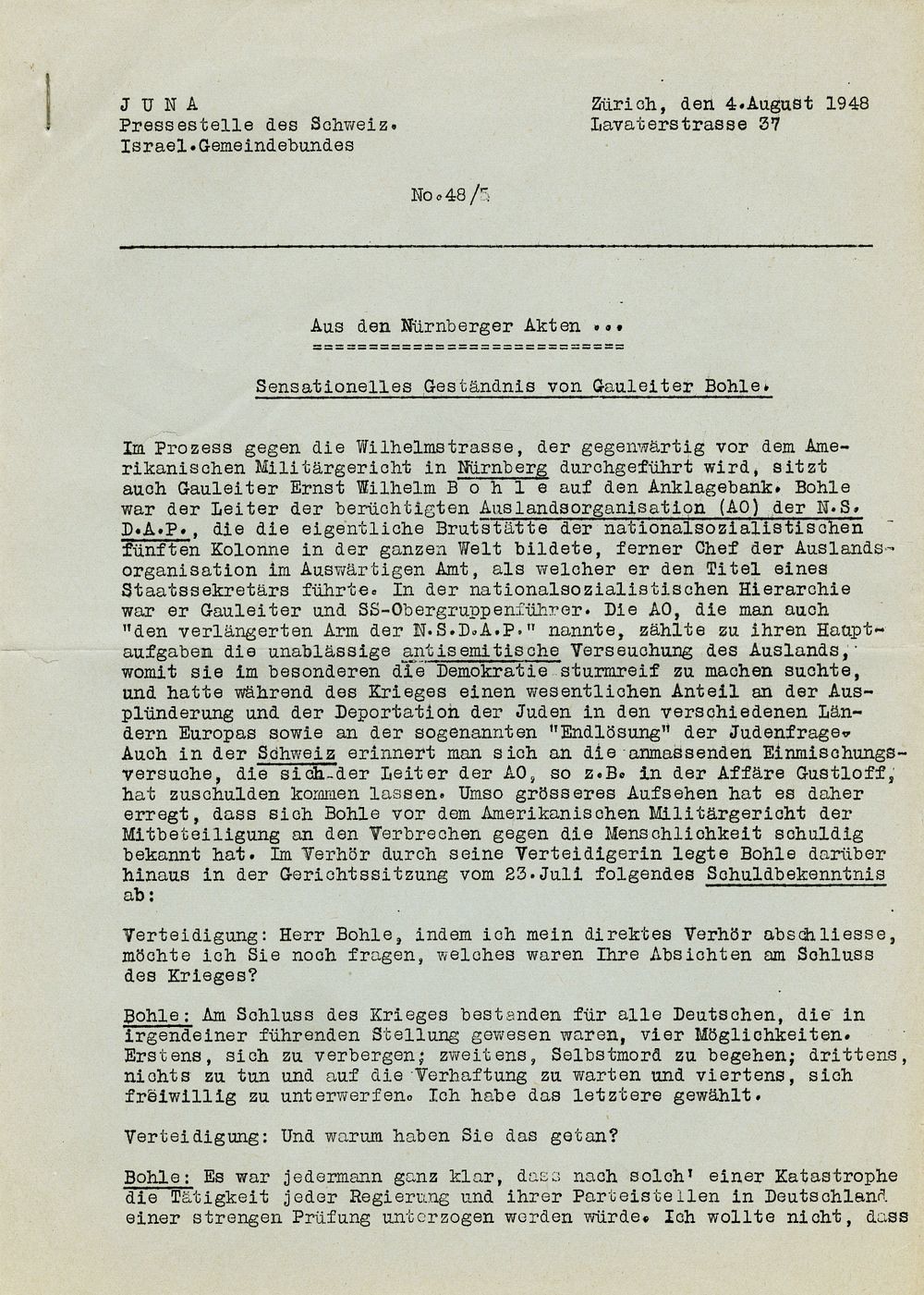
From the Nuremberg Courtroom – Transcripts of the interrogations of Nazi war criminals at the court – Internal publication issued by the Press Office of the Union of Local Israeli-Authorities - ”Kempner: If the name of Mrs. Wurmann, your wife, or the name of your daughter-in-law appeared on one of these deportation lists, would you have signed it as well? Wurmann: I cannot respond to that...” JUNA Pressestelle des Schweiz. Israel Gemeindebundes - Internal publication issued by the Swiss Press Bureau – Union of Jewish Communities. Zurich, August 4, 1948 – A detailed account of the court interrogations during the trials of Nazi war criminals then underway as part of the “Subsequent Nuremberg Trials” before the American Military Tribunal. Typewritten edition. German. Extremely rare. Rare documentation from the “Subsequent Nuremberg Trials” (the Ministries Trial) – a series of twelve trials conducted before United States military tribunals in which officers, statesmen, industrialists, and professionals of Nazi Germany were prosecuted for war crimes. The trials were held after the end of World War II, beginning in 1946 and continuing through 1949, at the Palace of Justice in Nuremberg, following the conclusion of the main war criminals’ trial before the International Military Tribunal. The present documentation presents excerpts from courtroom proceedings, including: the confession of Gauleiter Bohle and his expression of remorse for having been part of the Nazi extermination program; a letter in which the director of the I.G. Farben forced labor plant near Auschwitz expresses satisfaction with the large shipments of Jews sent to work in his factory; transcripts from the interrogation of officials from the German Foreign Office who signed a document approving the deportation of 6,000 Jews with French citizenship to Auschwitz; and testimony by Albrecht von Kessel describing the satisfaction felt among Nazi Party members when, during the 1936 Olympic Games, the Olympic Committee failed to enforce the annulment of discriminatory regulations against Jewish athletes. The report opens with the sensational confession of Ernst Wilhelm Bohle, who served as the head of the Foreign Organization of the Nazi Party throughout its entire existence. The issue presents a full transcript of his interrogation — the questions and answers posed to Bohle in court. At the time, Bohle stood on the defendants’ bench in Nuremberg and expressed remorse for his wartime crimes. During the war, he was the head of the notorious Foreign Organization (AO) of the Nazi Party (NSDAP), a fertile breeding ground for the Nazi fifth column across the globe. He also served as head of the Foreign Organization within the German Foreign Office, where he held the position of State Secretary. Among his main tasks was the continuous spread of antisemitic propaganda in foreign countries, through which he aimed, in particular, to prepare democracies for collapse and internal attack. Throughout the war, Bohle played a key role in the plunder and deportation of Jews across various European countries, as well as in the implementation of the “Final Solution” — the extermination of the Jews. As quoted in the present issue, Bohle expressed remorse for his actions and called upon the world to give Germany a chance to repent for its heinous crimes and its antisemitism. In court, Bohle confessed: ”I believe that this was without a doubt one of the most tragic and fundamental errors made by all of us who held leading positions... which led to a development that ultimately resulted in such a horrific final outcome...”. Also included in the report is the exposure of a wartime letter written by an employee at the I.G. Farben forced labor plant, constructed adjacent to the Auschwitz concentration camp. In the letter, the writer expresses satisfaction with productivity following the arrival of masses of Jews sent for forced labor, describing a human multitude that “could continuously supply Auschwitz with a fresh stream of human machines; Auschwitz no longer needed to concern itself too much with maintaining the stock it already had — even from the perspective of efficient production.” On this matter, witness Beuys testified about the deliberate starvation of Jewish laborers at the facility: “The commanding officer gave them just enough to keep them alive and functioning until replacements arrived.” Further in his testimony: “When these human machines collapsed completely, they were immediately liquidated on site. We saw for ourselves how I.G. constructed a special morgue to hold up to 40 people at once. If these human machines didn’t completely collapse but were so worn out that they were no longer useful to I.G., they were sent back to the main Auschwitz camp as waste — to be exterminated with the rest of the human refuse in the gas chambers at Birkenau. I.G. itself supplied the gas used for this purpose.