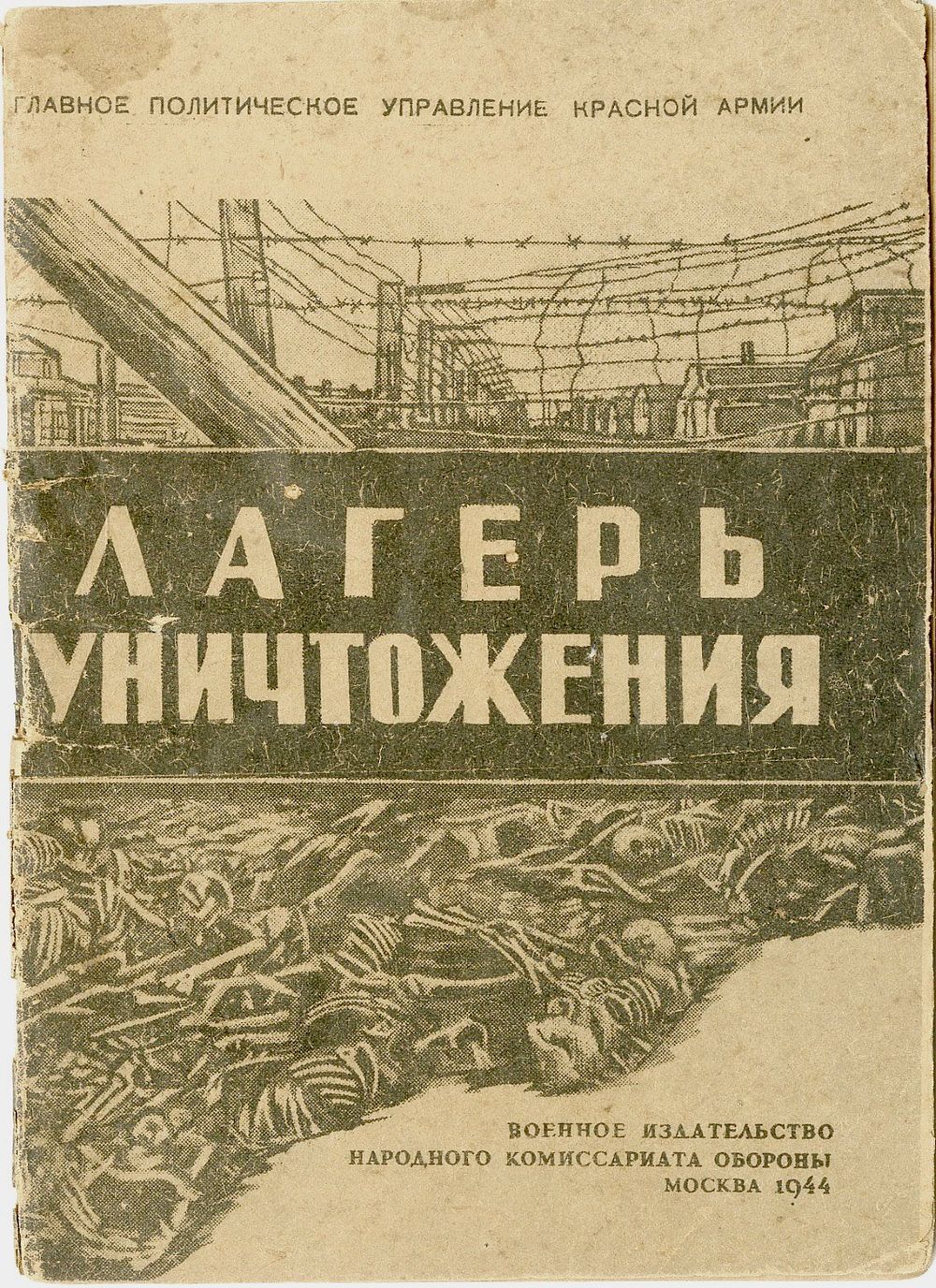
Bidspirit auction | The Extermination Camp – an
The Extermination Camp – an early publication on the atrocities of the Majdanek extermination camp. Moscow, 1944 – first edition - ”Лагерь уничтожения” – The Extermination Camp, an early Soviet publication by Konstantin Simonov on the atrocities committed at the Majdanek camp. Published by the People’s Commissariat of Defense (Народного комиссариата обороны) – the Main Political Directorate of the Red Army. Moscow, 1944 – issued even before the end of the war. Accompanied by harsh photos documenting the mass extermination facilities at the camp, the bodies of the victims, and their personal belongings. Extremely rare. An early documentation of the atrocities committed by the Nazis at the Majdanek extermination camp - from its establishment through the course of World War II. The booklet includes descriptions of the systematic extermination and some of the first eyewitness testimonies to the horrors committed by the Nazis. As Konstantin Simonov writes: “Perhaps I spoke with only one-hundredth of the witnesses and saw only one-tenth of the true traces of the crime…”. The findings presented here were mostly gathered by the Red Army upon its arrival at the camp in July 1944. Although 1,000 prisoners had been forced on a death march from the camp, the Red Army found thousands of inmates still inside, along with extensive evidence of the mass murder carried out there, including gas chambers, crematoria, and barracks used for storage and human habitation under inhuman conditions. In the first part of the booklet, Simonov provides a detailed account of the construction of the camp by Jewish and Polish prisoners of war, who were subjected to forced labor to the point of death. He describes the extermination process in detail - the disinfection procedures, the use of Zyklon B gas for mass murder - revealing for the first time extensive information about the size and structure of the gas chambers and the method by which the gas was introduced into the rooms. Also described are the crematoria and the incineration of corpses, including horrifying details about the burning process, the number of bodies incinerated per day, and the overall operation. He documents executions by hanging and shooting, and the various torture methods used by the Nazis during what was referred to as the “evening roll call, ” and by other means. Among other events, Simonov gives a detailed account of the mass execution that took place in November 1943, in which 18,000 prisoners were murdered in a single day by machine gun fire into pre-dug pits. The second part of the booklet includes testimonies from surviving Majdanek prisoners, who describe the horrors of the camp in detail, mentioning the names of fellow inmates who were murdered and giving extensive descriptions of the methods of extermination. The report is based on internal documents from the SS camp commanders from the years 1941–1944, which were found during and after the war, as well as on prisoner testimonies. Despite the difficulty of gathering sufficient evidence to produce a complete picture, the Red Army succeeded at a relatively early stage in forming a clear understanding of how the death machinery at the camp operated. As Simonov writes: “The fundamental assumption of the SS men responsible for the camp was this: all those who entered the camp - whether prisoners of war or detainees, whether Russians, Ukrainians, Poles, Belarusians, Jews, French, Presbyterians, and so on - would be exterminated sooner or later. They would never leave the camp alive and never tell anyone what had happened there. This assumption dictated both the behavior of the guards and the methods of extermination inside the camp. The dead are silent and cannot speak. They cannot give details or confirm these facts with documents...”. This original Russian publication is among the very first to systematically expose the atrocities committed at Majdanek. Within a short time, the booklet was translated into several languages. Cover design: at the top, an illustration of the camp surrounded by barbed wire; below, a disturbing drawing of piles of corpses. Extremely rare. Not listed in the global WorldCat library catalog. 45 [1] pages. Repaired tear affecting the first few pages, with no damage to text. Good condition.