Bidspirit auction | Testimonies from the Nuremberg Trials
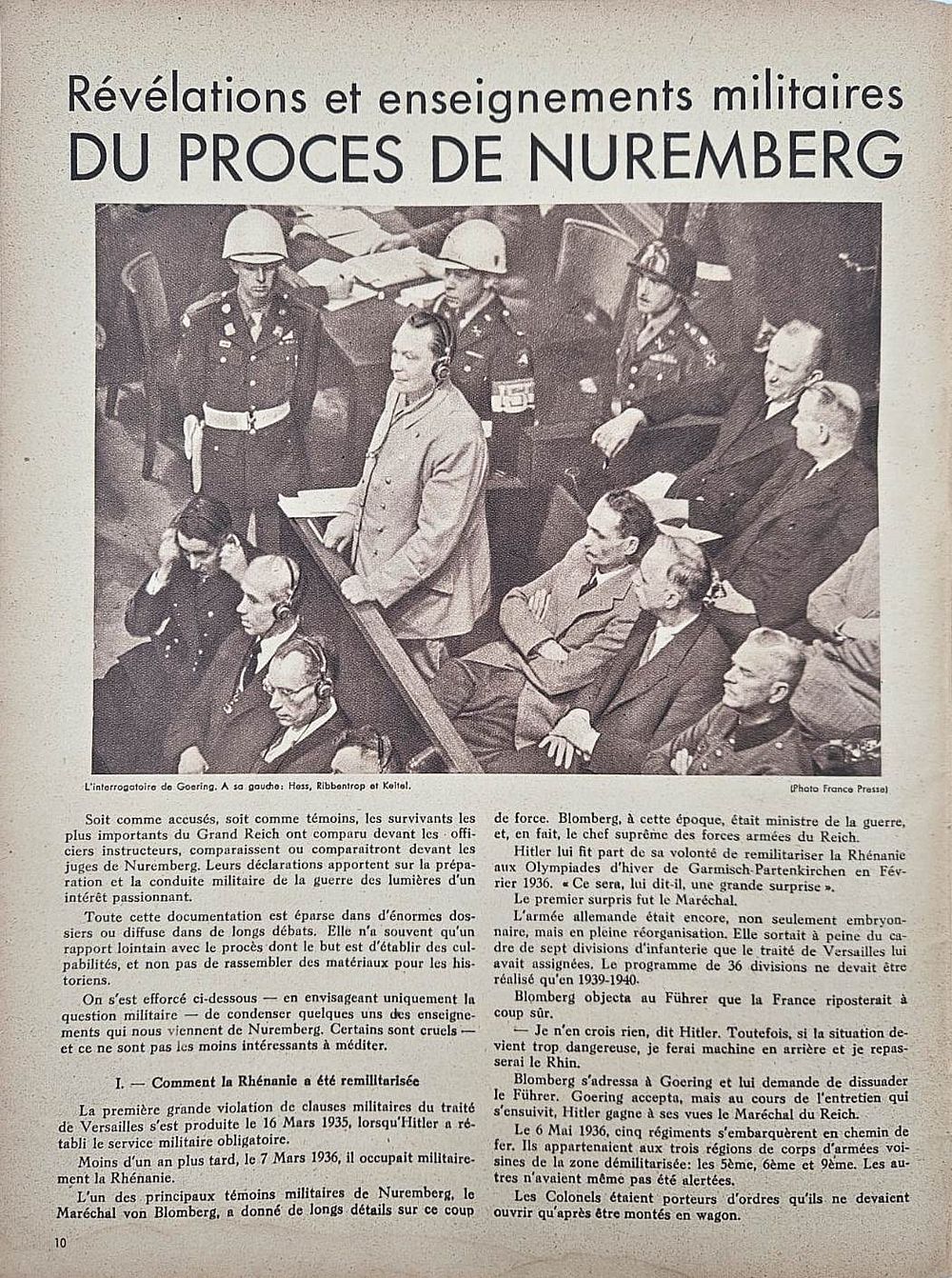
Testimonies from the Nuremberg Trials – Keitel, Jodl, Göring, and Dönitz reveal the military strategy of the Third Reich. An important issue of the French Revue d’Information. March, 1946 - Issue no. 6 of Revue d’Information des Troupes Françaises d’Occupation en Allemagne – a journal published by the High Command of the French Occupation Forces in Germany. At its center, an extensive article following the testimonies heard at the Nuremberg Trial from high-ranking officers such as Keitel, Jodl, Göring, and Dönitz regarding the military strategy employed by Hitler for the conquest of European countries, and why he refused to save himself at the end of the war by fleeing to the ”Bavarian Fortress.” Under the headline: Révélations et enseignements militaires du procès de Nuremberg – “Revelations and military lessons from the Nuremberg Trial.” March 1946. In French. “Whether as defendants or as witnesses, the most important surviving figures of the Great Reich have appeared before the investigating officers, are now appearing, or will appear before the judges in Nuremberg. Their words shed a fascinating light on the preparations and military conduct of the war...” In the main article of the issue, correspondent Raymond Cartier reports on how critical strategic decisions were made at the German High Command regarding the annexation of the Rhineland, the occupation of Austria and Czechoslovakia, the launching of war against Poland and France, the Sedan operation, and the “Bavarian Fortress” plan – based on the testimonies of Keitel, Jodl, Göring, and Dönitz in the courtroom at Nuremberg. The article is accompanied by photographs of the four in the courtroom. It was the first attempt to understand the military strategy as told by the very architects of World War II. The correspondent describes how, according to the testimonies, new insights were gained regarding the preparation of the army, the remilitarization of the Rhineland, and the German surprise strategy. For example, it is described how the Rhineland was rearmed – the Treaty of Versailles had prohibited the militarization of the Rhineland, but Hitler unilaterally nullified the ban in March 1936. Marshal von Blomberg testified that he was surprised by the move and even described it as a “great surprise.” The testimony details how highly classified military orders were given to transfer soldiers to western Germany, with the destination revealed to them only after they had boarded the train. At that time, the German army was still disorganized, yet Hitler imposed facts on the ground, knowing that there would be no French response. From the statements of those interrogated, it emerged that after the annexation of the Rhineland, Hitler waited two years before annexing Austria – a move carried out as a surprise and without any military preparations, despite concerns among the military leadership. Immediately thereafter, he began covert preparations for the takeover of Czechoslovakia, presenting the operation as a defense of the Sudeten Germans. Keitel, who appears in the photo accompanying the article, testified that the orders for the annexation of Austria were given just two days before the operation, with no prior mobilization or military preparation. The army was not ready, but Hitler imposed the pace of events and relied on the lack of international response. After the Munich Agreement, in which the Sudetenland was transferred to Germany, Hitler ordered the preparation of a plan to invade Poland and Danzig, showing contempt for the French army and disregarding reservations within the military. The testimony indicates that even the planning for the invasion of Poland was conducted under a fanatical veil of secrecy, and only a few were aware of it. In the photograph accompanying the article, Karl Dönitz, commander of the German Navy (and, following Hitler’s suicide, also President of Germany for a few days), is seen presenting a document to the other defendants. In his testimony, Keitel explained how Hitler became the “Victor of Sedan.” The plan to break through the French lines via Sedan was considered the pinnacle of strategic sophistication during the war. The plan was submitted by Keitel and General Jodl in October. Its main principle was to avoid a frontal assault on the French lines, as in World War I, and instead: to bypass them through the Ardennes Forest. This maneuver enabled the German forces to encircle the French army and isolate the British – within just two days. In this context, the generals admitted they were captivated by Hitler’s strategic concept – a bold, brilliant, and dangerous move. General Guderian, the German tank commander, led the decisive breakthrough. In his written defense, Jodl stated: “I did not believe such a move was possible – but it worked.” A second photograph appears, showing Alfred Jodl in his cell at Nuremberg Prison, writing a document.