Bidspirit auction | Issue of Picture Post magazine
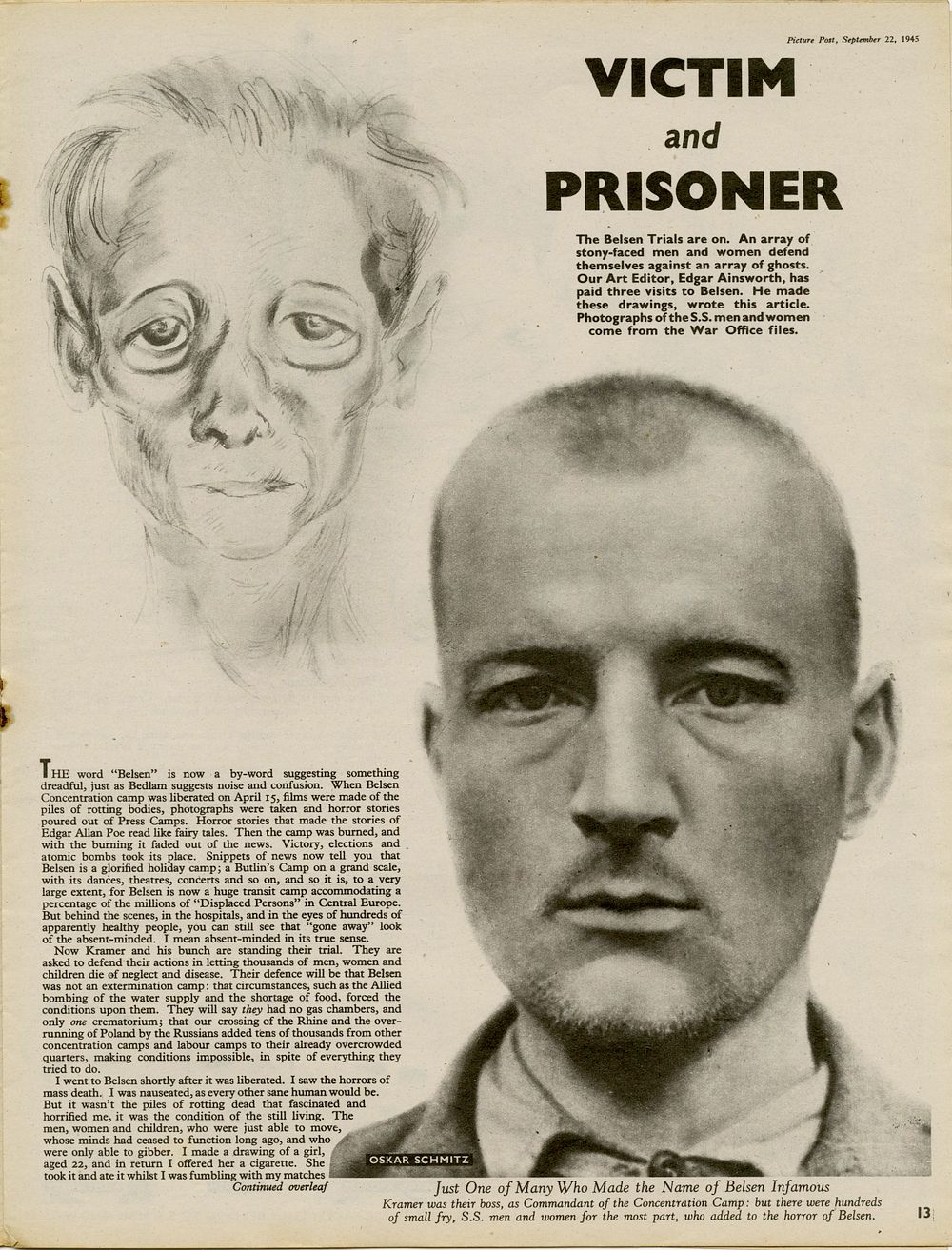
Issue of Picture Post magazine dated 22 September 1945 – documentation of the encounter with survivors of the Bergen-Belsen camp shortly after its liberation - ”But it was not the piles of rotting corpses that held and horrified me, but the condition of the living who still...” – issue of Picture Post magazine dated 22 September 1945, featuring a harrowing report by journalist Edgar Ainsworth on the condition of the Belsen survivors he encountered in the camp shortly after its liberation. The article is accompanied by photographs of SS guards at Belsen who were on trial at the time, as well as illustrations by Ainsworth himself depicting liberated prisoners in severe physical condition, drawn at the camp. Journalist Edgar Ainsworth visited the Bergen-Belsen camp and the courtroom during the trial three times. In the courtroom, he photographed the defendants, while simultaneously sketching Belsen survivors who were, at the time, staying in the rehabilitation section of the camp in horrifying physical condition. This took place while the camp commandant, Kramer, and his associates were standing trial, claiming they bore no responsibility for the death camps. Throughout the article, Edgar documents the horrific state of the Belsen camp after its liberation: ”I travelled to Belsen shortly after its liberation. I saw the horrors of mass death. I suffered from nausea, like any other sane person. But it was not the piles of rotting corpses that held and horrified me, but the condition of the living who still were. The men, women, and children who could barely move, whose minds had long since ceased to function, and who could only mumble. I drew a portrait of a 22-year-old girl, and in return I offered her a cigarette. She took it and ate it while I fumbled with my matches to light it. Another woman I saw used the shoulder of a corpse as a lavatory seat. Conditions like these are beyond anyone’s ability to explain...”. What he found at the Belsen camp, he describes: ”I returned to Belsen a few weeks later... Three blocks had been converted into hospitals. The only remaining reminder of the old horror camp was the lingering smell of death that hovered over the pine woods, and the sections cordoned off with wire bearing signs that read ‘Keep out – Typhus’... In one of the stables in the barracks there was a sign: ‘Human Laundry’. Inside, both men and women were laid out on tables, being cleaned of lice and washed by German nurses. A constant stream of their emaciated bodies was carried in. Bodies that bore no resemblance at all to what one sees in a bath. Some were swollen from starvation...”. He also recounts a chilling event that took place in the camp after liberation: ”Outside another stable there was a sign: ‘Harrods Store’. Inside, in every stall, there was every type of women’s clothing imaginable, taken from the surrounding German population. I saw a group of women slowly entering. They had not seen women’s clothing since they had been imprisoned. They stood at the entrance staring blankly, their eyes burning in their yellow and pale faces, thinking this was some kind of bait to lure them into the gas chambers they knew so well. When they realized they could choose, they rushed in as fast as they could, grabbing and snatching at anything they could get hold of...”. Edgar continues: ”As I left the camp, I noticed blackboards outside the hospitals showing a decrease in the death rate of 1 in 10. Along the edges of the grass, groups of former prisoners lay with their skirts or trousers pulled up, anxious that their limbs receive some sunlight. One elderly woman - 21 years old, as it turned out – motioned for me to stop. I stopped. Then she asked me in a trembling whisper if I would take her to a dance. I asked her what kind of dance, and she told me that a concert and dance would be held that afternoon and evening at Canteen 4, Block 3. I went with her, but I could only bear half an hour. I had never seen a more pitiful sight. A stage had been set up, and on it played a band of the R.A.M.C. The front rows were filled with children, their eyes wide and silent, wondering what it was all about. The sound of ‘Darktown Strutters’ Ball’ stirred some emotion in them, they knew it was somewhat pleasant, but what it meant they had no idea. They had never heard music before. Yugoslav choirs and Polish dancers performed, as did groups of men and women who wept quietly with memories of home.”. ”At the evening dance, British soldiers in battle dress, Red Cross workers, and R.A.M.C. doctors danced - or tried to dance - with women who, for the most part, could barely walk. Every woman had tried to turn the dress she received from ‘Harrods’ into something resembling an evening gown. They had ripped open the sleeve seams and left the rough edges. They danced, still clutching the sleeves in one hand in case someone stole them. They cried hysterically while dancing,