Bidspirit auction | Collection of Le Grelot issues
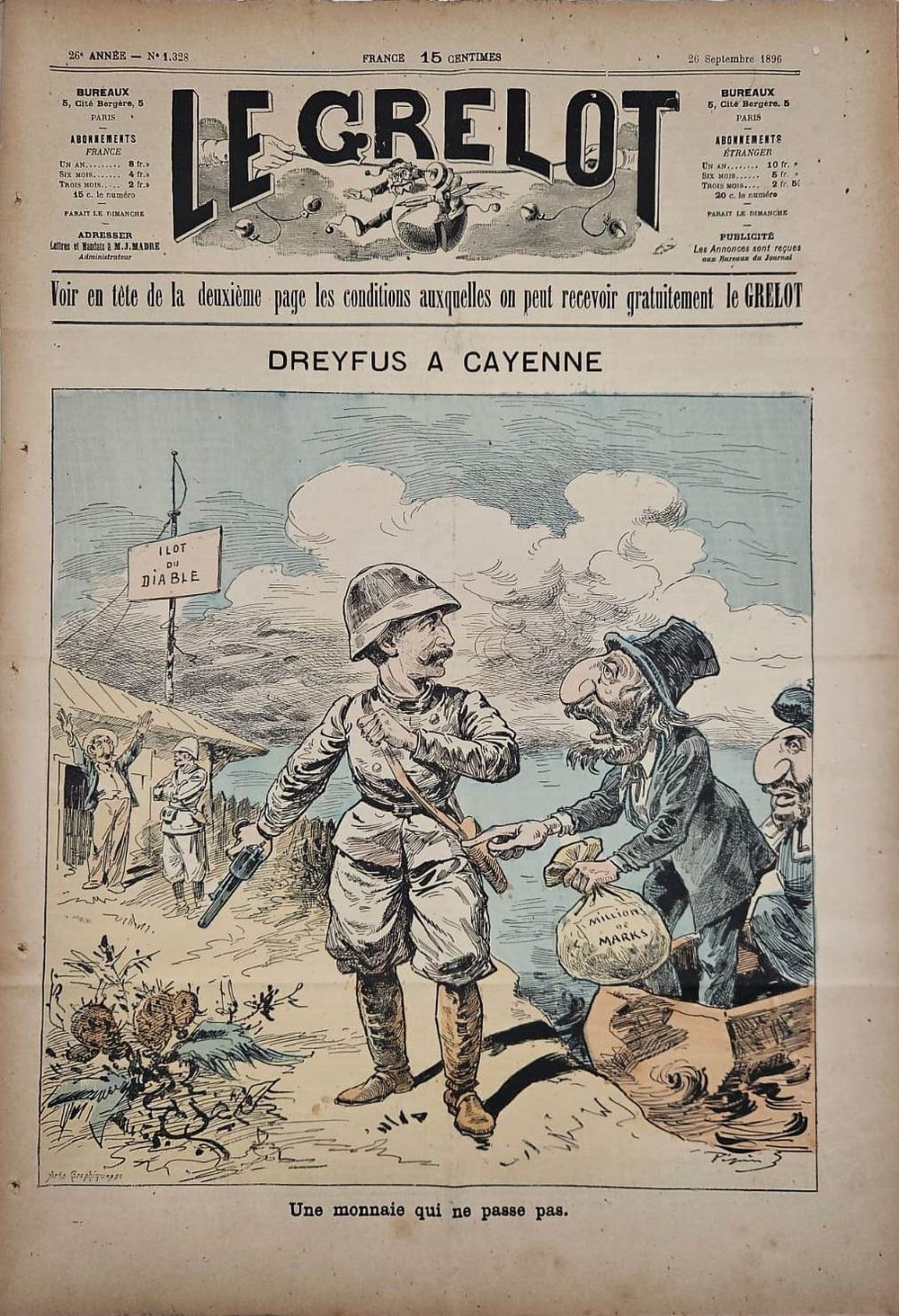
Collection of Le Grelot issues – The Dreyfus Affair - Five issues of the French newspaper Le Grelot (The Bell), all featuring antisemitic covers dealing with the Dreyfus Affair. Years: 1896–1899. All the covers are hand-colored lithographs (from the editions supplied to prestigious subscribers or for display in shop windows). Issue No. 1328: September 26, 1896, titled DREYFUS À CAYENNE – “Dreyfus in Cayenne” (Cayenne – the capital of French Guiana, near the “Devil’s Islands” where Dreyfus served his sentence). The cover features a cartoon expressing a sharply anti-Dreyfus stance, with clear antisemitic motifs. The cartoon depicts Dreyfus on the penal colony on Îlot du Diable (Devil’s Island). Figures dressed in stereotypical “Jewish attire”, long noses, beards, urban clothing, are attempting to bribe the soldier guarding Dreyfus. In the “Jew’s” hand is a bag of money labeled: “1 million de marks” - a clear reference to the age-old accusation that Jews use money to buy power, justice, and the military. The guard, however, heroically rejects the bribe – he holds a rifle, signals “stop, ” and defends the rule of law. In the background, Dreyfus, with stereotypical facial features, waves in greeting to those attempting to help him through bribery. The caption at the bottom: Une monnaie qui ne passe pas – “A coin that doesn’t pass (isn’t accepted).” This is a play on words: both a literal reference to the rejected money, and a critique of the attempt to “pass off” guilt through bribery. Issue No. 1388: November 14, 1897, titled ENCORE DREYFUS – “Dreyfus Again.” A distinctly anti-Dreyfus cartoon criticizing Scheurer-Kestner for his attempt to bring the affair back into public discourse. It was published during a particularly sensitive period – November 1897 – just before the case exploded again in the public sphere, and precisely when voices were beginning to emerge publicly in favor of Dreyfus’s innocence. At the center of this effort stood Auguste Scheurer-Kestner, Vice President of the Senate, one of the first establishment figures to believe Dreyfus had been wrongly convicted and to act in pursuit of the truth. Scheurer-Kestner is depicted as a carpenter or metalworker emerging from a dilapidated workshop (with a sign identifying him as: “Saw-cutter Officer – Vice-President of the Senate, Retailleur de Scies”). He is sharpening a sword using a giant saw labeled “Affaire Dreyfus” – “Dreyfus Affair.” A distorted, jumpy figure representing the anti-Dreyfus public appears terrified by the revival of the affair in public debate. The caption at the bottom reads: “De grâce ! M. Scheurer-Kestner, débinez-nous votre truc et que ça finisse !...” – “Please, Mr. Scheurer-Kestner, just drop your little trick and let this whole thing be over!” A cynical plea that reflects the sentiment many (especially on the anti-Dreyfus side) felt at the time: they were weary of the affair’s repeated return to the spotlight and wished to see it dismissed without seeking justice. Issue No. 1391: December 5, 1897, titled LE SYNDICAT DREYFUS – “The Dreyfus Syndicate.” This issue was published about two weeks before the release of Émile Zola’s famous article “J’accuse!” in January 1898. At the time, a small but growing group of intellectuals, politicians, and journalists had begun to support Dreyfus, demand justice, and challenge the ruling of the military court. Their opponents mockingly referred to them as “Le Syndicat Dreyfus” – essentially a “Jewish lobby” or a self-serving gang of defenders. In the background, a fence is visible with soldiers guarding Île du Diable – Devil’s Island, the penal colony where Dreyfus was imprisoned. A group of zealous Dreyfus supporters is shown carrying the key to his release toward him – among them are Émile Zola and Scheurer-Kestner. The caption at the bottom: “La clef de la situation” – “The key to the situation” – is a double entendre: both the literal key to Dreyfus’s release and the metaphorical key to understanding the entire affair – a pointed jab implying that this “syndicate” is manipulating events behind the scenes. Here, the group of Dreyfus supporters is portrayed as an organized collective (like a guild), forcefully attempting to break through the gates of justice and free a traitor – all while disregarding the law and the truth. Issue No. 1479: August 13, 1899, titled LES ACCUSÉS – “The Accused” (ironically). The cartoon was published during Dreyfus’s retrial in Rennes, at a time when public opinion was beginning to recognize that Dreyfus was innocent and that his conviction had been built on forgeries and the deliberate concealment of evidence by senior figures in the French military. The illustration presents three “accused” figures, each shifting the blame onto the others: Ferdinand Esterhazy – depicted as a ridiculous military clown, holding a document that reads “the bordereau was written at his instruction, ” thus indirectly admitting guilt as the true traitor.