Bidspirit auction | The autobiography of Rudolf Höss,
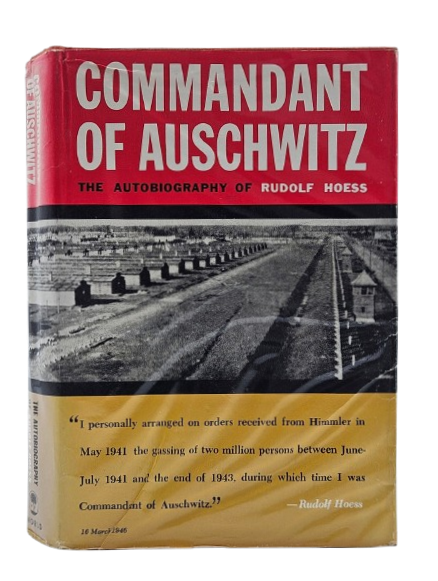
The autobiography of Rudolf Höss, the commandant of Auschwitz, written by him before his execution at the end of the war. New York, 1959 – first English edition - ”It was certainly an extraordinary and monstrous order. Nevertheless, the reasons behind the extermination program seemed right to me. I did not reflect on it at the time: I was given an order, and I had to carry it out... To this day, I cannot understand how I was able, in complete calm, to give the order to shoot...”. Commandant of Auschwitz: The Autobiography of Rudolf Hoess – one of the most important autobiographical documents written by a perpetrator of the Holocaust himself - the Nazi SS officer and commandant of the Auschwitz extermination camp, who was responsible for the murder of millions of Jews and hundreds of thousands of victims of other nations at Auschwitz during the Holocaust, and one of the senior officials directly involved in carrying out the “Final Solution.” Published by The World Publishing Company, Cleveland and New York, 1959 – first English edition. Foreword by Lord Russell of Liverpool. Rudolf Höss – commandant of the Auschwitz extermination camp from 1940 to 1943, where the Nazis murdered approximately three million Jews. From its establishment in 1940 (he was responsible for its construction) until the end of 1943 - the peak year of mass extermination, he was the man who knew more than anyone else, both firsthand and as administrator, about the greatest crime committed by Nazi Germany. At the end of the war, Höss was found and captured by the British, handed over to the Polish authorities, tried, sentenced to death, returned to Auschwitz, and hanged there. During the period between his trial and execution, he was ordered to write this autobiography. Höss wrote it during his imprisonment in a Polish jail in the months of January–February 1947, after the preliminary investigations had been completed and before his sentence was carried out. Höss was held under strict but relatively reasonable conditions, as the Polish authorities recognized the documentary value of his testimony. After intensive interrogations, he was asked to write the story of his life in his own words, with the goal of documenting the Auschwitz camp system from the perspective of its executor and chief administrator. Unlike other Nazi criminals, Höss did not deny his actions. On the contrary, he described in detail and with chilling composure his role as commandant of Auschwitz, the methods of extermination, and the orders he received. The investigators were struck by his ability to recall logistical details, names, numbers, and data as if he were drafting an administrative report. He wrote with full awareness that he was facing execution, as he knew the prosecution possessed ample evidence of his responsibility for the crimes. Nevertheless, he attempted to give the impression that he had been forced to carry out the murder orders by his superiors, and that his personal nature was entirely repulsed by the monstrous process he oversaw day after day. He wrote the autobiography in a fluent and chronological manner, describing events from his youth, his joining of the Nazi Party, and his rise through the ranks of command. However, throughout the text, he inserted, almost incidentally, arguments intended to prove his innocence, aiming to portray himself as a warm-hearted individual and to absolve himself of guilt. His central claim was that in committing the grave crimes he carried out, he was merely executing orders given from above, in a manner that left him with no possibility of resistance. He describes his early conditioning in obedience already at the beginning of the autobiography, noting that even in his youth he was accustomed to following orders: “From my early childhood I was raised with a strong sense of duty. In my parents’ home, it was insisted that every task be carried out precisely and with dedication.” Later, recounting his time in the German prison in Leipzig (in the 1920s he was sentenced to ten years in prison for involvement in the murder of Walter Kadow, a teacher suspected of collaborating with the French occupation authorities in the Ruhr), he writes: “From childhood I had been taught to be completely obedient, clean, and meticulously orderly; so in these matters I had no difficulty complying with the strict discipline of the prison. I carried out my clearly defined duties with dedication. I completed the work assigned to me, and usually more, to the satisfaction of the work supervisor…”. In September 1933, he was accepted into the SS, and in 1934, according to him, was asked by Himmler to join the Death’s Head Units (SS-Totenkopfverbände), and indeed enlisted in December of that year. These units, composed of fervent Nazis, later became the human reservoir for operating the concentration camps and the entire mechanism of Jewish extermination.