Bidspirit auction | Two banknotes from Westerbork camp
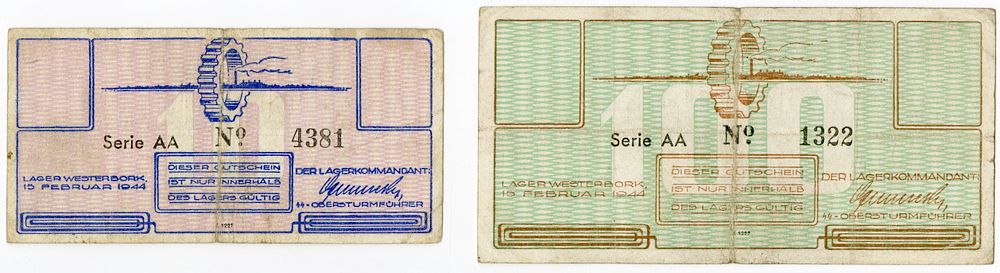
Two banknotes from Westerbork camp – Netherlands. February 1944 - Two banknotes used by prisoners in the Westerbork camp, denominations: 100 (serial number 1322), 10 (serial number 4381). Both notes are from Series AA – the first banknote series. On the front of the 100-cent note, a smokestack can be seen as part of the camp landscape illustration. On the reverse of each note appears the printed signature of the camp commander, Albert Gemmeker, as well as the print date: February 15, 1944. The currency design of the Westerbork camp was created by camp inmate Werner Lowenhardt. The front of the notes features the name of the camp and their face value, along with a logo displaying a cogwheel symbolizing labor. On the reverse side, a landscape of the camp is printed in low relief. All denominations were produced in three series (AA, BB, and CC) at the Van de Kamp printing house in Groningen (identified as print house K 1227, marked at the bottom of the note). The notes were printed on paper bearing the watermark of the “Vuga NORMAAL” mill. Since this watermark was not used consistently, notes are known to exist with full, partial, or even no watermark at all. The logo, depicting a camp with a smokestack surrounded by a cogwheel, represented camp commander Gemmeker’s assertion that Jewish labor was essential to the German war effort. According to Mr. Lowenhardt, camp currency was used to purchase items in the canteen, whenever something was available. Typically, prisoners received only substitute soap, coffee, and razor blades—but no food. After the liberation of the camp, prisoners took several hundred used notes with them, which were then circulated outside the camp. The Westerbork Police Transit Camp for Jews (Polizeiliches Judendurchgangslager Westerbork) was one of two transit camps established by the Nazis in the Netherlands (the second being Vught, in southern Holland) for the deportation of Dutch Jews to concentration and extermination camps in the East. The camp was established in February 1939 and began functioning as a transit camp on July 1, 1942, after the German occupation of the Netherlands. Approximately 102,000 Jews were deported from the camp to their deaths in Auschwitz and Sobibor. (Anne Frank stayed in the camp from August 7 to September 3, 1944, before being deported to Auschwitz.) The camp was liberated on April 12, 1945, by Canadian soldiers. Stains and light creases. Overall good condition.