Bidspirit auction | Registration card of a Jewish
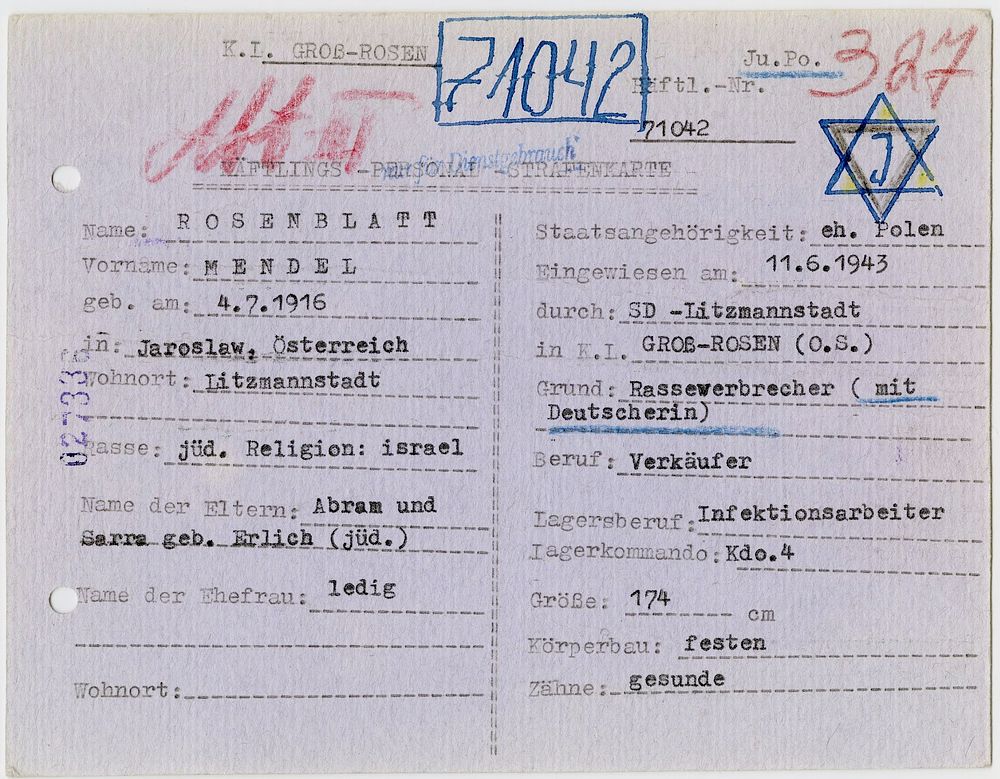
Registration card of a Jewish prisoner at Gross-Rosen, who was sent to the camp for being a ”racial offender with a German woman” - Prisoner registration card from the Nazi concentration camp Groß-Rosen (K.L. Groß-Rosen) in Lower Silesia, Nazi Germany. The card records the details of a Jewish prisoner named Mendel Rosenblatt, prisoner no. 71042, and provides rare documentation of the systematic bureaucratic record-keeping employed by the Nazis for their prisoners, including a record of punishment on the reverse of the card. Rare. According to the details appearing on the card, Rosenblatt was born on February 4, 1916, in Jarosław, Österreich (Jarosław, Austria – today in Poland). Before being brought to the camp, he lived in Łódź. It is noted that he was Jewish (jüd.), of the Jewish faith, and the names of his parents were Avram and Sarah (née Ehrlich). Marital status: single. He was admitted to the camp on June 11, 1943, by the SD – the Security Service of the SS in Łódź. Reason for imprisonment: “racial offender – with a German woman” – under the Nuremberg Laws, this was considered by the Nazi regime to be a crime of “racial defilement.” It is further written that he worked in the camp as an Infektionsarbeiter – an ”infection worker” (apparently under particularly harsh conditions, possibly in a sanitation unit or in the disinfection of contaminated clothing), in the labor group (Kommando): Kdo. 4. In the upper right corner appears a Star of David with the letter J inside, indicating that he was Jewish. On the reverse of the card, under the heading “Strafen im Lager” – “Punishments in the camp”, it is noted that on November 6, 1943, Rosenblatt was punished with 5 days in a standing cell for the offense of “theft” – one of the cruelest forms of punishment in the camps, in which the prisoner was placed in a small, extremely narrow cell (approximately 60×60 cm), where it was impossible to sit or lie down – only to stand for hours or days. At times, prisoners died during or shortly after such punishment – due to exhaustion, dehydration, or physical collapse. Signed and stamped by the reporting officer, commander of the protective custody detention section – signed: Hofmann (name of an SS officer), among others. At the Gross-Rosen camp, punishment was an integral part of the Nazi terror apparatus - a calculated system of control, humiliation, and slow murder. Any breach of discipline, whether real or fabricated, was met with extreme penalties: public lashings, forced labor to the point of collapse, food deprivation, solitary confinement, or immediate execution. These punishments were not merely intended as “deterrents, ” but as a means to break the human spirit—to turn prisoners into beings devoid of will, identity, or hope. At Gross-Rosen, mere survival was an act of defiance. Good condition.