Bidspirit auction | Victory Issue of the American
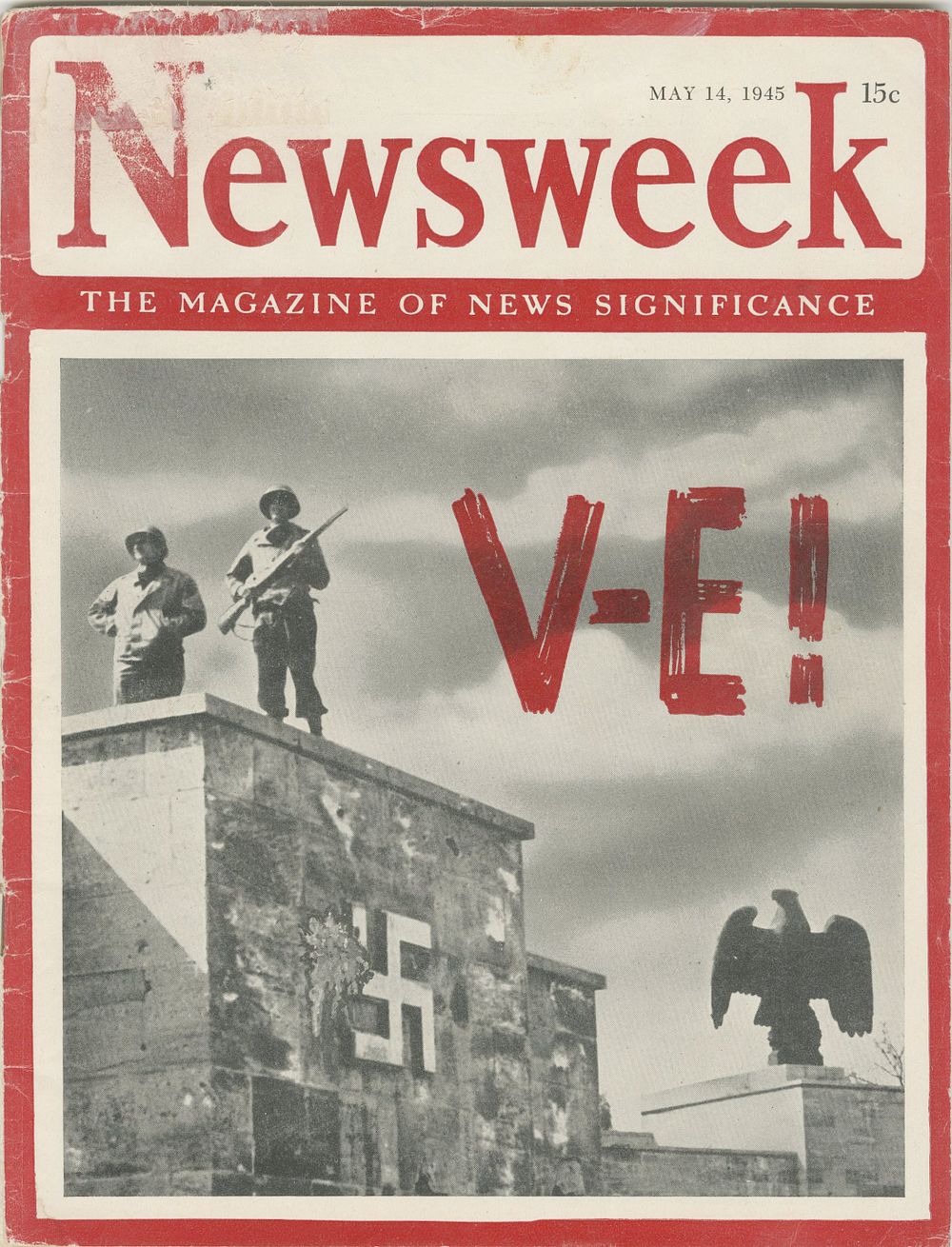
Victory Issue of the American magazine Newsweek – May 14, 1945. - Victory Issue (V-E!) of the American Newsweek magazine – May 14, 1945. Published one week after Nazi Germany’s surrender, which was officially declared on May 8, 1945 (V-E Day) the day on which victory celebrations were held around the world. The cover features a striking photograph of two armed American soldiers standing atop the roof of the Nuremberg stadium, in front of a massive swastika and the German eagle statue – symbols of the Third Reich – at the very site where Adolf Hitler once addressed tens of thousands of followers. The magazine's central pages are entirely dedicated to the events surrounding the end of the war: postwar America preparing itself for an era of justice, recovery, and international responsibility. Justice Robert H. Jackson is appointed to the historic role of Chief U.S. Prosecutor at the Nazi war crimes trials, to be held before the International Military Tribunal in Nuremberg. Jackson emphasized that the goal of the trials was not revenge, but true justice – based on evidence, testimony, and due legal process. He stated: ”We must not turn execution into a political decision, but rely on a pure legal process.” The issue also reports the capture of Josef Kramer, commander of Bergen-Belsen concentration camp, and notes that he would be tried locally and not by the international tribunal (Kramer was in fact tried by the British, convicted, and hanged at the end of 1945). President Harry Truman, in his address on V-E Day, declared: ”The Allied forces, through sacrifice, courage, and the help of God, have achieved an unquestionable victory – the unconditional surrender of the Nazi enemy.” It is reported that the Associated Press leaked the news of the war’s end 24 hours before the official announcement, leading to confusion and premature celebrations in cities such as New York, London, and Paris. General Alfred Jodl is shown signing the official act of surrender before the Allied powers. Another feature article includes a map titled ”Surrender by Pockets”, documenting how Germany’s surrender did not occur all at once, but through regional collapses, army by army – the Reich disintegrating like a house of cards. The article describes how surrender was not uniform; some German units capitulated late, while others continued to fight until forcibly subdued. In London, V-E Day celebrations are described as feeling like ”Christmas, Easter, and New Year’s all in one.” One page features the headline ”How Are the Mighty Fallen” – a biblical verse used here with biting irony in relation to the capture of German Field Marshal Karl Gerd von Rundstedt, age 69, a legendary figure in the German army who had commanded major campaigns in Poland, France, and Russia. He was captured by the Americans in Bad Tölz after being evacuated from a hospital. Rundstedt remarked coolly: ”Unpleasant. A painful experience for an officer after 43 years of service.” The magazine also includes a list of German generals captured by the Allies, along with a remarkable list of prominent individuals liberated from concentration camps and Gestapo prisons, including former French Prime Ministers Édouard Daladier and Paul Reynaud; former Austrian Chancellor Kurt Schuschnigg; André Trocmé, French ambassador to the Soviet Union; General Bór-Komorowski, commander of the Warsaw Uprising; high-ranking church leaders such as anti-Nazi German bishop Johannes Wienecke; and Lord Lascelles, a representative of the British royal family, among others. 112 pages. Complete issue. Good condition.