Bidspirit auction | The Nuremberg Trial – The
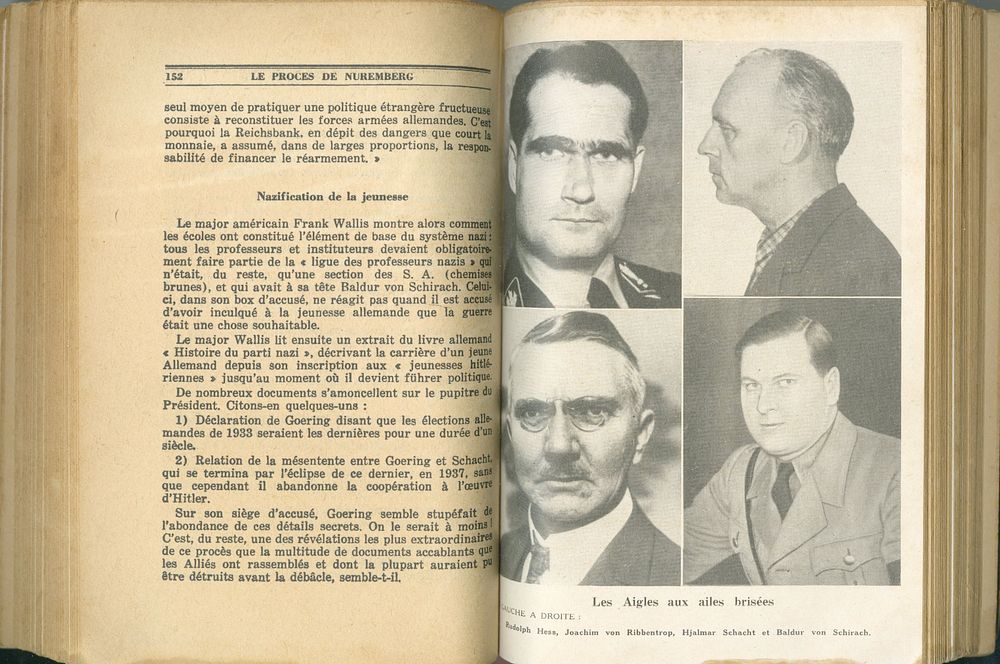
The Nuremberg Trial – The Nazi Criminals Before Their Judges – Real-Time Journalistic Report from the Nuremberg Courtroom – Published During the Ongoing Trial - Le Procès de Nuremberg – Les criminels nazis devant leurs juges – The Nuremberg Trial – The Nazi Criminals Before Their Judges. By Roger Crouquet, published by Éditions Dupuis, Charleroi. Paris, 1946 – First edition. An important publication written during the proceedings of the tribunal by a Belgian war correspondent who was present at all sessions of the Nuremberg Trials. His mission was to deliver to readers, in real time, the dramatic events unfolding in the courtroom, along with transcripts of the trial and the reactions of the defendants – all the proceedings covered here took place before the verdicts were delivered. Accompanied by 40 previously unpublished photographs, as well as several facsimiles of documents. Rare. ”We felt the need to compile, in a collection accessible to all, an honest account of all the wrongs, all the crimes, and all the German atrocities revealed in this trial. We also wanted to once again show the depths of savagery to which people can descend when they allow themselves to be enslaved by mad criminals, and above all, to urge people to support and assist, with all their strength, those in Nuremberg who seek to 'kill war' by indicting, for the first time in history, those who brought about the catastrophe from which we barely emerged—devastated and destroyed. It is essential that all people of goodwill support the rescue effort of the Nuremberg judges, for people thirst for peace and wish never to return to the nightmare of recent years. Everyone must take an interest in the drama unfolding at this very moment in Nuremberg, where the fate of the world is being decided... This is, in a way, the story and the minor story of the Nuremberg Trial, as seen through the eyes of a Belgian journalist who wishes to remain objective, but cannot help but declare, at the bottom of these opening pages, all his contempt and all his hatred for those who plundered and devastated his country and cruelly murdered many of his fellow citizens, including several of his friends.”- From the author's preface to the book. A complete real-time record of the proceedings held in Nuremberg from November 20, 1945, to February 7, 1946 (the final session included here features the French prosecution presenting its charges and supporting evidence) – a total of 56 sessions. Each session is reported in detail (by its specific date), including the statements of the judges (“As soon as silence fell, the President rose and in a brief address emphasized the full significance of this trial”), and the reactions of the defendants (“All the defendants, except for Hess, put on their headphones. Göring leaned back on the defendants’ bench, rested his elbow on the edge of the dock, and struck a dignified pose. He was fully aware that he was the center of attention…”). The author also reproduces verbatim the testimonies of prisoners as delivered in court, such as: “Professor Alfred Balachowsky, formerly head of the laboratory at the Pasteur Institute in Paris and a prisoner in Buchenwald, stated: I am able to confirm and prove that Himmler was fully aware of the horrific practices of vivisection and deliberate infection carried out on political deportees…” He reports on classified protocols revealed in court and the conclusions that emerged from them, harrowing testimonies of Jewish Holocaust survivors who had just been liberated from the death camps, the application of Nazi racial theory and human experimentation, and more. As background to the proceedings—which, as noted, form the core of this publication through both real-time reporting and verbatim transcripts—Roger also shares his impressions of what was taking place in the city of Nuremberg during the trial. He provides a detailed description of the “press camp” assigned to journalists from around the world, located near Stein, about seven kilometers from Nuremberg, and of the journalists’ tireless efforts to report headlines from the courtroom at all hours of the day. He also describes the security arrangements of the U.S. Army surrounding the courthouse. Additionally, he presents the background of each defendant, with particular attention to their wartime crimes (he refers to Rudolf Hess as “the madman who isn’t mad”), describes in detail the preparatory legal work carried out by the Allies even during the war, outlines the fundamental principles that guided the judges—including the central role given to written documents in the legal determinations, and, for the first time, reveals in detail the lines of defense adopted for each of the Nazi war criminals. Roger also pays close attention to the facial expressions and reactions of the defendants, meticulously documenting their behavior throughout the trial. For example, regarding Göring during the first session on November 20, 1945,