Bidspirit auction | Album documenting the events of
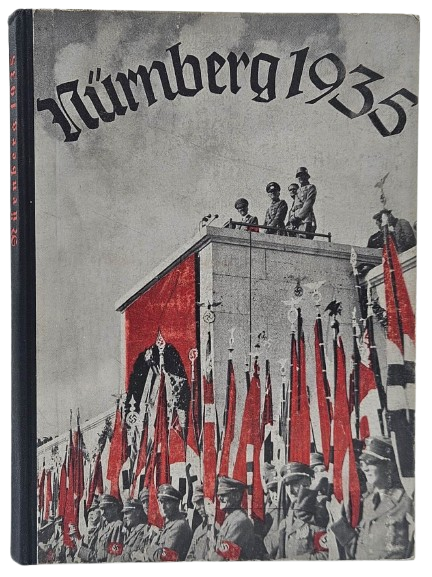
Album documenting the events of the Nazi Party Congress held in September 1935 – numerous photographs. Berlin, 1935 – first edition - Der Parteitag der Freiheit – “The Party Congress of Freedom” – an experiential report from the days of the Party Congress in Nuremberg, held between 10–16 September 1935 – a vivid documentation of the enthusiasm of the German masses in the streets, the ceremonies, the speeches, and the Führer’s personality cult. Published by Freiheitsverlag G.m.b.H., Berlin SW. Berlin, 1935 – first edition. In German. Extremely rare. “For weeks, every effort was made, with selfless dedication, to prepare the sophisticated event and its procession in an efficient and uninterrupted manner. And when the Führer arrived in Nuremberg on 10 September, the city was ready. Nothing was lacking, inside or out. They stood along all the access roads, countless people from every region of the Reich. Everyone wanted to witness this significant event in which the Führer arrived in his city. Feverish excitement gripped them all, and when the large three-engined Ju 52 airplane appeared in the sky after circling the festively decorated city, the joy knew no bounds. At 16:20, the plane landed on the runway. The Führer arrives! And accompanied by Reich Minister Dr. Goebbels and Obergruppenführer Brückner, he descended the three steps. The Führer had arrived in Nuremberg! The procession through the city was a triumphal march without equal. Time and again he was compelled to shake hands with his old comrades and new followers… Faithful and shouting ‘Heil!’, the people looked up at the illuminated window where the Führer stood, deeply moved. And above everyone’s heads, above the venerable old city, above the rooftops, towers, and timeworn walls, the church bells rang out, announcing the Party’s Congress of Freedom…”. A finely produced album documenting the events of the Nazi Party Congress held in September 1935. The first part contains an euphoric account of the Nazi Party rally, described as a “milestone on the path to Germany’s revival, ” followed by detailed documentation of the various events that took place consecutively over those four days of September 1935 - hour by hour: the excitement of the German masses leading up to the event and the extensive preparations, the arrival of the Führer and his central speech, the opening of the Party Congress by Rudolf Hess, the laying of the cornerstone for the new Congress Hall, the march of 52,000 workers, torchlight processions, Dr. Goebbels’ speech, the conference of the Nazi Women’s League, the SA parade, and more. The second part includes dozens of rare photographs documenting the Nazi Party leadership - Adolf Hitler’s deputies Streicher, Hess, Himmler, Göring, and others—at his side during the various ceremonies; the city of Nuremberg packed with citizens crowding the streets to take part in the major event, saluting with the raised arm; the Congress of Nazi German Women at the Luitpold Hall; the German Wehrmacht marching through the streets of Nuremberg; photomontages of Adolf Hitler during his speech; a Hitler Youth tent camp set up for the event; and many others. “The Party Congress of Freedom” was one of the annual congresses held by the Nazi Party in the city of Nuremberg. The 1935 congress was the most significant of them all, as it was during this event that the Nuremberg Laws were proclaimed - the racist laws against the Jews, which for the first time transformed antisemitism into official state policy. The events were orchestrated as grand mass spectacles designed to create a sense of unity, order, and collective power (the album describes this unity, noting how: “All the German dialects blended together, from the soft Saxon and Swabian to the sharp-accented Berlin dialect, from the Low German of Hamburg to the language of Hesse”). Through monumental architecture, strict visual discipline, music, and carefully choreographed ceremony, a narrative of “national renewal” and historical destiny was constructed. For a wide audience that had experienced economic crisis, political instability, and national humiliation after World War I, these events provided an intense emotional experience of belonging and security. The messages were conveyed not only through speeches but also through aesthetic means: symbols, processions, flags, and cinema. The atmosphere generated mass identification based less on rational argument and more on sensory and emotional experience. The written and photographic documentation of the events preserved their impact beyond the few days in which they took place, and the Nazi Party repeatedly used these records in the years that followed. The title page features an official party approval for publication, stating in the name of the chairman of the Party’s Committee for Nazi Literature: “The National Socialist German Workers’ Party (NSDAP) does not object to the publication of this work.” Special design of the cover,