Bidspirit auction | Personal belongings of victims found
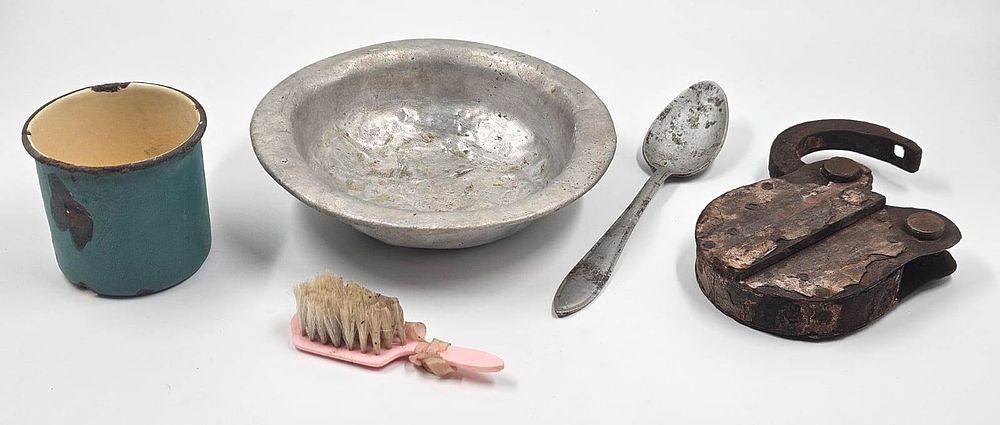
Personal belongings of victims found on the grounds of the Chelmno camp - Due to Bid Spirit's policy of not allowing the sale of items of this type on the platform, we have removed the item from the site. Bids can be submitted on the Invaluable website. We recently received information from a local resident that personal belongings of Jews who perished at the Chelmno camp can still be found on the camp grounds. A supplier of the auction house traveled to the area, and after several days of searching and excavation, uncovered a number of items belonging to victims. Some were donated to institutions dedicated to preserving Jewish artifacts from the Holocaust era, and some are presented here. We have no information regarding the original owners of these items, which, as noted, were found on the grounds of the camp. The items before us are: A tiny comb for a doll. A soup bowl and spoon. An aluminum cup. A large padlock (rusted; locking mechanism jammed). The Chelmno camp served as an extermination camp in western Poland, near the village of Chelmno, approximately 60 km northwest of the city of Łódź. It was the first extermination camp established by the Nazis, marking a significant escalation in the development of the ”Final Solution”: for the first time, Jews and others were murdered using gas vans; it was the first site where extermination was carried out in a fixed location, and the first site where the bodies of the victims were burned. The Chelmno extermination camp operated from December 8, 1941, until April 1943; its operations resumed in June 1944 and continued until its liquidation on January 18, 1945. Jews from the Łódź Ghetto, nearby towns and villages, and later also Jews deported from Germany, Austria, and Czechoslovakia were brought to the site under the pretext of “resettlement, ” and were immediately murdered with engine exhaust gas during transport to the burial forest. The bodies were initially buried in mass graves and later burned as part of the operation to erase evidence of the crimes. In total, approximately 300,000 Jews were murdered at Chelmno. The overwhelming majority of victims—around 98%—were Jews. There are very few testimonies regarding what occurred at Chelmno, due to the extremely small number of survivors. Until 1957, no preservation work was carried out at the site, and many of the remains were destroyed or disappeared—including one of the gas vans, which still stood at the site. Over the years, extensive excavations were conducted by various researchers, as the land used for the camp remains fully exposed. These excavations were guided by aerial photographs taken by the German Air Force in 1942, as well as original plans and drawings. The excavations revealed, among other things, human remains and numerous personal belongings. (In the past, Yad Vashem curator Dr. Lucja Nowak also conducted excavations at the site, uncovering many items including Passover wine cups, eating utensils, medicine bottles, toothbrushes, and more.) General condition: moderate.