Bidspirit auction | Haggadah de Hitler – the
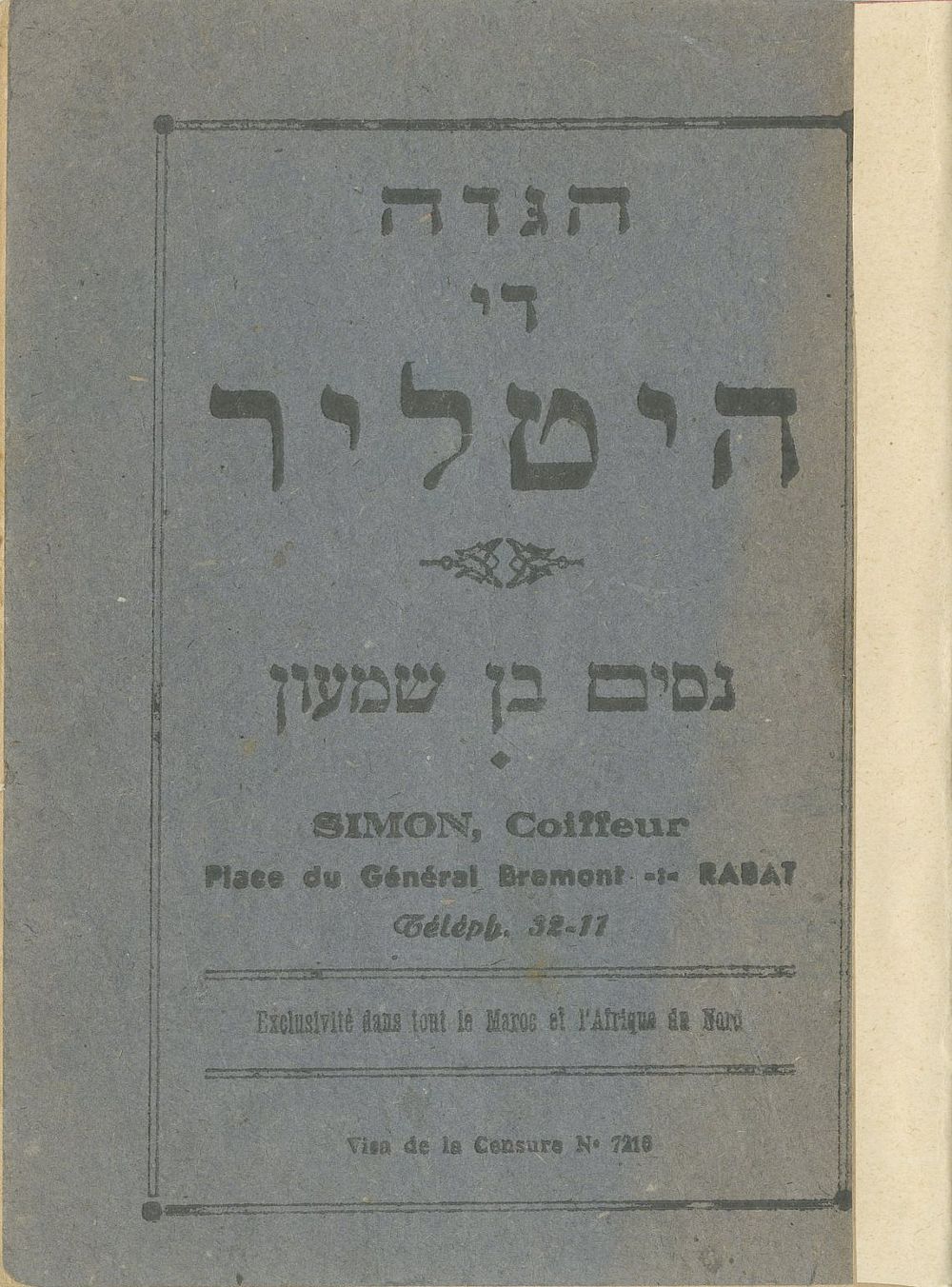
Haggadah de Hitler – the story of the rescue of the Jews of North Africa from the Nazi invasion, in the format of a Passover Haggadah. Rabat, [1943] - Haggadah de Hitler, by Nissim Ben Shimon. A unique composition about Hitler and the fate of the Jews during World War II, written in the style of a Passover Haggadah – in Judeo-Arabic. Rabat, [1943]. The story of the rescue of North African Jewry from the Nazi invasion following the Allied victory. Haggadah de Hitler is the only known literary work from Morocco dealing with the events of the war in the format of a Passover Haggadah. ״Haggadah de Hitler״ was composed by Nissim Ben Shimon and published in Rabat with the approval of the French censors. Although the publication date does not appear on the title page, the events described within it indicate that it was written in 1943. The Haggadah was published in Morocco in the wake of the defeat of the Nazis in North Africa. The author draws a parallel between the biblical redemption of the Israelites from Egypt and the rescue of North African Jewry from Nazi invasion, following the victory of the Allied forces. The text recounts the suffering of the Jews during the Holocaust from the perspective of Moroccan Jewry. The key events highlighted in the Haggadah include the landing of British and American troops in North Africa on November 8, 1942, and the abolition of the antisemitic laws known as the “Jewish Statute” (Statut des Juifs), an act attributed in the Haggadah to Charles de Gaulle. The Haggadah de Hitler addresses the hardships endured by the Jews during the war, as well as the ”plagues” inflicted upon the Germans by the Allied forces. Numerous events from the history of European Jewry under Nazi rule are mentioned, each presented as a parallel to the biblical narrative of bondage and suffering in the traditional Passover Haggadah. According to the text, the fate of European Jewry was well known in the countries of North Africa. The author describes the harsh decrees imposed on the Jews, including forced labor, wearing the yellow badge and armbands, the construction of concentration camps, and mentions a Nazi scheme to use Jews as a “fifth column” - to be sent into enemy nations for purposes of espionage and sabotage. The author explicitly refers to the Final Solution several times, naming key figures of the Third Reich: “Go out and learn what that bastard Göring sought to do to our ancestors-Hitler issued decrees only against the Jews, and Goebbels wanted to uproot everything.” The planned extermination of the Jews is mentioned in two additional places: in one, the Nazis are described as plotting a massacre, and in another, there is mention of Hitler’s order to throw the Jews into lime - a chilling allusion to horrific and unnatural forms of death. The sequence of events is summarized toward the end of the Haggadah in the section titled ”Al Achat Kamah V’Kamah” (All the more so), written in Judeo-Arabic and translated here: “They expelled them from Egypt, and exacted judgment upon them, and took Tobruk from them, and pursued them as far as Tunisia, and pursued them to Sicily, and destroyed their cities, and returned the Jews to their work, and saved our ancestors, and abolished the Jewish Statute, and the Jews returned to their positions, and they sought to bring us all to Palestine, to atone for all our sins.” This poetic summation links the Allied victories in North Africa and Europe with the redemption of the Jews, framing the defeat of the Axis powers as a divine deliverance and historical justice—modeled in the language, structure, and tone of the traditional Passover Haggadah. The traditional story in the Haggadah of the sages who spoke of the Exodus all night is reimagined in this version as referring to the five leaders of Italy and Germany—Mussolini, Hitler, Göring, Ribbentrop, and Ciano—who plotted their wicked scheme during the night. The narrative concludes with a play on words rooted in the Judeo-Arabic poetic style (sharḥ): ”Until the angels of destruction came, And shook them, O our rabbis, And cast them into the furnace of the dawn.” (“Ḥattā zāw malāʾkhī ḥabala / wazzazūhum yā sayyādnā / wramāw-hum f-l-kūsha d-ṣabāḥ”). The theme of the Return to Zion appears in two places in the Haggadah. At its opening, the traditional phrase “Next year in the Land of Israel” is replaced with: “Next year in Palestine, as free people.” Later, toward the end of the text, Roosevelt’s proposal to bring the Jews to Palestine is presented as the climax of events in the adapted version of Dayenu. In both cases, the author chooses the name “Palestine” (Fālisṭīn) instead of the traditional “Land of Israel” (Eretz Yisrael)—a notable linguistic and political choice reflecting the local and historical context. Haggadah de Hitler is written in Hebrew script and based on the Judeo-Arabic language style reflected in the sharḥ (the traditional translation and commentary of the Passover Haggadah).