Bidspirit auction | The Oradour-sur-Glane Massacre by Hitler’s
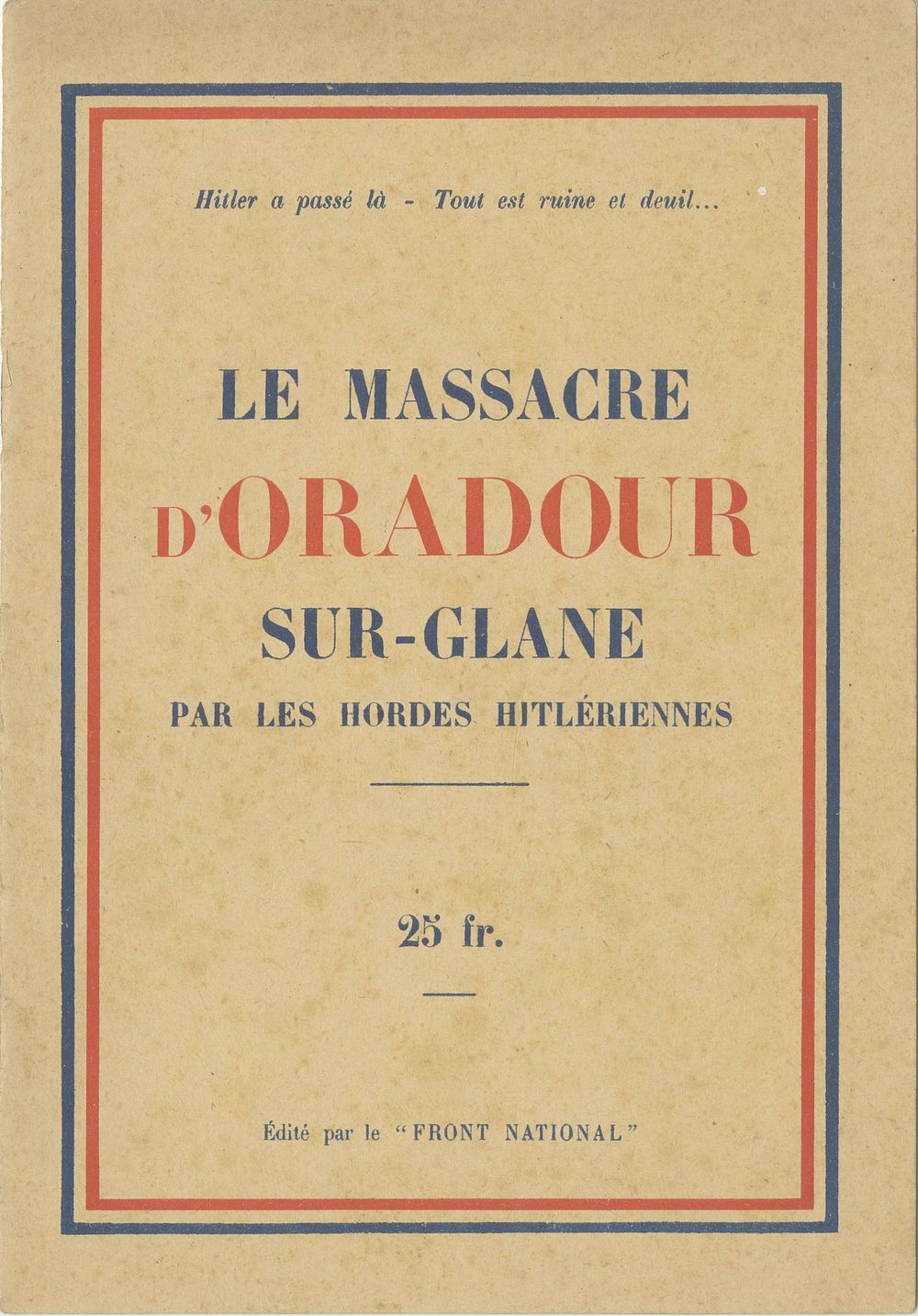
The Oradour-sur-Glane Massacre by Hitler’s Gangs – A Rare Publication from the Time of the Events. Limoges, 1945 – First edition - Le Massacre d'Oradour-sur-Glane par les hordes hitlériennes – ”The Oradour-sur-Glane Massacre by Hitler’s Gangs”, edited by René Louis, published by Front National; Impr. de Brégéras, Limoges, 1945 – First edition. Rare. A rare publication issued by the French Communist Resistance movement Front National shortly after the Oradour-sur-Glane massacre, with the aim of documenting the Nazi crimes committed in the village, where hundreds of innocent residents of the quiet town were slaughtered. The booklet opens with excerpts from speeches delivered at the mass funerals of the victims, particularly by the regional governor Freund Valade and local church leaders. It then proceeds to describe the massacre itself in harrowing detail. A detailed testimony is presented by one of the village's citizens—how he managed to escape the clutches of the Nazis while witnessing the murder of infants and documenting the massacre carried out in the church. He concludes: ”Within a few short hours, a large town was wiped off the map, completely destroyed along with part of its rural population. The number of dead is estimated at around 800. Entire families perished; the entire region is in mourning. In the face of this unfathomable crime, the question naturally arises in everyone’s mind: what were the reasons? What could the residents of Oradour have been accused of? But no one answered those questions. There was no weapons cache or resistance force in the town; not a single shot was fired at a German...”. The booklet is accompanied throughout by photographs of the village and its residents from the days when they lived in peace and tranquility before the Nazi invasion, as well as shocking images of the victims and the vast destruction left behind by the Nazis. Oradour-sur-Glane is a small village near the city of Limoges in France, where one of the most horrific massacres carried out by the Nazis during World War II took place. On June 10, 1944, soldiers of the 4th Regiment of the Waffen-SS “Der Führer” entered the village and carried out a cold and calculated massacre, despite the fact that the villagers had no involvement in any resistance activity. The reason for the massacre was likely a resistance operation during which a German soldier was killed and boxes of gold were stolen from German officers. Under the command of Sturmbannführer Adolf Diekmann, the soldiers gathered the villagers in the central square under the pretext of a routine identity check—including six passersby. The women and children were locked inside the church, while the men were taken to barns where firing squads had been prepared. The soldiers first shot the men in the legs to cause slow deaths, and then set them on fire while they were still alive. 190 men were murdered, with only five managing to escape. The Nazis then set fire to the church where the women and children were imprisoned, and shot anyone who tried to flee. 247 women and 205 children were murdered; only one woman survived. About 20 of the village’s residents managed to escape before the massacre began. The entire village - 328 houses - was destroyed that night. The mass burial of the victims was only possible several days later. After the war, 65 of the approximately 200 soldiers who took part in the massacre were put on trial, but most escaped punishment by claiming they had been forcibly conscripted. Charles de Gaulle, leader of Free France, decided that the village would not be rebuilt—it would be preserved as a memorial site to Nazi brutality. Today, the ruins of buildings, vehicles, and personal belongings of the victims (watches, glasses, coins) remain visible. A sign at the entrance bears the word “Remember, ” and a memorial center was established nearby. The cover bears the phrase: “Hitler a passé là – Tout est ruine et deuil...” – “Hitler passed through here – all is ruin and mourning...”, along with the colors of the French flag. Rare. Only three copies recorded in the WorldCat global library catalog, all in libraries in France. 16 pages. Very good condition.