Bidspirit auction | Shulchan Aruch – an antisemitic
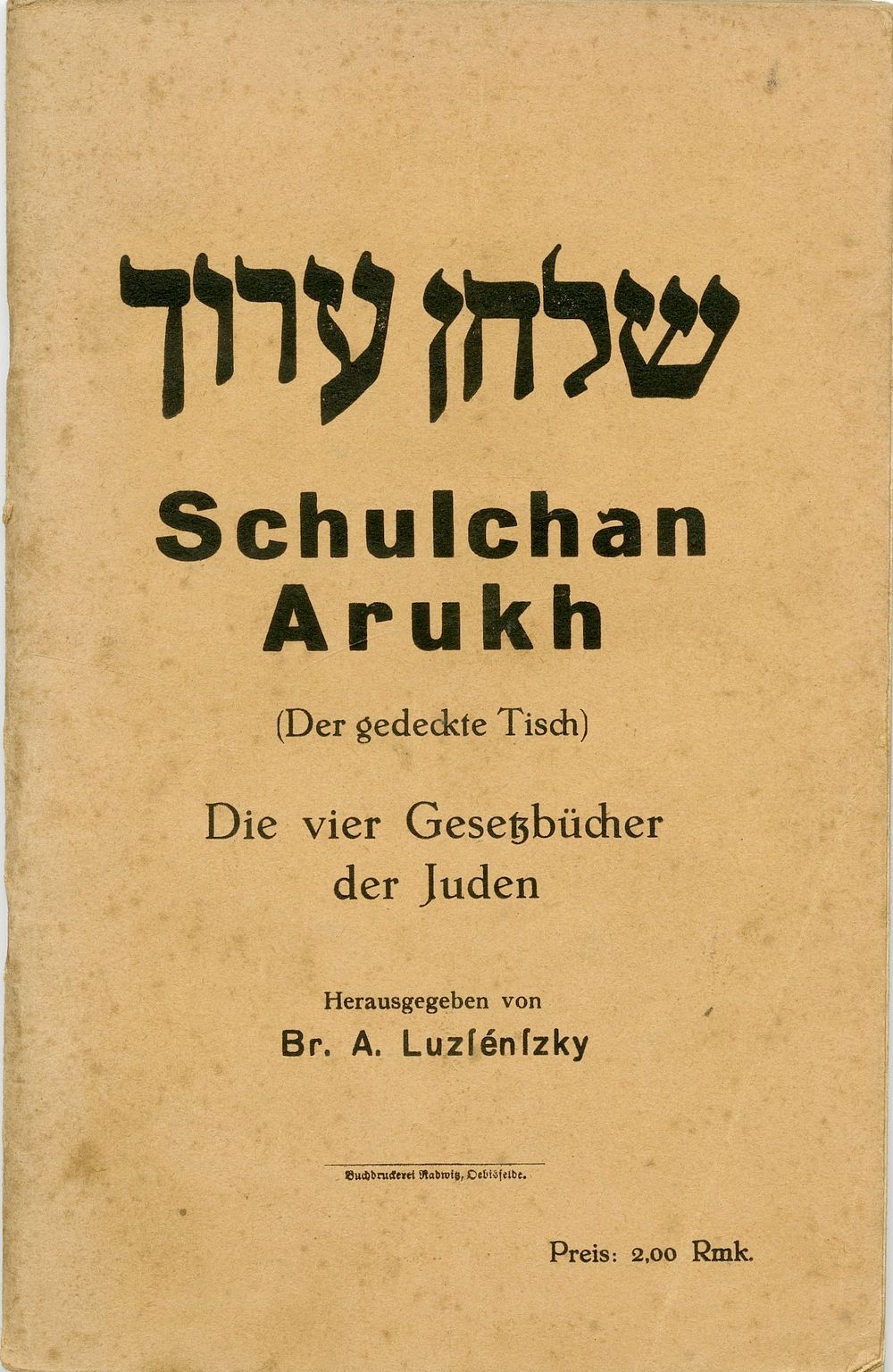
Shulchan Aruch – an antisemitic publication based on a deliberate distortion of Jewish law for incitement purposes - ”These terrible things and absurdities are the foundation of true Jewish morality” – Schulchan Arukh (Der gedeckte Tisch) Die vier Gesetzbücher der Juden – Shulchan Aruch – The Four Law Books of the Jews. An antisemitic publication in Nazi Germany quoting the Jewish code of law, the Shulchan Aruch, in a distorted manner with the aim of inciting hatred and persecution of Jews. Edited by Br. A. Luzlénlzky. Germany, [before 1935]. An extremely virulent antisemitic publication in which the Jewish Shulchan Aruch is presented as a kind of “secret Jewish code of law, ” allegedly proving that the Jewish religion commands its followers to hate, persecute, and murder non-Jews, while promising them reward in the World to Come for doing so. In the introduction, the author writes: ”The assembly of Hungarian rabbis in 1866 approved the following resolution: 'The Shulchan Aruch must be publicly denied in the eyes of Gentiles, but in reality, every Jew in every country is obligated to obey these laws at all times.' (This resolution was signed by 94 rabbis, 182 lawyers, 45 doctors, and 11,672 other Jews.) Every theologian, jurist, and educated person concerned with the Jewish question must be familiar with these laws... These terrible things and absurdities are the foundation of true Jewish morality.” After quoting several halachot regarding a person’s morning conduct, intended to give the impression that he is merely citing the text verbatim—the author goes on to selectively and misleadingly present rulings from the Shulchan Aruch related to what is permitted and forbidden concerning non-Jews, such as the prohibition against employing a non-Jewish wet nurse, the statement “one must not inform a non-Jew that one relies on his judgment, ” the laws of chalav akum (milk produced by non-Jews), the prohibition against sending gifts to non-Jews on their festivals, the prohibition of dining with non-Jews, the laws of charging interest to non-Jews, and the claim that a Jew who has converted has no atonement. He also includes laws concerning the preference of a Jew’s lost object over that of a non-Jew, the prohibition against litigating in non-Jewish courts, and the prohibition of intermarriage with non-Jews, all with the intent to portray the Jewish legal code as encouraging hatred, or worse. Throughout the book, the author deliberately emphasizes passages that supposedly instruct distancing from non-Jews, aiming to incite the reader into believing that Judaism commands hatred and total separation from non-Jews in every form. In the second part of the book, under the title “150 Quotations from the Writings of the Most Famous Rabbis, ” he cites excerpts from the works of Jewish sages in the realm of mysticism, texts not readily understood by the average reader, with the intent of portraying Jewish scholars as engaging in absurd or trivial matters, as well as passages relating to the punishment of evildoers in the World to Come. He quotes Maimonides stating that the Christian faith constitutes idolatry; he cites writings claiming that the world was created for the sake of the Jewish people; he includes statements from Abarbanel’s commentaries against Islam; and he brings passages from various books describing the judgment of the wicked in Gehenna, from Radak’s commentary on the Torah, and from prayer books (such as the Frankfurt Machzor) relating to divine justice upon the wicked, again, all taken out of context. In the final part of the book, under the heading “The Murders Committed by Jews, ” the antisemitic narrative escalates. Here, the focus is no longer merely on “dry laws” from the Jewish code of law, but rather on their alleged implementation throughout the generations in the form of murders supposedly committed by Jews according to their religion. The author revisits the ancient blood libel, as it appeared among others in the writings of Sebastian Münster, to claim that already in antiquity Jews murdered children in order to use their blood for baking Passover matzah. He also recounts various fabricated stories from the Middle Ages and the modern era across European countries, incidents that never happened, in which Jews allegedly killed Christians in religiously motivated circumstances, kidnapped non-Jews, and so forth. The rhetorical mechanism of the booklet lies in its extraction of complex halakhic rulings, written by rabbis in specific historical and legal contexts, and presenting them out of context in order to create an impression of hostility, scheming, and hatred toward non-Jews. It employs absurd manipulations: omissions, abridgments, and the substitution of terms such as “idolaters” (עכו״ם), “goy, ” “Kuthite, ” or “apostate, ”making it easier for the untrained reader to connect Jewish law to modern racial propaganda.