Bidspirit auction | Adolf Hitler, Chancellor of Germany
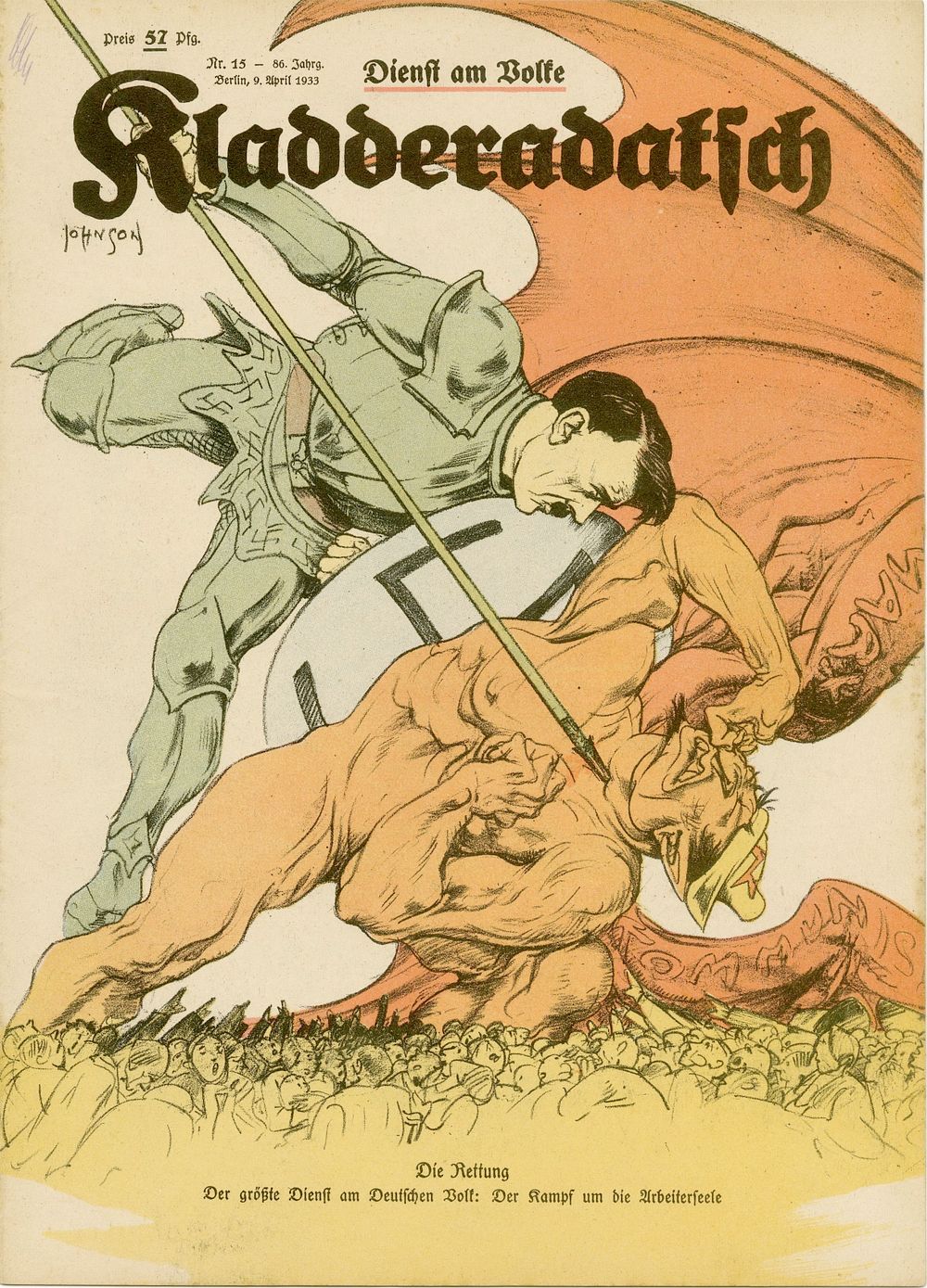
Adolf Hitler, Chancellor of Germany – three issues of the newspaper Kladderadatsch announcing the “German Spring” - Three issues of the newspaper Kladderadatsch announcing the era of Hitler’s rise to power in the spring of 1933 – featuring antisemitic content. The covers of all three issues display color illustrations by Jonson portraying Adolf Hitler as the savior of Germany and heralding the era of the Third Reich. Issue of April 9, 1933: On the front page, Hitler is depicted in the uniform of a Roman soldier defeating his enemy, with the working class in the background and the caption: “Salvation – the greatest service to the German people: the struggle for the soul of the worker.” The editor’s article mockingly lists Jewish surnames to announce their end: “Trochke, Braunstein, Apfelbaum… in Germany, dawn rises after a long night, and all that stems from German blood awakens from a deep sleep…” Another article proclaims the German people’s complete victory over “Juda, ” mocking Otto Braun and the left-wing parties that lost the election. Elsewhere appears a large caricature mocking Uncle Sam and the Jewish–American connection. A comic strip ridicules Jewish council employees who are soon to be removed from their posts. The issue also includes articles in praise of Germany and the German worker, and more. Issue of May 21, 1933: The front page features a large illustration of Hitler riding a horse and giving the Nazi salute. Along the edges of the image appears a poem about the leader’s powerful voice rising with full force. The editorial praises Hitler as the “liberator of Germany, ” and highlights the victory celebrations that herald the new era. Additional articles extol the German race, call on Munich’s flag manufacturers to increase production of Nazi flags, and more. Issue of June 4, 1933: On the cover, Hitler is seen gazing at the blossoming spring. Along the bottom edge of the illustration, under the heading “Hitler’s grave warning, ” is a poem proclaiming the “new spring.” The inner pages include ridicule of the Treaty of Versailles, a caricature in the form of an angel heralding the German spring, mocking remarks toward Roosevelt claiming he would not succeed in confronting Germany’s rearmament, the slogan “Germans, return to Germany, ” and more. The German satirical newspaper Kladderadatsch accompanied Hitler’s rise to power in 1933 with a visual language that aligned seamlessly with the emerging Nazi propaganda apparatus. In its illustrations and headlines, Hitler appeared as a symbol of a “new spring” and a purifying force, employing the language of seasonal renewal, social cleansing, and restored order. “Spring” functioned as a political metaphor: it framed the Nazi takeover not as a violent or anti-democratic act, but as a natural, inevitable process that swept away the “old” and revived the vitality of the nation. Within this framework, imagery with biological connotations (cleansing, removal of pests) was used to establish a stark contrast between the “healthy Germans” and groups portrayed as disruptive or harmful elements. This visual language was not merely entertaining; it stripped away moral and political complexity and helped recast future violence as a seemingly natural and positive process. All three issues are complete and in very good condition.