Bidspirit auction | Anna Frank’s Final Days After
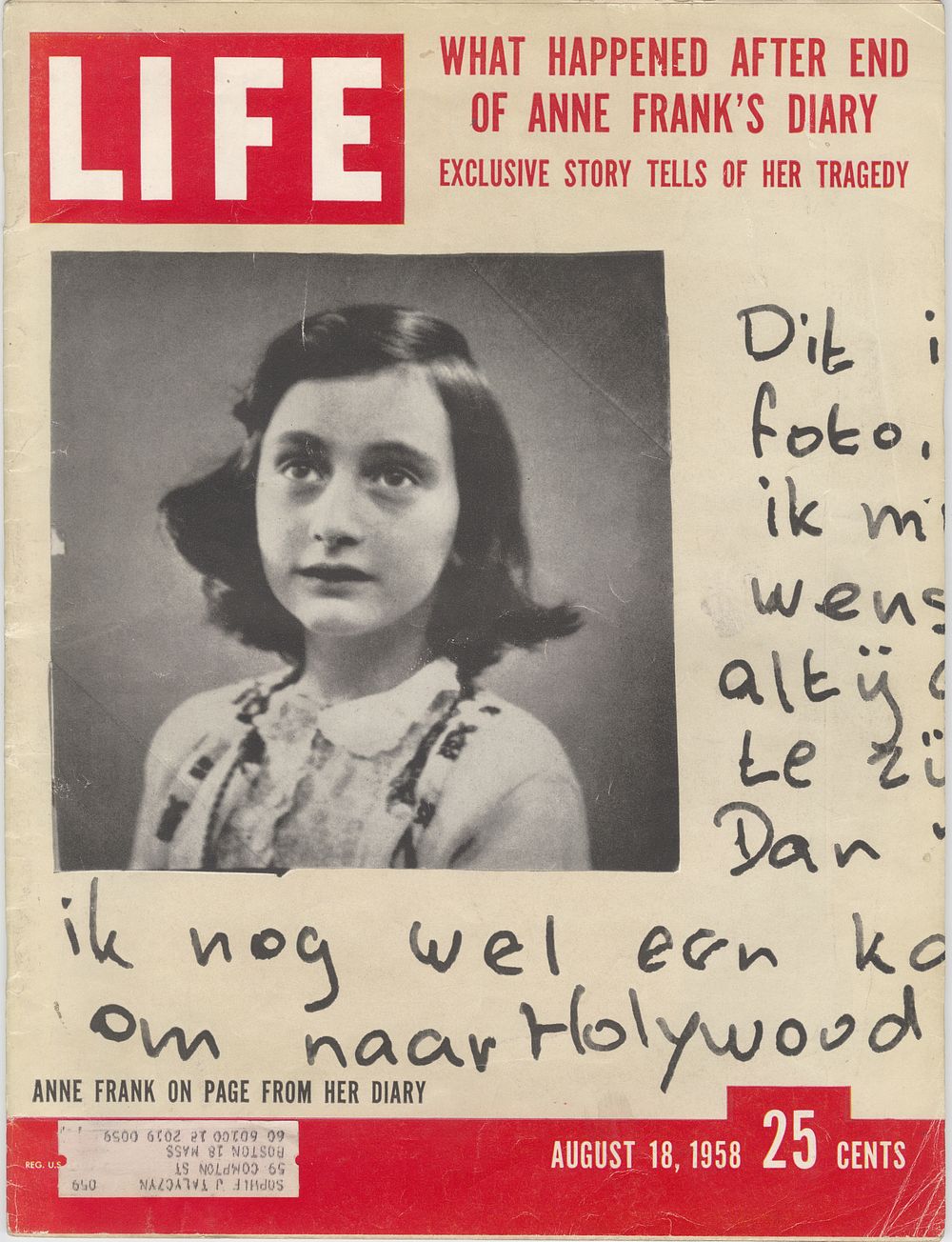
Anna Frank’s Final Days After She Was Caught with Her Family in the Hiding Place – a major feature article in the American Life magazine. August – 1958 - ”Mrs. de Wijk saw Anne Frank every day in Auschwitz. 'Anne looked even more beautiful there.״ The American LIFE magazine, dated August 18, 1958, focuses on the critical days of Anne Frank and her family at the time they were caught in their hiding place, deported to Auschwitz, and later to Bergen-Belsen — as recounted by various witnesses who were with Anne until her final days in Bergen-Belsen. Its main headline: “What Happened After End of Anne Frank’s Diary.” Journalist Ernst Schnabel succeeded in locating several people who saw Anne Frank during her last days in the hiding apartment, in Auschwitz, and later in Bergen-Belsen, and obtained riveting testimony from them about what befell the girl who gave humanity the most important diary written during the Holocaust years. On the cover photo, the magazine features the familiar portrait of Anne Frank alongside words she wrote in her diary on October 10, 1942: ”This is a photo of me as I’d wish myself to look all the time. Then I might still have a chance to get to Hollywood. But now I’m afraid I usually look quite different. Amsterdam, Holland.” In the main article of the issue, spanning approximately ten pages, journalist Ernst Schnabel reveals the story of Anne Frank and her family from the moment they were caught in their hiding place until Anne’s death in Bergen-Belsen. Schnabel interviewed 42 people who knew Anne Frank -many of whom provided information about those final months of her life. Among them were the people closest to Anne Frank, who were in the main part of the building where the hiding apartment was located at the time she and her family were taken — Miep, Mr. Kleiman (who emigrated to Toronto after the war), Otto Frank, Anne Frank’s father, the only one from the hiding place who survived, and Mr. Kugler. These individuals worked near the family’s hiding place and provided them with food and relayed news for about two years (they themselves were taken to prison and released shortly afterward). Miep provided details about the Gestapo raid on Anne’s apartment: “The footsteps moved along the corridor. Then a door creaked, and a moment later the door connecting to Mr. Kleiman’s office opened, and a fat man pushed his head in and said in Dutch: ‘Quiet. Stay where you are.’ At first, I didn’t know what was happening. But then, suddenly, I knew...”. The man who burst into their office ordered them not to move, and the search of the building began. Mr. Kraler recounted: ”A first sergeant in the uniform of the occupation police and three men in civilian clothing entered my office. They wanted to see the storage rooms at the front of the building. Everything will be fine, I thought, as long as they don’t want to see anything else. But after the sergeant finished checking everything, he stepped into the corridor and ordered me again to come. At the end of the corridor, they suddenly drew their pistols, and the sergeant ordered me to push aside the bookcase and open the door behind it. I said: ‘But there’s only a bookcase there!’ At that moment, he became agitated, because he knew everything. He grabbed the bookcase and pulled it - and the secret door was exposed. Perhaps the hooks weren’t properly secured. They opened the door, and I was forced to go up the stairs ahead of them. The officers followed behind me. I could feel their guns against my back. I was the first to enter the Franks’ room. Mrs. Frank was standing by the table. I made a great effort and managed to say: ‘The Gestapo is here.’” Otto Frank recounted the same event: “I was showing Peter van Daan his spelling mistakes when suddenly someone came running up the stairs. The steps creaked, and I stood up, because it was morning, a time when everyone was supposed to be quiet. But then the door suddenly burst open, and a man stood before us, pointing his pistol at my chest. In the main room, the others had already gathered. My wife, my children, and the Van Daans stood there with their hands raised. Then Albert Dussel came in, followed by another stranger. In the middle of the room stood a uniformed officer. He stared at us. ‘Where are your valuables?’ he asked. I pointed to the cabinet where I kept my cash box. The officer took it. Then he looked around, and his eye fell on the leather satchel in which Anne kept her diary and all her papers. He opened it and shook everything out, throwing the contents on the floor so that Anne’s papers, notebooks, and journals were scattered at our feet...”. Otto Frank went on to describe to him the family’s reaction to the discovery of the hiding place at that moment: “Now everyone packed. Otto Frank recalled the arrest: ‘No one cried. Anne was very quiet and calm, just hopeless, just like all of us. Perhaps that’s why she didn’t think to take her notebooks, which were scattered on the floor.