Bidspirit auction | Eichmann’s Commando – How the
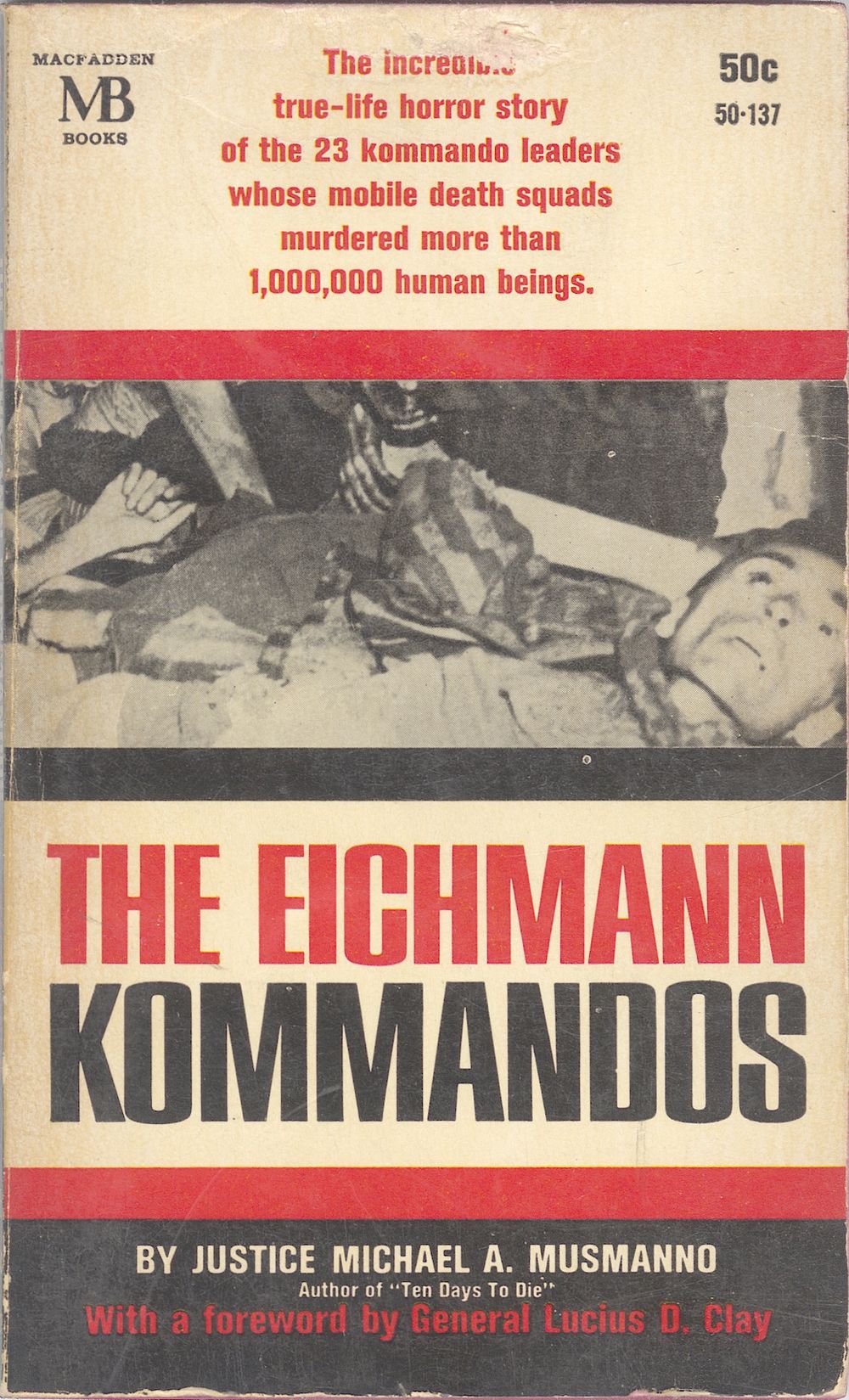
Eichmann’s Commando – How the execution network that carried out the mission of extermination operated under the direction of Adolf Eichmann’s office, as recounted by the judge who interrogated the Nazi war criminals - The Eichmann Kommandos by Michael Angelo Musmanno, published by Macrae Smith Company. A chilling documentation of the crimes committed by those directly responsible for carrying out the death orders issued from Adolf Eichmann’s office, as told by the judge Michael Musmanno who sentenced them to death at Nuremberg and later testified against Eichmann himself at his trial in Jerusalem. Philadelphia, 1961 – first edition. ”The atmosphere in the courtroom is thick with dread at the prospect of an impending horrific revelation. One may grow accustomed to the most dreadful scenes, yet the deliberate murder of innocent children leaves all of humanity wounded and shaken to the point of being unbearable. Ohlendorf does not disappoint expectations, and as the audience listens in helpless shock, he responds with chilling composure: 'I believe it is quite simple to explain if one begins with the fact that this order was not intended merely to achieve [temporary] security, but rather permanent security. For this reason, the children were individuals who would grow up, and surely, as children of parents who had been killed, they posed a danger no less than that of their parents…’. I summarize Ohlendorf’s explanation: 'The witness stated that the reason these children, under the age of five, under the age of four, under the age of three, even unborn, I imagine were killed, was that they posed a potential threat to Germany…’”. On May 15, 1961, Justice Michael Musmanno of the Pennsylvania Supreme Court took the witness stand at the People’s House in Jerusalem to testify for the prosecution in the trial of Adolf Eichmann. Thirteen years earlier, in Nuremberg, in a trial that lasted six months, Justice Musmanno had delivered the verdicts of 23 leaders of the Einsatzgruppen - Eichmann’s mobile killing units that murdered their victims in their own towns and villages, rather than deporting them to mass extermination centers. In The Eichmann Kommandos, Musmanno reveals the full drama of that Nuremberg trial: Who were these 23 “educated and intelligent” war criminals, whose barbaric hands were stained with the blood of more than a million of Eichmann’s victims? What were their methods of operation? And how did the execution network function carrying out extermination orders issued from the office of Adolf Eichmann, the chief engineer of the killing mechanism, who in turn received his directives straight from Adolf Hitler. Musmanno’s book, which documents the crimes committed by the operatives within Adolf Eichmann’s extermination apparatus, is based on direct interrogations and testimonies he conducted with members of the deportation and annihilation system under Eichmann’s command. He meticulously records their responses to his toughest questions, detailing their personalities, modes of operation, and the degree of responsibility held by those who carried out the death orders issued from Eichmann’s office. Through his investigation of Nazi war criminals during the Nuremberg Trials, Musmanno illustrates how a bureaucratic and technical-administrative mechanism absorbed ideological policy from Eichmann’s office, compiled lists, concentrated populations, coordinated transport trains, and worked in close collaboration with the police and the SS, turning mass murder into a chillingly efficient and sophisticated operation. Musmanno provides in-depth descriptions of the accused's reactions during questioning, and based on their testimonies, reconstructs how the deportations were carried out from Western and Southern Europe. He examines the elaborate system of deception and lies employed against the victims, the structure of the killing mechanism used by the Einsatzgruppen, and the various methods of execution that evolved over time from gas vans, to mass shootings, to the coordination of collection centers, train stations, and transit camps, leading the condemned from their homes to their final path into the crematoria of death. Musmanno demonstrates the blurred line between bureaucracy and atrocity: the deportations executed by Eichmann and his men were framed as an “administrative solution to a problem, ” but in fact constituted the most monstrous act of mass murder in human history. Through countless facts and details, Musmanno proves that these crimes were not the actions of a mere “special unit in the field, ” but rather the outcome of an entire bureaucratic enterprise, where every deputy director, liaison officer, and transportation official played a critical role in the machinery of extermination. “Fourteen SS officers were sentenced today to be hanged for at least one million murders. The verdicts concluded the largest murder trial in history.” Nuremberg, April 10, 1948.