Bidspirit auction | Full Transcript of the Interrogation
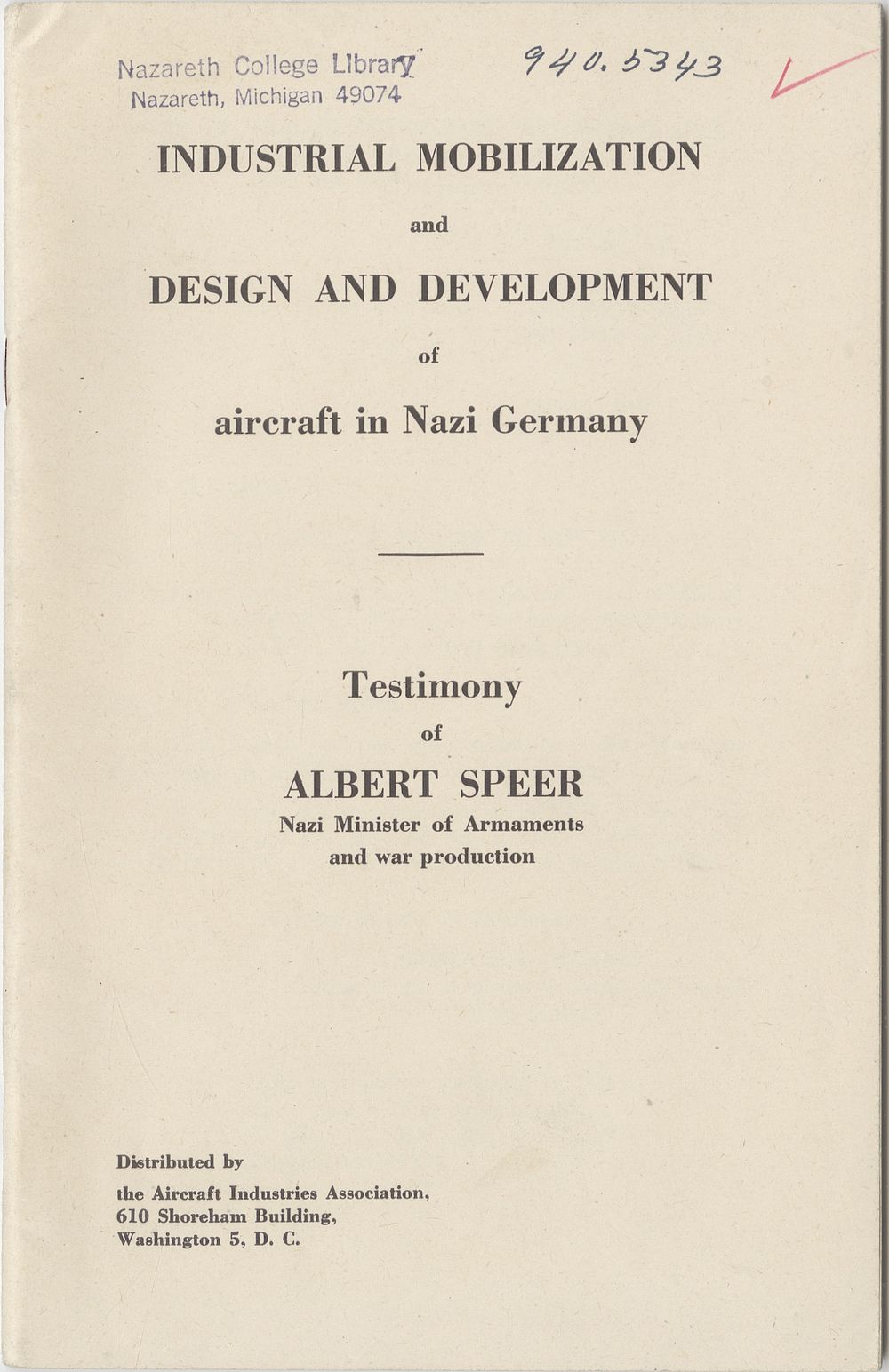
Full Transcript of the Interrogation of Nazi Armaments Minister Albert Speer – Official Report. Washington, 1945 – First Edition - Industrial Mobilization and Design and Development of Aircraft in Nazi Germany – Testimony of Albert Speer, Nazi Minister of Armaments and War Production. Published by the Aircraft Industries Association, Washington, 1945 – First Edition. Official Intelligence Report by the Office of Military Government for Germany (U.S.), Office of the Director of Intelligence: Interrogation of Albert Speer and Former Officials of the Reich Ministry for Armaments and War Production – containing Albert Speer’s answers to the questions posed by investigators of the AAF (Army Air Forces). The central focus of Speer’s interrogation concerned his direct responsibility as the head of the forced labor apparatus used in German munitions production during the war. Speer responded that throughout the war years he had in fact opposed Hitler’s policy of forced labor, viewing it as ineffective in practice. He cited a speech he delivered in Essen, in which he openly objected to the employment of forced laborers. In his testimony, Speer further revealed that Nazi leaders such as Hitler and Göring deliberately surrounded themselves with ineffective subordinates in order to secure total freedom in decision-making: “This is why such deputies, like Göring’s aide, are generally insignificant individuals, ” he said. When asked about Göring: “Question 11c: Does Göring give the impression of a man with ideas?” Speer replied: “He is intelligent, has a flood of clever ideas and considerable perception, but he lacks the toughness needed to carry them out. Some of his ideas were so poor that they outweighed his intelligence. He overcommits himself. His ideas were both his strength and his danger, because he was not realistic enough.” The appendix includes excerpts from memoranda Speer submitted to Adolf Hitler, as well as passages from his speeches that either support or contradict claims made during the interrogation. Speer also stated that he envied Russia and the United States for how the circumstances of war forced them to reach a high level of improvisation in weapons production, compared to Nazi Germany. He remarked that they managed to mobilize their armed forces much faster than Germany: “In Germany, we had economic leaders who were strangers to industry, and therefore responsible for far lower output than the available potential would have allowed.” He also revealed that German public morale was significantly lower than it had been during the First World War—even during military successes on various fronts: “Joyful events, such as the great feats of army commanders, submarine captains, or fighter pilots, did not inspire the kind of celebrations we had seen in the last war...”. Speer’s testimony here serves as first-hand documentation on centralized production, assembly line planning, manpower organization, the distribution of resources between military branches, and the impact of the Reich’s strategic needs on the armaments industry. Albert Speer [1905–1981] – German architect and Nazi war criminal, a senior member of the Nazi regime in Germany under Adolf Hitler. Speer served as Hitler’s personal architect, and a friendship developed between the two. In 1942, he was appointed Minister of Armaments in Hitler’s government, a position in which he was responsible for supplying weapons to the collapsing Wehrmacht under extremely difficult conditions - amid relentless Allied air raids and through reliance on a vast forced labor apparatus. At the Nuremberg Trials, Speer was indicted for his role in the crimes of the Nazi regime against humanity, particularly for his part in the exploitation of forced labor. Speer claimed that he was not involved in organizing the forced labor system and shifted the blame to his fellow cabinet member, Fritz Sauckel. During the trial, Speer admitted to a certain degree of guilt as a member of Hitler’s cabinet, but insisted that he had no knowledge of the mass extermination acts, including the Holocaust and the destruction of the Jews, and was not responsible for the conditions under which the forced laborers were employed. He acknowledged that membership in the Nazi apparatus required blind obedience, and for this, he accepted guilt. This stance spared Speer from the death penalty, and he was sentenced to twenty years in prison, which he served in full at Spandau Prison. Fritz Sauckel, on whom Speer placed the responsibility for the conditions under which the forced laborers worked, was sentenced to death and executed. 57 pages. Ex-library copy. Very good condition.