Bidspirit auction | Memoirs of War Criminal Karl
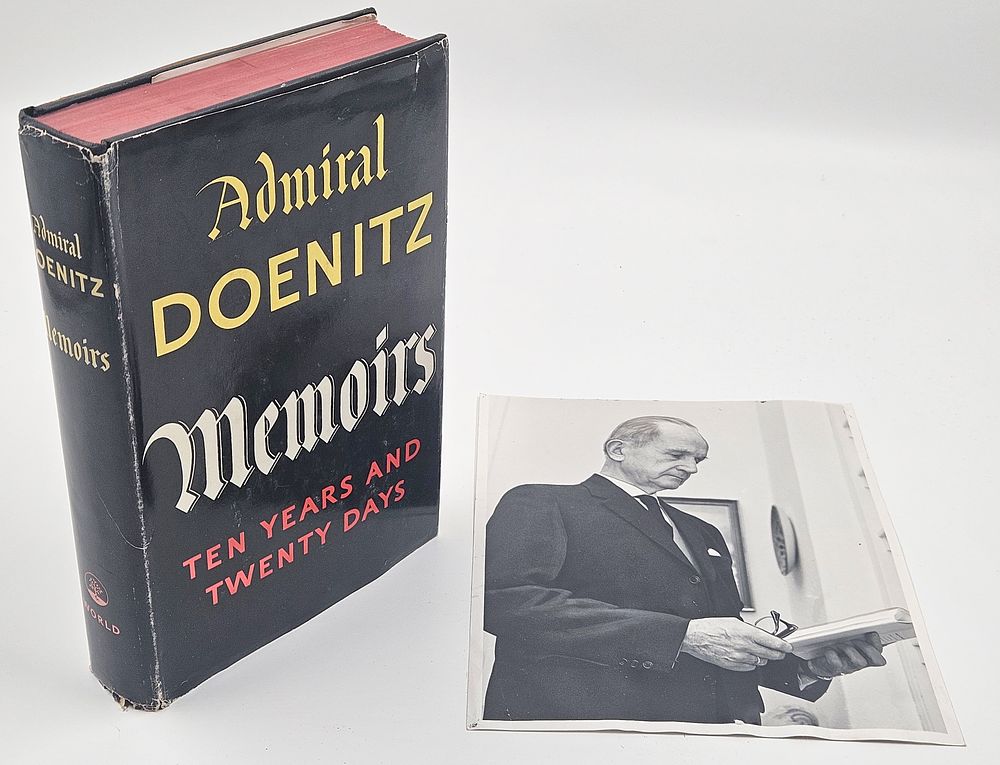
Memoirs of War Criminal Karl Dönitz, Successor to Adolf Hitler – First English Edition - ”My knowledge of the inhuman aspects of the Nazi state was very limited. I learned the full facts, to my great shock, only after the war...”. “Memoirs: Ten Years and Twenty Days” – The Autobiography of Admiral Karl Dönitz - The memoirs of Karl Dönitz, commander of the German U-boat fleet during World War II, later commander-in-chief of the Kriegsmarine (Nazi Germany’s navy), and ultimately Adolf Hitler’s appointed successor as head of the Reich for a few days following Hitler’s suicide in April 1945. Published by The World Publishing Company, Cleveland–New York, 1958. The first English translation, issued about a year after the original German edition. Second printing. Includes a press photograph of Dönitz dated 16 May 1976. An autobiography in which Karl Dönitz recounts his senior years of service in the German Reich—the ten years during which he commanded the U-boat fleet, and the twenty days during which he served as acting President of Germany (1–21 May 1945), until Germany’s surrender. This first-hand account of Dönitz’s decade as “Mr. U-Boat” and his twenty days as Hitler’s successor sheds new and important light on two distinct, yet at times overlapping, realms: the naval and the political. Grand Admiral Karl Dönitz, as commander of the German navy, was the architect of the U-boat warfare strategy, through which the Germans hoped to defeat the Allies. Dönitz was the man responsible for rebuilding Germany’s submarine fleet and for directing its undersea warfare campaign. It is a historical fact that Dönitz’s U-boats exacted the heaviest toll on the Allies in the Battle of the Atlantic. Throughout the book, whenever Karl Dönitz describes his personal relationship with Adolf Hitler and the direct orders he received from him, he consistently employs language that removes or distances personal responsibility. For example, he writes: “When Hitler issued his infamous ‘scorched earth’ order on 19 March 1945, my main concern was to ensure that control over every step the Navy might be required to take would remain in my hands…”. Elsewhere, he recounts his reaction upon receiving the secure naval code message naming him as Hitler’s successor: “Grand Admiral Dönitz. The Führer has appointed you, Admiral, as his successor in place of Reichsmarschall Göring. Written confirmation will follow. You are hereby authorized to take any steps the situation requires. Bormann.” Dönitz continues: “It took me completely by surprise. Since 20 July 1944, I had not spoken to Hitler at all, apart from at some large gathering. He had never given me even the slightest hint that he considered me a possible successor. I had received no suggestion to that effect from anyone else, and I believe none of the other leaders had considered such a possibility. By the end of April, of course, it was clear to me that Göring was no longer a candidate, and it was also clear that Himmler expected to be named. But the thought that I myself would be entrusted with the task had never crossed my mind. Having spent my entire life as a naval officer, the idea seemed thoroughly improbable. Even when I received the message, I couldn’t grasp what might have led to my appointment…”. Dönitz continues to describe his feelings - carefully working to clear his name : “When I read the message, I did not doubt for a moment that it was my duty to accept the task… I also understood that my name would forever be associated with it, and that hatred and distortion of the facts would continue to attempt to tarnish my honor. But duty demanded that I ignore such considerations. My policy was simple, to try to save as many lives as possible…”. He further claimed that Hitler’s death had been kept from him, and that he knew nothing about the suicide. He writes that he wished to denounce Hitler but refrained because those around him still revered him: “History will pass its rightful judgment on him in due course.”. And he adds: “My knowledge of the inhuman aspects of the Nazi state was very limited. I learned the full facts, to my great shock, only after the war. At that time, I believed that fairness required me to phrase my message the way I did. I also do not believe that I would have acted differently today, had I found myself in the same position and with the same limited knowledge of that aspect of the regime’s conduct… My primary task at that point was to inform the German people of what I intended to do next.” In the book’s epilogue, Dönitz extends this tone to the German people as a whole, claiming that they should not bear collective guilt: “Every decent German today is ashamed of the crimes committed by the Third Reich behind the back of the nation. To place the blame on the entire people for the sins of a small minority contradicts every canon of justice. One cannot condemn individuals for things they had absolutely no knowledge of.