Bidspirit auction | “The greatest trial in history
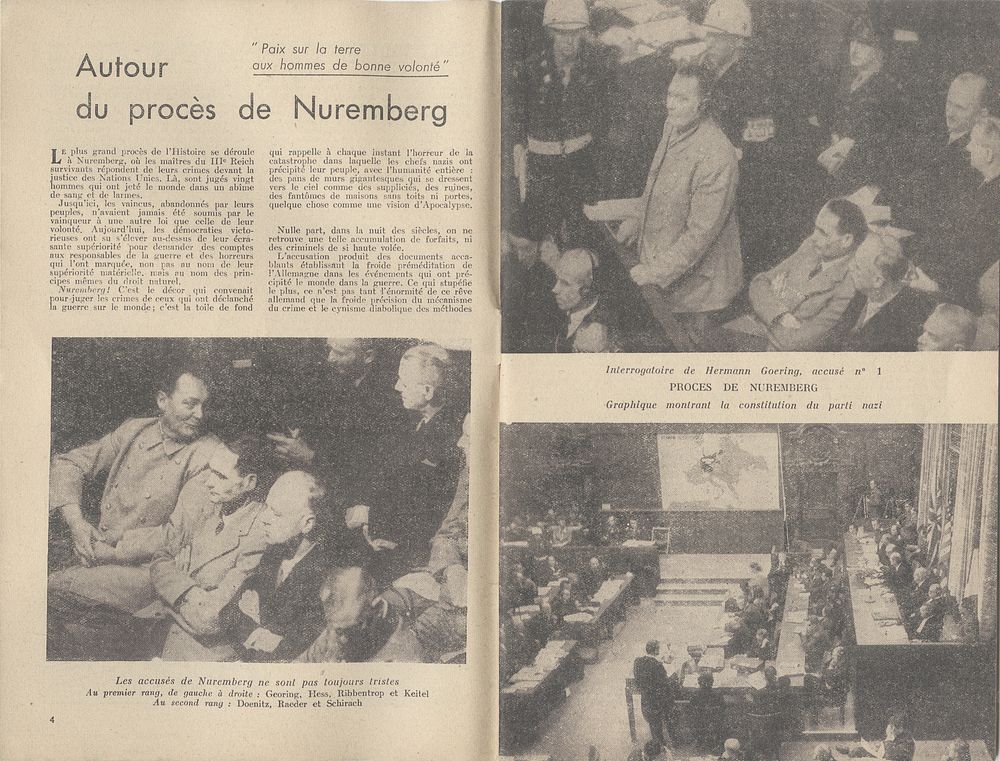
“The greatest trial in history is taking place in Nuremberg...” – on the importance of the Nuremberg Trials for the stability of civilization for generations / testimonies of prisoners from Dachau - Issue of the regional French weekly Le Maine Libre, under the section Les Cahiers du Maine Libre, December 1945 edition for Christmas – “Noël 1945”. At the opening of the issue, a compelling editorial discusses the importance of the Nuremberg Trials in shaping a better future for all humanity, accompanied by photographs from the courtroom. Extremely rare. An editorial by André Duteil is devoted entirely to the Nuremberg Trials. In a compelling and insightful text, he explains how the Nuremberg Trials are destined to impact generations, laying the foundation for a more secure civilization. The article was written at the time of the opening of the courtroom proceedings. Later in the issue appears a rare report by a staff correspondent who arrived at the Dachau camp following its liberation. Thus writes André Duteil: “The greatest trial in history took place in Nuremberg, where the surviving leaders of the Third Reich are being held to account for their crimes before the United Nations. There, twenty men who plunged the world into an abyss of blood and tears are being judged. Until now, the vanquished, abandoned by their own people, had never been subjected by the victor to any law other than that of his own will. Today, the victorious democracies have risen above their overwhelming supremacy and demanded accountability from those responsible for the war and the atrocities that marked it, not in the name of material superiority, but in the name of the very principles of natural law. Nuremberg! It was the perfect setting in which to judge the crimes of those who unleashed war upon the world; a backdrop that constantly reminds us of the horror of the catastrophe into which the Nazi leaders cast their nation, along with all of humanity... Nowhere, in the mists of time, can such an accumulation of crimes be found, nor criminals of such high rank. The prosecution presented damning documents establishing Germany’s coldly calculated intent in the events that dragged the world into war. What is most astonishing is not so much the scale of this German dream, but the cold precision of the criminal machinery and the demonic cynicism of its methods. Men recruited to serve this horrific purpose, all in the name of Lebensraum and race...”. André continues, describing how, despite everything that had already been revealed at the time - the defendants still denied their guilt and pretended not to know what had taken place in the death camps: “And yet, the defendants deny all guilt! They deny everything. They refuse to take responsibility for the terrible cost. It is, they say, the first time they’ve heard that deportees died in concentration camps; not one of them suspected the murder of the Polish population, nor the tortures devised by the Gestapo. These masters of the world never concerned themselves with such details. But now they invoke international law. They construct a shield for the man with the outstretched arm, the frenzied barker whose evil shadow still looms over the screen where the images of death from Buchenwald and Dachau were projected. But the people await the punishment of the guilty, in the name of all those who will never return. The hour of judgment has come. The trial must not fail in its mission. To succeed, it must not only punish the Nazi savages who, for more than a decade, carefully prepared and carried out the most monstrous program of enslavement ever to threaten the world; it must also censure those who upheld the regime, the captains of heavy industry, whose spraying furnaces glowed red day and night to supply Hitler with the monstrous machinery necessary for the relentless execution of Mein Kampf... May the verdict of the Nuremberg Tribunal therefore be a clear affirmation of the law that forbids wars of aggression, in a way that is striking and unforgettable... In Nuremberg, from the depths of this nightmare - reawakened by the rise of Nazi horrors, perhaps peace is now beginning to spread its wings over the wounded world.” Later in the issue appears a compelling article dealing with the horrors of the Dachau concentration camp. Journalist Colette de Follin arrived at the camp shortly after its liberation in April 1945 and managed to gather testimonies from prisoners in severely weakened physical condition who were still present at the site. They told him about their daily food rations, 200 grams of bread and 750 ml of soup. The prisoners were organized into groups of 25; when one member of the group became gravely weakened, the others committed to giving him 10 grams each from their own portions, thereby providing him with an additional 240 grams. In this way, 400 French prisoners were saved. These groups forbade any form of bartering, such as exchanging bread for cigarettes,