Bidspirit auction | “Persecution of the Jews and
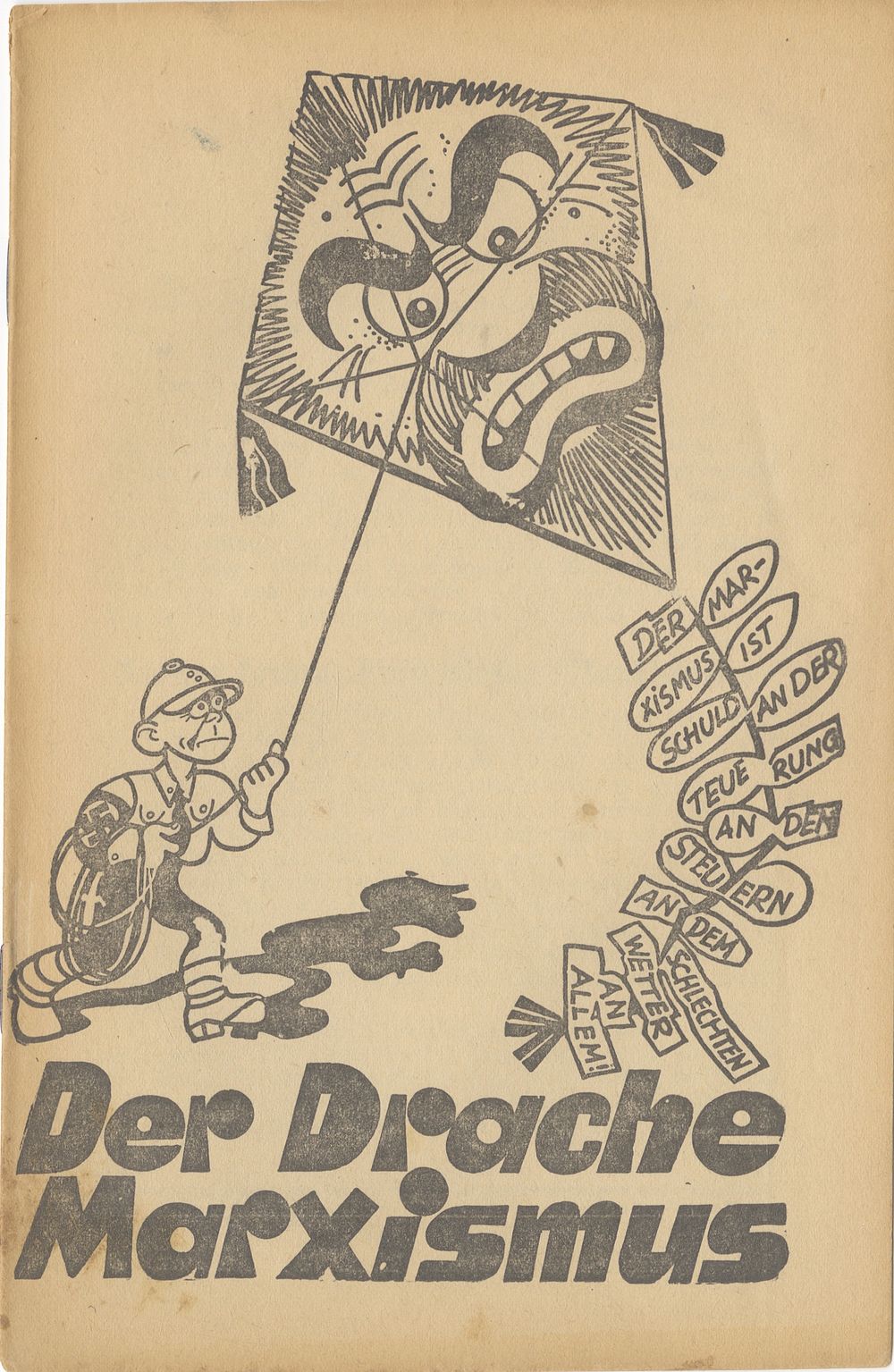
“Persecution of the Jews and racial hatred will not change the system” – Pamphlet outlining the platform of the Social Democratic Party in Germany - Der Drache Marxismus – The Dragon of Marxism, published by the Social Democratic Party of Germany. Platform of the Social Democratic Party of Germany ahead of the 1930 elections. Published in Bernburg (Saxony) by Bernburger Buchdruckereigesellschaft. Germany, [1930]. Extremely rare. A pamphlet outlining the platform of the Social Democratic Party of Germany (SPD), published in opposition to the Nazi Party and its foundational principles, which claimed that the persecution of Jews and Marxism would bring salvation to Germany. Released in advance of the elections held on 14 September 1930. In the early 1930s, the SPD was a center-left parliamentary party with a pro-democratic and pro-republican stance. This pamphlet, issued shortly before the elections, condemns the rise of antisemitism and the German parties promoting it. It explains that antisemitism is a reactionary phenomenon serving the interests of the Right and fostering social division, and argues for a path of civil and constitutional equality, not as a “racial” or “political” matter, but in direct contrast to the nationalist-right rhetoric of the late 1920s and early 1930s. The author reiterates the message: “Violence can destroy both the good and the bad, but it cannot build. This cannot be achieved through the persecution of Jews and racial hatred, as the National Socialists intended. Such methods harm individuals, both good and bad, but do not change the system itself.” The pamphlet instead proposes a reorganization of the existing economic order, “as the Social Democratic Party strives to do wherever it gains influence.” The party advocates health insurance funds and national insurance programs as a path toward social uplift, declaring explicitly: “We begin this in the Reichstag, where we have never held a majority, through the social shaping of legislation, and by striving for state dominance over the economy.” Since World War I, and especially in the late Weimar years, a position solidified within the party holding that Marxism was not a doctrine of violent revolution but a framework for socio-economic analysis that could be implemented through constitutional means: improving working conditions, establishing a welfare state, progressive taxation, strong labor unions, and the preservation of civil liberties. On 14 September 1930, general elections were held for the Reichstag. These elections are considered one of the major turning points in the history of the Weimar Republic. The most striking result was the dramatic surge of the NSDAP (Nazi Party), which transformed from a fringe group into a major parliamentary force; the party rose from 12 seats in 1928 to 107 in 1930, becoming the second-largest faction. While the SPD remained the largest party (with 143 seats), it lost practical influence due to severe polarization and the rise of both the Right and the Communists (the KPD rose to 77 seats). Following the 1930 elections, German politics became increasingly ungovernable, with the cabinet relying more and more on presidential decrees under Article 48, until the final collapse of the parliamentary system in early 1933 and the Nazi rise to power. The cover design was aimed at attacking the Nazi Party’s hostility toward Marxism and the Jews, a kite-like dragon in the shape of a threatening Jewish figure, with a side caption blaming “Marxism” for every possible ill (“inflation, ” “taxes, ” “bad weather, ” “everything!”), while below, a youth in a swastika uniform attempts to “pull it down.” Extremely rare. Only one copy listed in the WorldCat global library catalog, held at the National Library of Denmark. 16 pages. Very good condition.