Bidspirit auction | Zebra – A Factual Report
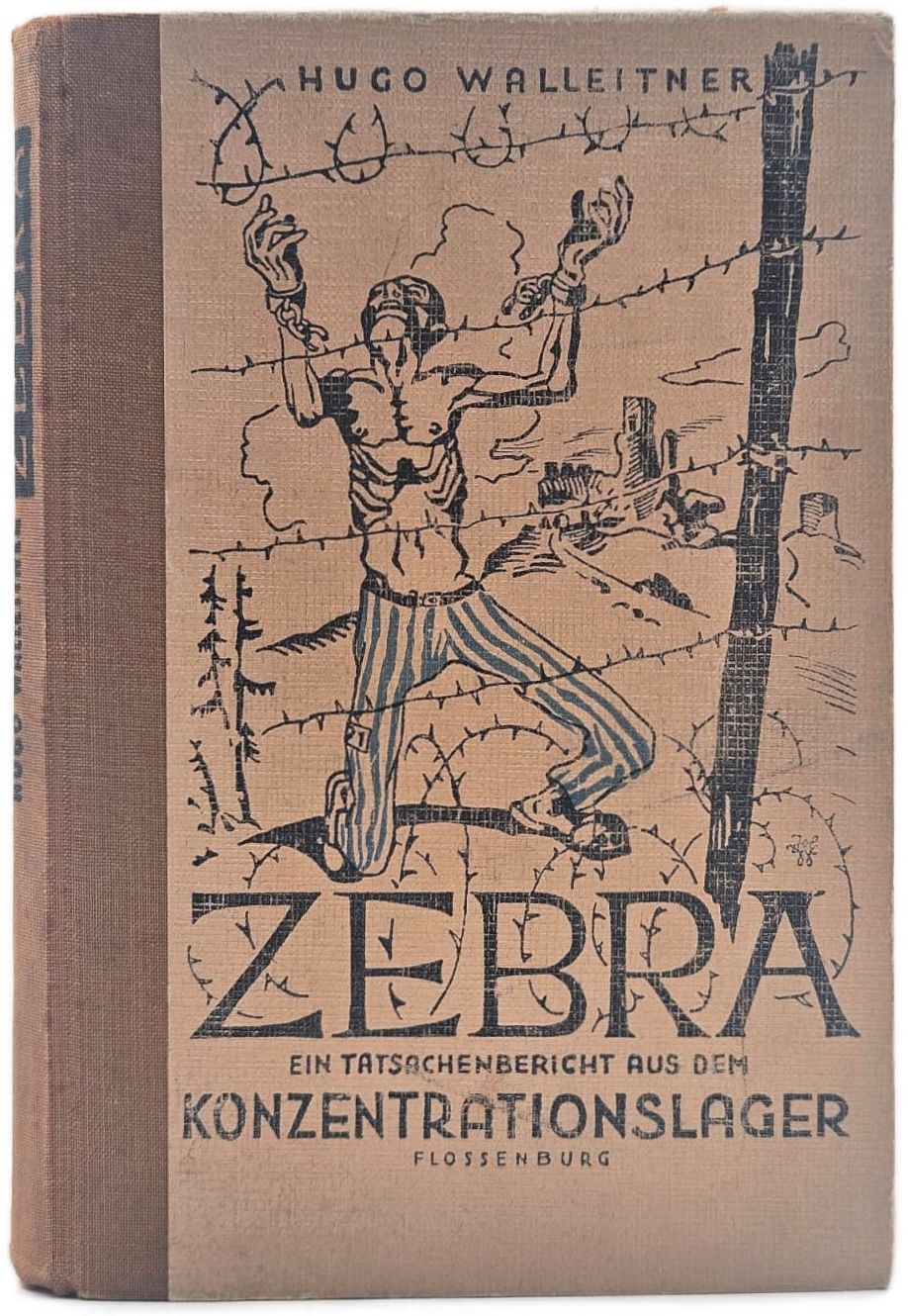
Zebra – A Factual Report from the Flossenbürg Concentration Camp – A rare testimony by an Austrian inmate who was held in the camp for three years. Austria, 1946 – first edition - Zebra – Ein Tatsachenbericht aus dem Konzentrationslager Flossenbürg – Zebra – A Factual Report from the Flossenbürg Concentration Camp, by Hugo Walleitner, an Austrian inmate who was imprisoned there for three years. Includes 34 harrowing photographs of severe events in the camp, taken by the author. Self-published by the author. Bad Ischl (Austria), [1946] – first edition. In German. Extremely rare. ”Presents the naked truth of this suffering with stark honesty... Clad in zebra stripes – white and blue – exiled for many years behind barbed wire; whether black or green, purple or red, we all awaited our shared death...” (from the foreword). A harrowing account of prisoner life in the Flossenbürg concentration camp in Bavaria, where over 30,000 people were murdered by the Nazis, written by Austrian inmate Hugo Walleitner (born March 16, 1909, Bad Ischl – died June 16, 1982, Vienna). Walleitner was imprisoned in Flossenbürg for more than three years. In his book, he does not detail the reasons for his arrest, presumably linked to his homosexuality, which led to his immediate internment and torture upon arrival (his arrest is documented in Andreas Schmoller, “Hugo Walleitner, Graphic Artist and Victim of Homosexual Persecution under Nazism”, in: The Memorial Book of Upper Austria, Franz and Franziska Jägerstätter Institute, Catholic Private University of Linz, Linz 2021). Walleitner recounts the inferno he endured from the very first day, describing how only three out of a group of 27 men survived the torture inflicted by SS guards en route to the camp. Upon arrival, they were greeted by an SS officer who shouted violently: “Within three minutes, we were forced to stand before him, completely naked. Everyone had to hand over all their clothing. Watches, rings, money, and valuables were immediately confiscated or stolen by the so-called ‘elders’ when no one was looking...” The men were shaved and issued prison uniforms, and from that point forward, the book documents the horrors of daily life in the camp. Because the Nazis constantly needed to expand the camp due to the massive influx of deportees, the prisoners were forced into grueling labor, clearing earth and digging to expand the camp grounds. Despite repeated expansions, the number of inmates always far exceeded the camp’s capacity. Living conditions were unbearable: the forced labor in the quarries, the lack of medical care, and the brutal treatment at the hands of guards and overseers claimed countless lives. Dozens of acts of cruelty and unimaginable deaths are described throughout the book. Walleitner is meticulous in providing specific details about the executions and the circumstances under which they occurred, including the names of kapos and SS men responsible for the atrocities, as well as the exact locations and events. Thanks to his talent as a visual artist, Hugo Walleitner managed to survive, as the Nazis made use of his skills, commissioning him to paint watercolors on demand. (All the illustrations in the book were drawn by Hugo while he was imprisoned in the camp.) Walleitner was brutally beaten even while painting, if his work did not please his superiors, he would be struck during the act of creation. Later, as the only graphic artist employed by the Nazis in the camp, he was instructed to produce greeting cards for high-ranking officials, cards which were then sent to top leadership in Berlin and other parts of the Reich. His “payment” for these works consisted of scraps of bread. According to Walleitner’s testimony, the highest mortality rates in the camp occurred in the infirmary, which consisted of two barracks and a tuberculosis shed. In 1944, more than 1,000 prisoners died there every month. “Severely ill and emaciated, these masses of dying men writhed in those barracks, desperately seeking help from a doctor.” He also describes prisoners’ attempted escapes, the harsh punishments for those caught, or for others in place of those who succeeded, as well as the typhus epidemic that claimed countless lives, and the various ways prisoners tried to cope with the disease. Walleitner survived the inferno of the camp and provides one of the rare, vivid eyewitness accounts of the liberation of Flossenbürg. After the war, he returned to his home near the Salzkammergut estate. He concludes: “I am fully aware that I will carry these horrific images within me for the rest of my life, and that it will not be easy to forget or overcome them. I saw too much contempt for humanity and too much annihilation, it shook me to the core, as it did millions of other former concentration camp prisoners. Only my unwavering determination and my reluctant career as a painter saved me from what would have otherwise been certain death…”. Extremely rare.