Bidspirit auction | “Mother, may I bring the
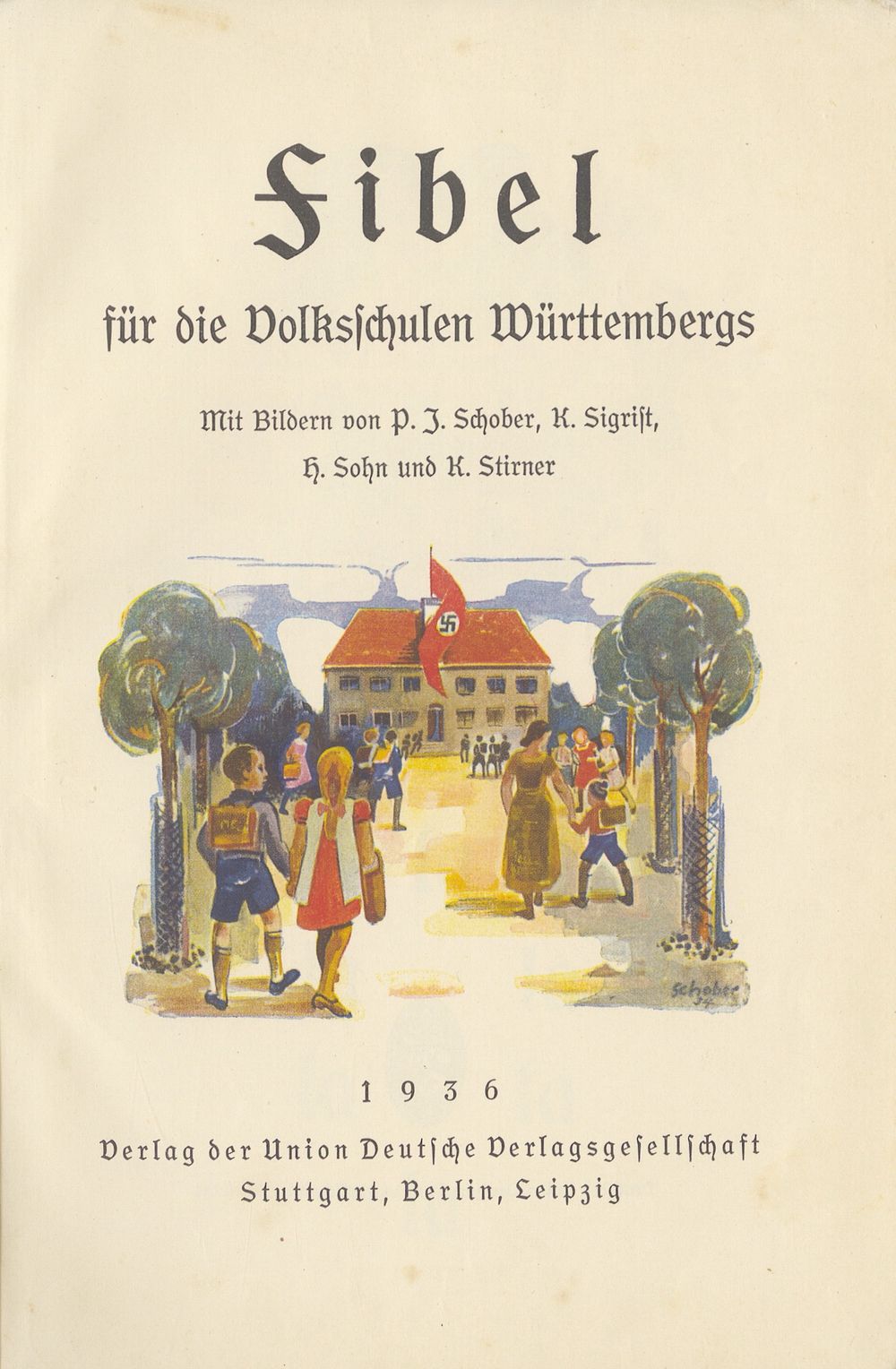
“Mother, may I bring the Führer flowers?” – A first-grade reading textbook from Nazi Germany with direct Nazi messaging - Fibel für die Volksschulen Württembergs. With illustrations by P.J. Schober, K. Sigrist, H. Sohn, and K. Stirner. A first-grade reading textbook for elementary schools in Württemberg, combining throughout its content and numerous illustrations messages of admiration for the Führer and the Nazi movement. Published by Verlag der Union Deutsche Verlagsgesellschaft, Stuttgart, Berlin, Leipzig, 1936. The textbooks that corrupted an entire generation. Extremely rare. A basic primer for learning the German alphabet, accompanied by illustrations on every page. The book is structured around reading and singing passages intended for young children just beginning their first steps in school and learning to read. Throughout the book appear seemingly innocent segments drawn from the world of children. However, intentionally embedded within the entire work are reading and singing passages that glorify Adolf Hitler and the Nazi ideology, aimed at instilling the Nazi worldview and admiration for the Führer in German children from an early age - befitting a dictatorship state. The book was published in 1936, and its content aligned seamlessly with the broader German propaganda disseminated through other social communication channels of the time. Early children’s books known as Fibel had already been published in Germany at the beginning of the 20th century in a similar format of short reading segments accompanied by innocent, colorful illustrations. Yet under the Nazi regime, they assumed a new character, their content adapted to convey messages designed to enslave children's minds to the idea of an all-powerful leader. Swastika flags and passages of admiration for the Führer - along with photographs of Adolf Hitler himself with children - were incorporated into editions already beginning in 1934, with new segments added and expanded each year by the publisher. The title page of the book opens with a large illustration showing children and their parents arriving for the first time at school, atop which flies the Nazi swastika flag. The first segment in the book leaves no room for doubt regarding its central intent: it features an illustration of children dancing with Nazi swastika flags and the song ”La la la.” Following that are songs and reading passages for children, drawn from German folklore—each song focusing on a different letter of the German alphabet, in order. After several innocent reading pieces and songs comes the song “Hop hop – how the gentlemen ride, ” accompanied by an illustration of three children riding horses, one of whom waves a Nazi swastika flag. The book continues with seemingly innocent reading pieces such as: We’re holding a wedding, Rock-paper-scissors, It’s raining outside, By the fountain, Cherries for sale, Hansel and Gretel, and more. Later in the book appears a segment titled Jungvolk – The Youth March: ”We march through the streets with steady steps, Above us the flag waves cheerfully, Dong dong… Diro dong, Heil Hitler!” The song is accompanied by an illustration of children in Hitler Youth uniforms waving flags bearing the party emblem, while townspeople around them wave swastika flags. Further on appears the story: “Max is allowed to join the Youngsters” – ”It was Hitler’s birthday. Max had really been looking forward to the evening. There was going to be a torch parade. His mother promised he could go too. There, beside the SA men, stood many boys in brown shirts. They even had shoulder straps and belts, and they could stand at attention just like the SA. Then Max said: ‘Mother, I want to join the Hitler Youth too.’ His mother gave him permission, and he was allowed to register immediately. Now Max was even happier. And when it was over, he shouted in a very loud voice: ‘Heil Hitler!’”. Further on, additional youth folk songs are interwoven—The Fire Brigade Song, The Fire, Give Us Our Daily Bread, The Piece of Bread, The Kite, What Do You Want to Be When You Grow Up, and others. After these seemingly innocent songs comes the poem “Our Wehrmacht”: “Boom, boom! Hurrah! Music! Music! These are the soldiers. Three of them march ahead, Wearing steel helmets and carrying rifles. The captain rides in front. All are covered in dust. Where have they been? Where are they headed? Everyone is happy when the soldiers arrive. We salute our Wehrmacht. They protect our homeland. Heil Germany! Heil Hitler!” The song is accompanied by illustrations of German Wehrmacht soldiers marching. Following this comes the reading piece “We’re Playing Soldiers”: ”Hermann and Wilhelm are the leaders. Each one wants to lead the Germans. Wilhelm is older. He is allowed to lead the Germans. Hermann leads the enemy. Now it can begin. Into the storm! March, march! Hurrah! Hurrah! They charge forward like savages. They capture their enemies and strike them down…”.