Bidspirit auction | Four issues of the antisemitic
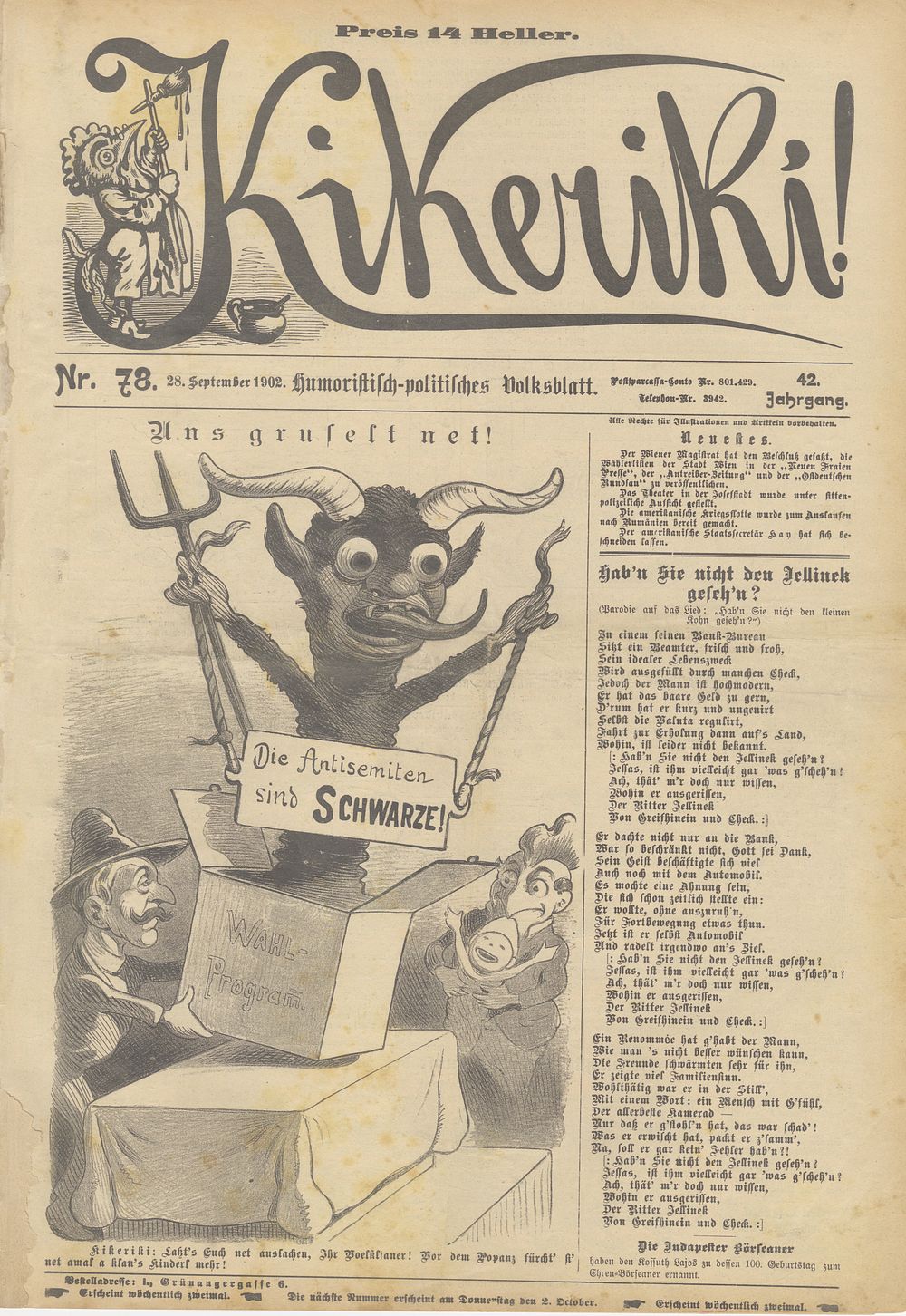
Four issues of the antisemitic biweekly – Der Wiener Kikeriki – 1902 - Four issues of the early virulent antisemitic biweekly Kikeriki. Vienna – Austria. 1902. Countless grotesque caricatures, poems, and articles against the Jews. Antisemitic articles and caricatures ahead of the elections in Austria warning of Jewish domination. ssue no. 76 dated September 21, 1902 Issue no. 78 dated September 28, 1902 Issue no. 90 dated November 9, 1902 Issue no. 91 dated November 13, 1902 These issues focus on the upcoming elections in Vienna and warn that if the “right” parties - those advocating antisemitism are not elected, disaster will strike Austria in the form of expanding Jewish domination. All four issues are filled throughout with antisemitic articles and caricatures. For example, Issue no. 78 features a caricature depicting a group of Jews with stereotypical faces being crushed under a bourgeois figure, with the caption: “Election Day.” On another page, there is an article discussing how Viennese Jews have destroyed the field of culture. On the back of the issue appears a large caricature portraying a Jew as a pig going to a Jewish theatre, alongside an explicit recommendation to attend only pure German theatre. Another caricature depicts a Jew lying in wait for local citizens with the caption: “A new courtship, ” and yet another shows Jews fleeing with the caption: “A small cause, a great effect.” Issue no. 91 features a full-page spread titled “The Antisemitic City Council Members” and includes an article, “A Look Back After the State Elections, ” warning of the election results in the form of Jewish domination if the antisemite party does not expand its representation. Issue no. 76 reports on its front page about an Austrian woman allegedly murdered by Jews, and includes a poem by the editorial board titled “The Jews will take all of us and take the people with them, ” urging the public to go vote in the upcoming elections lest the Jews take over Austria. The inner pages are filled with antisemitic caricatures; one shows a Jew with stereotypical features with the caption: “The Zionist music director in action.” There is also a large advertisement for antisemitic publications titled: “Attention Antisemites!” The editorial article of Issue no. 90 describes how Vienna has been ruled by Jews for many years, to the extent that its residents are no longer aware of how deeply they are in Jewish hands. On the same page appears a caricature showing Jews with stereotypical features shouting: “Change of attitude for the state elections, antisemitism no longer works.” This issue, too, is filled with antisemitic caricatures. Kikeriki was an antisemitic biweekly magazine published in Vienna, Austria, between the years 1861 and 1933. The editor of the paper was Ottokar Franz Ebersberg, a journalist and playwright who wrote under the pseudonym O. F. Berg. Kikeriki was extremely popular among the German-speaking population, and at its peak reached a circulation of 25,000 copies. In its early years, the paper adopted a liberal line, but from the 1890s and into the early 20th century, under the influence of Karl Lueger, it became the most virulent antisemitic publication in the world, focusing solely on Jew-hatred. Each issue featured numerous antisemitic caricatures portraying Jews in the most grotesque manner, alongside articles and inciting slogans against Jews. The caricatures mainly centered on degrading the Jew’s “innate traits, ” such as greed, avarice, cowardice (evasion of military service), and danger. The magazine repeatedly depicted “Jewish domination” in the press, in politics, and in all areas of life. Week after week, across all its pages, the paper portrayed again and again the figure of “the incorrigible Jew.” Kikeriki was the first newspaper to publish the infamous caricature of a Jew clutching the globe in his blood-drenched hands—an image that later appeared in countless antisemitic publications and was eagerly adopted by Nazi propagandists. The magazine saw itself as the mouthpiece of “the antisemites, ” and in many issues, articles were directed specifically to “the antisemites” as the paper’s primary target audience. In various issues, some pages even bore the footer: “Like-minded individuals demanded the Kikeriki be available in all restaurants and cafés!” In later years, Nazi propagandists made extensive use of Kikeriki issues and adopted many of the caricatures published therein in their war against the Jews. Four complete issues. Overall good condition.