Bidspirit auction | “The traitor Dreyfus” - a
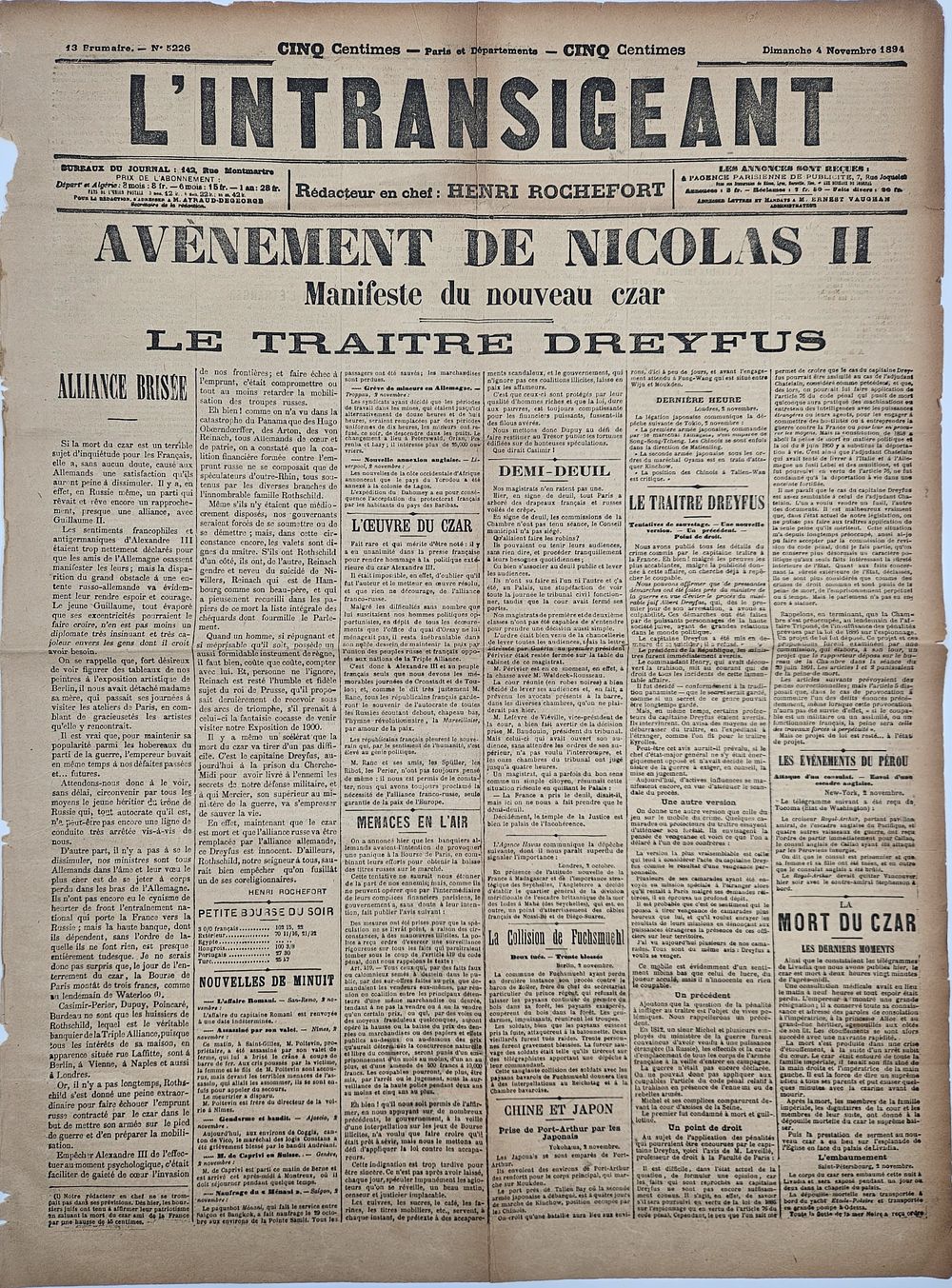
“The traitor Dreyfus” - a rare issue of L’Intransigeant from the early days of the Dreyfus Affair, stating that the appropriate punishment for Dreyfus is death - An issue of the newspaper L’Intransigeant, a Parisian daily - from November 4, 1894 - following the main announcement regarding the coronation of Emperor Nicholas, the Tsar of Russia, appears the sensational headline “LE TRAITRE DREYFUS” – “The traitor Dreyfus” - an issue from the early days of the affair, asserting that the appropriate punishment for Dreyfus “the traitor” is death, or at the very least life imprisonment in accordance with the limits of French law. It discusses the reasons that led him to betray the French army, with his guilt in treason not being in any doubt. In the article appearing on the front page, Dreyfus is portrayed as a traitor whose guilt—of passing military secrets to the Germans—is proven by “the most decisive evidence”: “We have published all the details of the crime committed by the captain who betrayed France. And so! Despite the most decisive evidence, despite the publicity given to this case, they are already attempting to release the accused on bail. We can confirm that urgent appeals have been submitted to the Minister of War requesting to prevent the trial of the unfortunate Jew Albert Dreyfus, who confessed his guilt from the very first day of his arrest. These appeals were submitted by powerful figures within high Jewish society, possessing extensive connections in the political world. Captain Dreyfus was given the opportunity to commit suicide ; he refused . The President of the Republic and the ministers were immediately informed. Major Henry, who uncovered the betrayal, reported to the relevant authorities all the events in this unfortunate affair. It was decided - according to the Panamanian tradition, that the secret would be kept, as if a secret of this kind could be preserved for long. Yet at the same time, some of Captain Dreyfus’s defenders were warned. They intervened. They devised ways to dispose of the traitor by sending him abroad, as was done with the traitor Eyrel. Perhaps this opinion would have prevailed, had not the Chief of the General Staff firmly opposed it and persuaded the Minister of War to demand, in council, that the case be brought to trial. Even now, active influences are still being exerted, with the aim of mitigating the scandal of the trial...”. The newspaper continues and proposes another version of events, asserting that Dreyfus’s act of treason stemmed from personal revenge. Since several of his colleagues were sent on special missions abroad while he remained in Paris despite his repeated requests, he felt deep resentment, and as a result decided to thwart their missions by denouncing the presence of these officers in their areas to foreign powers. The issue goes on to discuss what the appropriate punishment for the “traitor” should be. I t presents the “learned” opinion of Mr. Laveil - a professor of law at the Faculty of Paris, who points to a precedent from 1812 in which a man in the Ministry of War was executed by guillotine after being suspected of revealing the location of French army corps to the enemy. The issue concludes that this is the appropriate punishment for Dreyfus, “to punish with death anyone who engages in intrigues or maintains relations with foreign powers, ” but since the Constitution of 1848 abolished the death penalty, he should be sentenced to life imprisonment. ״L’Intransigeant״ was a Parisian daily with a militant political line, founded in 1880 by the journalist and politician Henri Rochefort. Rochefort, the editor of the newspaper, was a central figure in the radical press in France, and the paper was known for its forceful and populist style. It combined sharp rhetoric, a personal and at times provocative tone, with a national-radical political line that opposed the moderate republican establishment. During the Dreyfus Affair, the newspaper adopted a strongly anti-Dreyfus stance, even before the details of the case had become clear, supporting Dreyfus’s conviction and portraying him as a traitor. The publication date of the present issue belongs to a very early stage of the Dreyfus Affair. Alfred Dreyfus was arrested on October 31, 1894. During the month of November, the accusations in the case were investigated, while the military trial took place in December of that year. At the stage when this issue was published (November 1894), the French public was still in a phase of initial revelations and rumors. Despite the fact that at this point Dreyfus was only a suspect, this issue already presents him as guilty of treason and of passing military secrets to the German army. A rare survivor from the heart of the affair, demonstrating how already at this early stage the anti-Dreyfus French press began shaping his public image as a “traitor,