Bidspirit auction | “The Lion in the Jews’
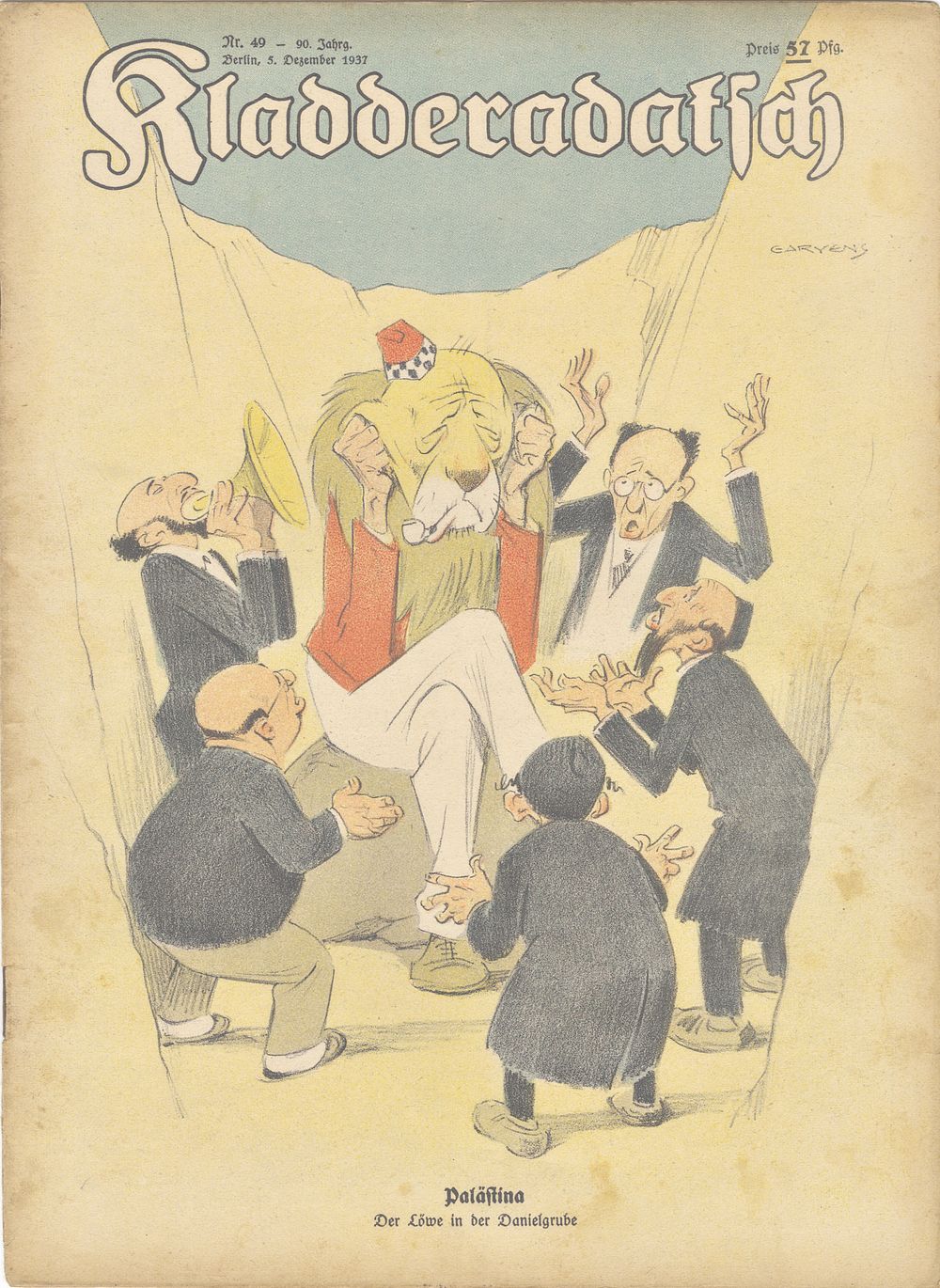
“The Lion in the Jews’ Den” - an antisemitic issue of Kladderadatsch - Berlin, 1937 - color illustrations - “The Lion in the Jews’ Den” - an issue of the illustrated antisemitic journal Kladderadatsch [a humorous, meaningless word, akin to “nonsense” in Hebrew], Berlin, December 5, 1937. On the title page of the issue appears a particularly sharp and biting antisemitic caricature depicting a frightened lion surrounded by Jews. Beneath it appears the antisemitic caption: Palästina - Der Löwe in Danielsgrub “Palestine - The Lion in Daniel’s Pit” - the “poor” lion has fallen into the pit of the Jews, named after the prophet Daniel. According to the biblical story of Daniel in the lions’ den, the illustrator has ‘reversed’ the roles, suggesting that the Jews are so powerful and frightening that they threaten the lion, the king of beasts, while the ‘strong’ lion is the one depicted as miserable and afraid of the Jews in Palestine. On the inner pages appear additional antisemitic caricatures: in one, Jews in a wine tavern are engaged in espionage and in revealing the enemy’s secrets; in another caricature under the title “Armament Madness, ” the Earth is depicted as ill, and one of its “diseases” is the conflicts between Jews and Arabs - on the left, an Arab is seen beating a Jew. Another caricature presents a Jew “informing” on a man hiding weapons, and more. Kladderadatsch was a German-language satirical magazine founded by Albert Hofmann and David Kalisch, which began in Berlin on May 7, 1848, and appeared “daily, except on weekdays.” It was published continuously until 1944 and was considered one of the highest-quality magazines in terms of colored graphics issued in the 19th and early 20th centuries. During the Weimar period, the magazine held a German-nationalist stance. After its takeover by the industrialist Hugo Stinnes in 1923, the magazine came under Nazi control, and its content became increasingly antisemitic. During the Third Reich, and especially after 1933, the paper became a distinctly antisemitic propaganda tool, disseminating racist imagery and expressions of dehumanization toward Jews. The caricatures of this period portrayed Jews with exaggerated physical features, as part of the broader system of public indoctrination aimed at justifying their exclusion, humiliation, and ultimately their destruction. Under the guise of political entertainment, the newspaper served as a powerful instrument in embedding Nazi ideology among the public. [16] pages. 31 cm. Complete issue. Light stains on the cover. Good condition.