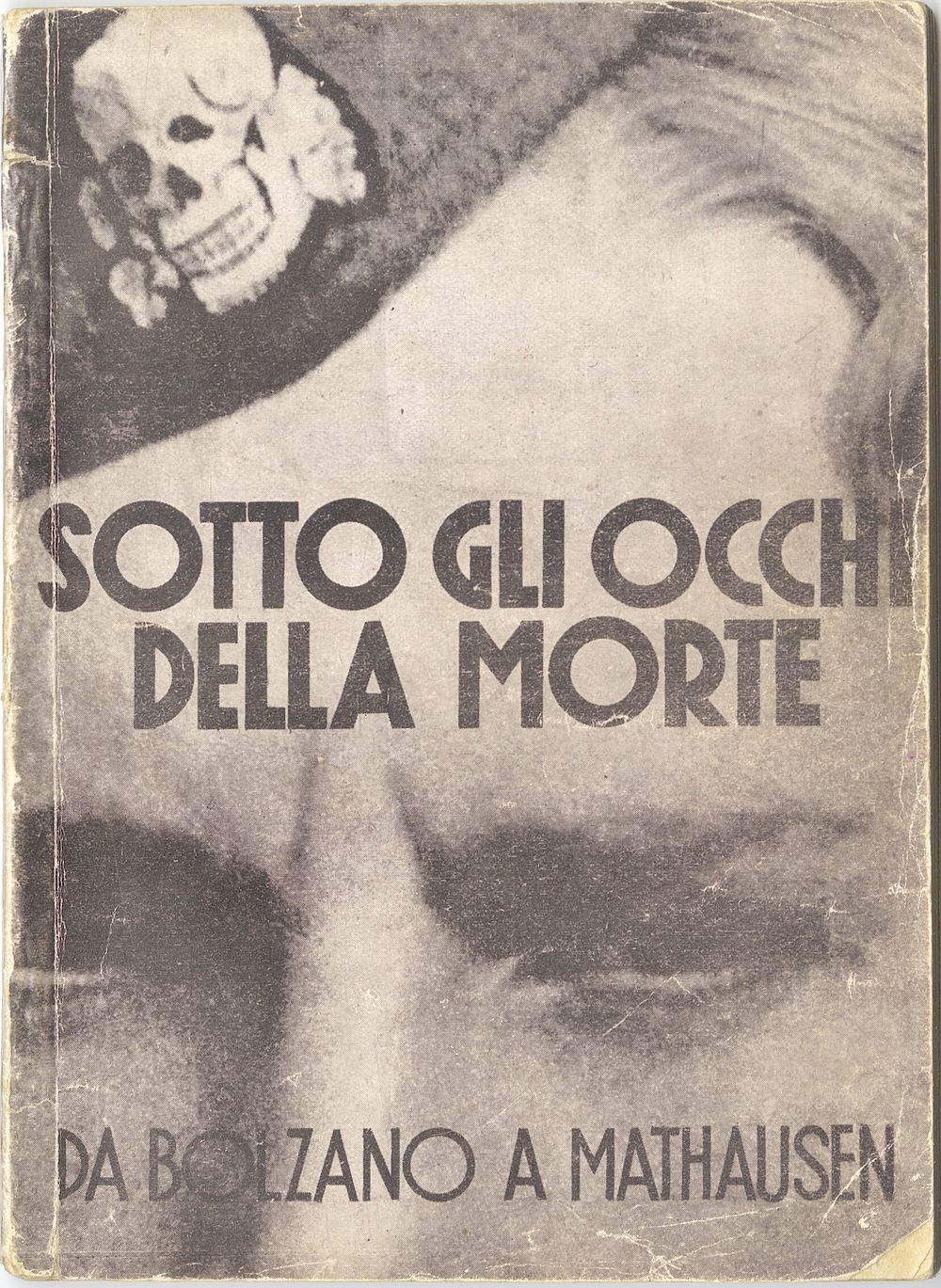
Bidspirit auction | Under the Eyes of Death:
Under the Eyes of Death: From Bolzano to Mauthausen - an early testimony by an Italian prisoner in the Bolzano and Mauthausen camps. Italy 1946 - First edition - Sotto gli occhi della morte Da Bolzano a Mauthausen - Under the Eyes of Death: From Bolzano to Mauthausen, by Aldo Pantozzi - an Italian prisoner who endured hell in the Bolzano and Mauthausen camps and recounts his story shortly after liberation, while still in a cardiac rehabilitation hospital in Bolzano. Published by the Organization for the Support of War Orphans and Victims of Political Persecution in Italy at the end of the war. Bolzano, Italy, 1946 - First edition. Italian. Extremely rare. A documentation of the days of the Italian deportee Aldo Pantozzi during his imprisonment in the Nazi police camp of Bolzano and in the Mauthausen concentration camp during the final months of World War II. While Aldo lay in a cardiac rehabilitation hospital in Bolzano after the war had ended, he set down his memories in writing, in which he describes his experiences over approximately one hundred days - from his arrest in the Bolzano transit camp to his deportation and survival in Mauthausen in the early months of 1945. Pantozzi describes the conditions of his imprisonment, daily life in the camps, the harsh forced labor, the arbitrary violence experienced by him and his companions at the hands of their Nazi commanders, the spread of disease in the camp, and life alongside death, focusing on numerous specific events that reveal the unimaginable cruelty with which prisoners, torn from routine life into a life of hell, were forced to contend. Already upon his arrival in Bolzano, he underwent extremely severe torture, which he describes in detail in his memoir. He was placed in Block E, his hair was shaved, and he and his companions endured systematic starvation for weeks, while each day he underwent exhausting morning and evening roll calls that included sadistic torture and arbitrary killings for minor “offenses” by prisoners. After a short time in the camp, he was transferred together with a group of prisoners on a transport train to the Mauthausen camp, where he was placed in Block No. 1. Upon entering the block, a shocking sight was revealed before his eyes - naked prisoners, utterly exhausted, lying one atop another in crowded conditions on filthy, lice-infested beds. This was the initial shock with which he was forced to contend already on the first day - “The first night in the block seemed endless, ” he writes. From this point, he describes in detail how prisoners were held under extreme conditions of violence, hunger, and forced labor. One of the well-known symbols of the camp was the large quarry, where prisoners were forced to carry heavy stones up steep steps – work carried out under beatings, humiliation, and “games” imposed by the Nazis, and which often ended in death from exhaustion or from falling - the torments endured by the prisoners on the 196 “Stairs of Death” are described by Aldo in detail. He further describes suffering from severe food shortages, extreme cold in winter, and diseases that spread rapidly in the overcrowded barracks. Many were systematically beaten by the guards, punished with various tortures, or executed without trial. Aldo witnessed the execution of many prisoners, as well as the deaths of prisoners who died of dysentery, starvation, and exhaustion. Aldo himself suffered swelling throughout his body due to forced labor and excruciating pain in all his limbs, while the danger of death from starvation loomed as bread rations diminished every few weeks. During his time in the camp, he describes a death rate of 500 prisoners per day! In the yard between Block 1 and Block 2, hundreds of bodies were loaded onto trucks daily out of the camp grounds and were cast onto the ground without burial, sometimes in pouring rain. Prisoners whose strength failed and who were unable to work would walk into those piles of bodies and hide among them, and thus in fact saved their lives. After all the suffering and torture, Aldo managed to survive until the liberation of the camp. The emotion of returning to freedom he describes in his chilling words: “The unexpected and longed-for return, and the feelings and joys of a rebirth that cannot be spoken of. The joyful journey home was interrupted, unfortunately, by the sorrowful lists of our exhausted companions, who could not continue; events that left us in a state of anxiety, skepticism in our own strength, and fear that perhaps we would not reach our longed-for destination. How, then, can I describe the emotion of seeing the Italian flag flying above the Brenner Pass? And the arrival at the aid center for return to the United States in the city of my birth? And the telephone call to my father? And the subdued tears that shaped our quiet conversation? And the meeting, in that same center, with old acquaintances who did not recognize me? And the meeting with my mother,