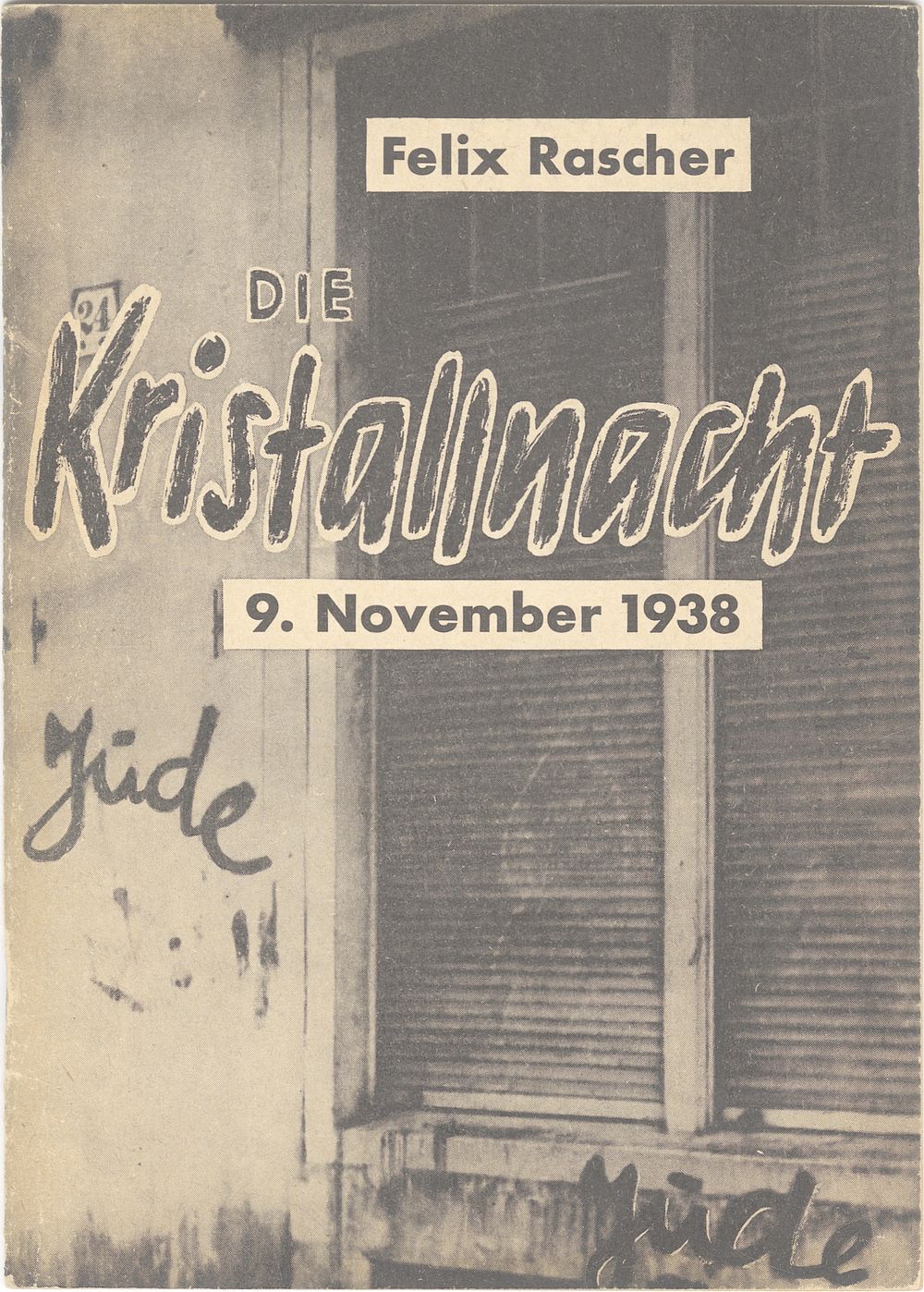
Bidspirit auction | Kristallnacht, November 9, 1938 -
Kristallnacht, November 9, 1938 - An important publication regarding the Kristallnacht pogroms and the role of the district commanders in Germany in inciting the events - Die Kristallnacht. 9. November 1938, “Kristallnacht, November 9, 1938”, by Felix Rascher - An early German publication dealing with the events of Kristallnacht, published by the Federal Executive Committee of the Association of Victims of the Nazi Regime. Frankfurt am Main, 1958 - First edition. German. Rare. An important booklet revealing previously unknown details about the mechanisms and covert processes that led to the Kristallnacht pogroms within the framework of the Nazi regime’s activities. Exposing the role of district administrators in Germany in the Kristallnacht riots, as well as the legal treatment after the war of those who took part in the pogroms against the Jews. The author places indirect blame on the “passive democrats” who did not do enough to prevent Nazi outbreaks that recurred over the years: “From November 1918, the day of the partial seizure of power by the republicans, through Hitler’s operetta-style putsch in that same month in 1923, and up to the complete takeover of Nazism ten years later, a direct political path was traced. A path along which stood far too many passive democrats, opposed by very active enemies of the republic...”, it is written. At the outset, he quotes statements published in the German press on the eve of the outbreak of the pogroms, which most clearly signaled what was to come. Thus, for example, it was written in the Nazi Völkischer Beobachter in November 1938: “It is clear that the German people will draw their conclusions from this latest act. It is an intolerable situation that hundreds of thousands of Jews live within our borders. The shooting at the German embassy in Paris will not only mark the beginning of a new German stance on the Jewish question....”. The author shows how the supposed pretext for the outbreak of the pogroms, in the form of the assassination of the German embassy adviser in Paris, Ernst vom Rath, by Herschel Grynszpan - a 17-year-old Jewish youth—was a well-planned Nazi provocation, and how the “boiling national spirit” was artificially ignited in the cesspool of the Nazi Party. Official reports submitted by the head of the Security Service, Heydrich, to Himmler are cited here, regarding the scope of the destruction of Jewish businesses and homes, as well as the praise that the violent events received in the Nazi press in the days following the events. Likewise, it is described here through several examples how the entire judicial system in Germany was mobilized in favor of the Nazi rioters and against the Jews, and how it deliberately ignored facts well known to it. Murderers of Jews received light sentences, and charges were systematically dismissed. The author presents here nominal lists of Nazi rioters whose criminal acts against Jews on Kristallnacht were beyond doubt, yet who were not punished at all. Likewise, matters are revealed here for the first time that emerged in the trial of Globke and Rasse-Günther in that same year, showing that even after the war they justified the persecution of the Jews and spoke in praise of the Nazi racial laws. In November 1955, an investigating judge at the district court issued an arrest warrant against Ernst Wollerth, a 56-year-old former district leader of the Nazi Party in Mühlhausen (Thuringia), who worked as a pharmacist in Steinach (Upper Franconia) after the war, on charges of breach of the peace and attempted murder. Wollerth played a significant role in the destruction of the Jewish synagogues in Mühlhausen in November 1938. The author describes in detail Wollerth’s crimes on Kristallnacht. Thus, for example, it is described how: “During the campaign against the Jewish population, the Mühlhausen synagogue was attacked, and Rabbi Rosenauer, who lived there with his family, was abused and arrested. That same night, Wollerth decided to shoot Rabbi Rosenauer himself. The rabbi was allegedly placed against a wall for this purpose in the presence of his wife and daughter. Wollerth missed his victim with the first shot; only with the second shot did the rabbi collapse, severely wounded.” The indictment states that Wollerth said: “I will show you what it means to murder a man, you swine, as I am District Leader Wollerth. I swore to kill the first Jew I encounter.” Despite his many crimes, he was sentenced to only two years’ imprisonment at the end of the war. Likewise, the names of several district leaders in Nazi Germany are revealed here, and the crimes they committed against Jews on Kristallnacht are described in detail based on eyewitness accounts and authentic documents. Also in the booklet, a shocking exposure of cases of antisemitism carried out in Germany after the war, such as numerous instances of desecration of Jewish graves committed by Nazis after the war, persecution of Jews in rural areas,