Bidspirit auction | Luba Krugman-Gordus - The Death
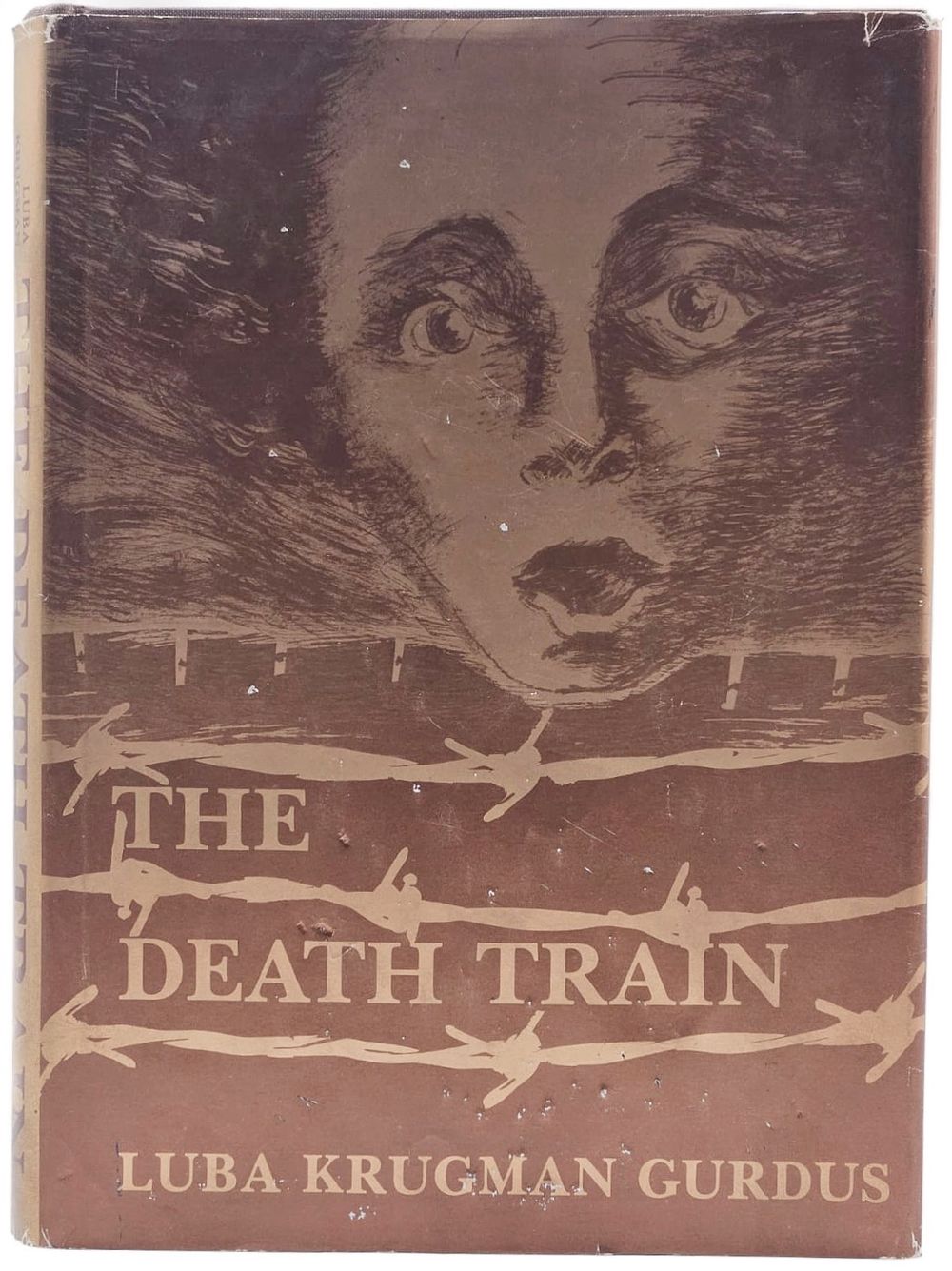
Luba Krugman-Gordus - The Death Train: A Personal Story of a Holocaust Survivor - First Edition - Dedicated and signed copy by the author - The Death Train: A Personal Account of a Holocaust Survivor - Rakevet Hamavet: Sipur Ishi shel Nitzolat Shoah, by Luba Krugman-Gordus. Published by The National Council on Art in Jewish Life. New York 1978 - First Edition. Dedicated and signed copy by the author. The well-known book by Luba Krugman documenting her suffering and that of her family during the years of the Holocaust. The author, a survivor of the Majdanek concentration camp, describes the life of her terror-stricken family, the painful separations, deportations, and death. The family, forced to wander from place to place due to Nazi persecution, finds temporary refuge in a small village near the road leading from Lublin to Belzec. From the windows of their home, one can see the railway tracks upon which the infamous death trains travel, carrying their human cargo to the extermination camp in Belzec. Krugman’s life journey during the war years is described here in great detail, with extensive reference to the fate of the Jews with whom she stayed during her wanderings and in the camps. The book contains particularly harsh descriptions documenting Jewish suffering during the Holocaust - the impossible conditions on the death trains, the screams of the tortured, harrowing scenes of children being separated from their parents, children hiding in forests, the suffering of the Jews in Majdanek, the selection, executions of Jews discovered in hiding places, the cruelty of the kapos toward the Jewish prisoners, hunger, and more. In addition to a vivid description of those years, the author addresses fateful questions such as why Poland became the central arena for the ”Final Solution of the Jewish Question, ” how Nazi deception led six million Jews to their deaths, who survived the mass murder and how, and more. The book is accompanied throughout by illustrations documenting scenes of horror, created by the author herself. Dr. Luba Krugman (Krugman), later Krugman-Gordus, was born on August 1, 1914, in Bialystok, Poland, to her Jewish parents, Tuvia and Anna Krugman. The family moved at an early stage to Warsaw, where she grew up. In 1930 she traveled to Switzerland and studied at an art school in Lausanne. A year later she continued her studies in Germany, studying in Berlin at the Academy of Fine Arts and at the School of Applied Arts. With Adolf Hitler’s rise to power in 1933 and the worsening anti-Jewish atmosphere in Germany, Krugman returned to Warsaw. In this city she integrated into the world of publishing and art, serving as an editor and illustrator at the “Blushek” publishing house. In 1935 she married Yaakov Gordus, and later began working at the “Stybel” publishing house owned by her brother-in-law, Avraham Yosef Stybel. The couple had a son, Robert-Michael, on August 24, 1938, in Warsaw. With the invasion of Nazi Germany into Poland on September 1, 1939, and the occupation of Warsaw on the 29th of that month, a sharp deterioration began in the condition of the city’s Jews. On November 23 of that year, Jews were required to wear white armbands bearing a blue Star of David in order to mark and separate them from the general population. Jewish educational institutions were closed, Jewish property was confiscated, and Jewish men were conscripted for forced labor. In the autumn of 1939, Krugman, her family, and the rest of Warsaw’s Jews were imprisoned in the walled ghetto. Living conditions in the ghetto were extremely harsh: severe shortages of food, overcrowding, and diseases that spread rapidly. By December 1941, Krugman, together with her son Robert-Michael, moved to the Lublin region, first to Brody Male and later to Zwierzyniec. On September 12, 1942, her son died of diphtheria, and during this period her parents also perished. She was later imprisoned in the Majdanek concentration camp. With the end of World War II in May 1945, Krugman survived the camp period. In 1946 she immigrated with her younger sister Mira to Eretz Israel. In the country, she worked at the “Yediot” publishing house and was among the initiators of the women’s magazine “LaIsha.” At the same time, she resumed her artistic activity and began creating a series of drawings depicting her experiences during the Holocaust; these works were exhibited in Israel and later also in the United States. In 1948 she sailed to New York aboard the ship Marine Carp and arrived there on January 7. In the United States she renewed her connections with the Stybel publishing house. During the war years she had been separated from her husband, Yaakov Gordus, who served in a Jewish unit within the Eighth Army of the British Army. In 1962, Krugman-Gordus received a doctorate in art history from New York University. Luba Krugman-Gordus passed away on December 6, 2011, at the age of 97.