Bidspirit auction | Our Struggle Against the Third
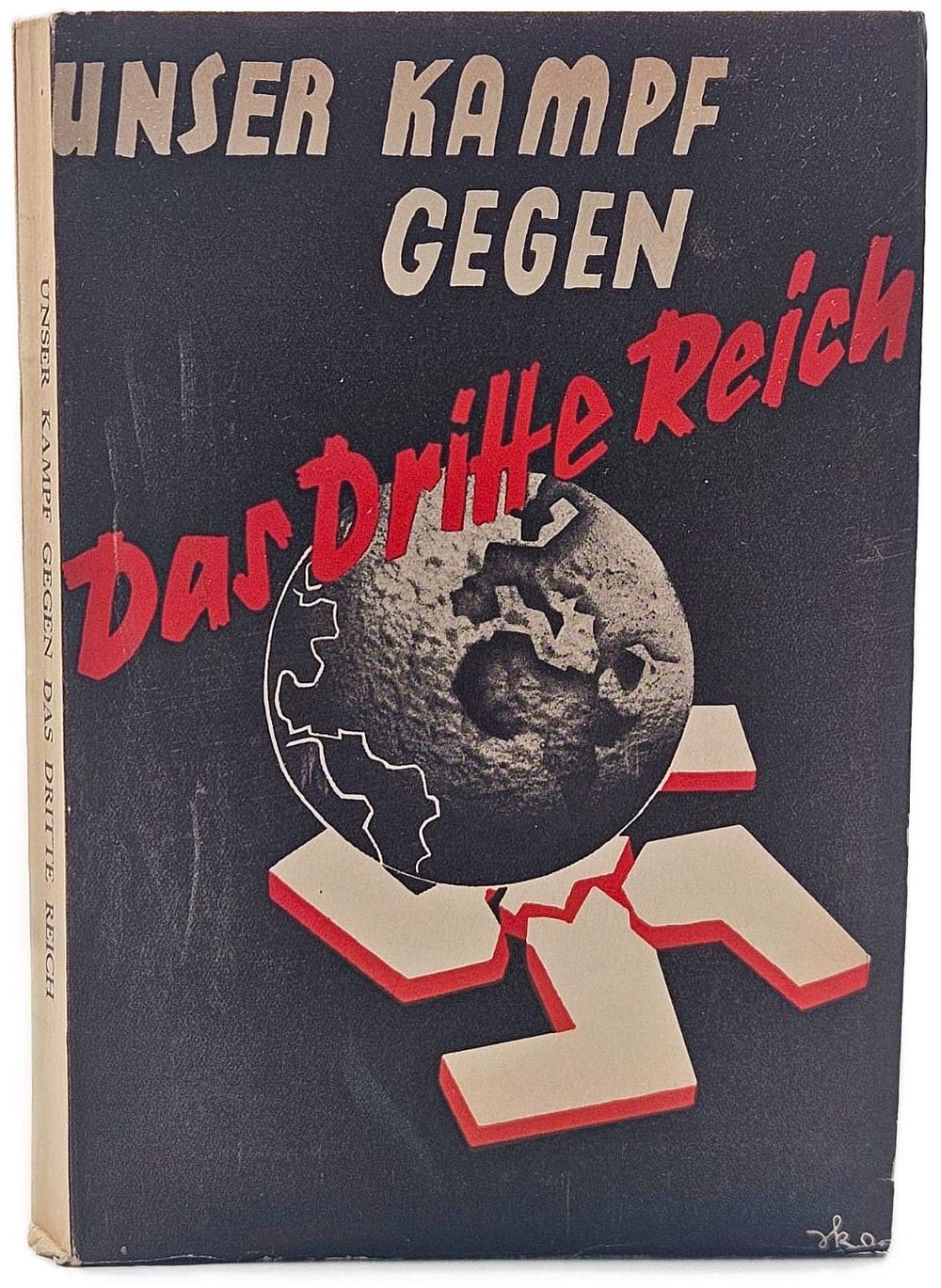
Our Struggle Against the Third Reich - Max Sievers, the man who warned of the danger of Nazism and was executed by guillotine. Stockholm, 1939 - First Edition - Unser Kampf gegen das Dritte Reich: Von der nationalsozialistischen Diktatur zur sozialistischen Demokratie - “Our Struggle Against the Third Reich: From the National Socialist Dictatorship to Socialist Democracy, ” by Max Sievers. Published by Axel Holmströms Förlag. Stockholm 1939 - First Edition. A courageous publication against Nazi Germany by a man who was forced into exile because of his oppositional views. He exposes in real time the disaster brought upon Germany by Hitler and Göring, as these words were written on the eve of the outbreak of World War II. Sievers was the man who warned of the danger of Nazism, was captured toward the end of the war by Gestapo agents, and was executed by beheading with a guillotine. An early political-propagandistic work directed against the Nazi regime. In it, Sievers describes the methods of deception that led to the rise of Nazism to power, the suppression of the opposition, and the collapse of democracy in the Weimar Republic. The title of the book, “Unser Kampf” (“Our Struggle”), was chosen deliberately as a direct and intentional provocation against Hitler’s book “Mein Kampf”: “Who rules Germany?... An enormous amount of power has been placed in the hands of Hitler and Göring. This power exceeds almost everything that was previously considered possible within the exercise of dictatorial authority. Therefore, it is quite understandable, and not entirely incorrect, that the answer to the question posed above is: Hitler and Göring rule Germany.” The author describes in detail the persecution of the opposition by the Nazi Party and its methods of operation behind the scenes: “During six years of Nazi rule, more than half a million people were imprisoned in prisons, jails, and concentration camps, and day after day new arrests and convictions were carried out; yet despite all this, centers of opposition were repeatedly dismantled, the illegal struggle continued, and the dictatorship was forced to impose new restrictions on personal freedom because the old ones proved insufficient.” He explains the extent to which the dictatorial regime in Germany was detrimental to the German economy, and how Hitler completely destroyed the entire structure of the army and the judicial systems in Germany. Alongside his sharp criticism of the Nazi dictatorship and the way it degraded Germany, he presents a political vision for Germany’s future based on principles of socialist democracy and a freer society after the fall of the regime, and outlines in broad and fairly accurate terms the developmental trends that might shape Germany following the defeat of the Nazi dictatorship. The author believed that: “The chance for a free Germany in the future exists only when the people themselves muster the strength to overthrow the Nazi dictatorship from within.” (from the introduction). The publication of the book outside Germany stemmed from the fact that its author was a fierce opponent of the Nazi regime and was forced to operate in exile after Hitler’s rise to power in 1933. Fearing for his life even while in exile, he refrained from providing details about the number of German “exiles, ” their names, or their locations, out of concern that they might be captured by collaborators with Nazi Germany outside its borders. The author was closely familiar with the Nazi regime, and even more so with its fragility. As stated at the beginning of the book: “For nearly six years, Germany has been ruled under the symbol of the swastika - a regime that lives under the illusion that all the problems of social life can be solved by violence, and whose ideology turns the cult of violence into a religion.” Based on what he knew of Nazi Germany, he was able to accurately foresee the destructive nature of the war that was about to break out: “People know that the war will turn Europe into a desert; they know that everything will be lost and nothing gained, and they accept this as self-evident, as a fatal necessity from which there is no escape.” In the second part of the book, he outlines a better future for Germany, if only it would succeed in casting off the Nazi dictatorship. Max Sievers (1887–1944), a German journalist and political activist, identified with the free-thought secular movement and with the democratic left in Weimar Republic Germany. He headed the Deutscher Freidenker-Verband—an organization of “free thinkers” that worked to promote secularism, freedom of conscience, and opposition to the political influence of religious institutions. After the Nazi takeover of Germany, the organizations in which he was active were banned, and he fled abroad, continuing his political activity and anti-Nazi writing in exile. Sievers’s own fate was tragic.