Bidspirit auction | A horrifying photograph of Jews
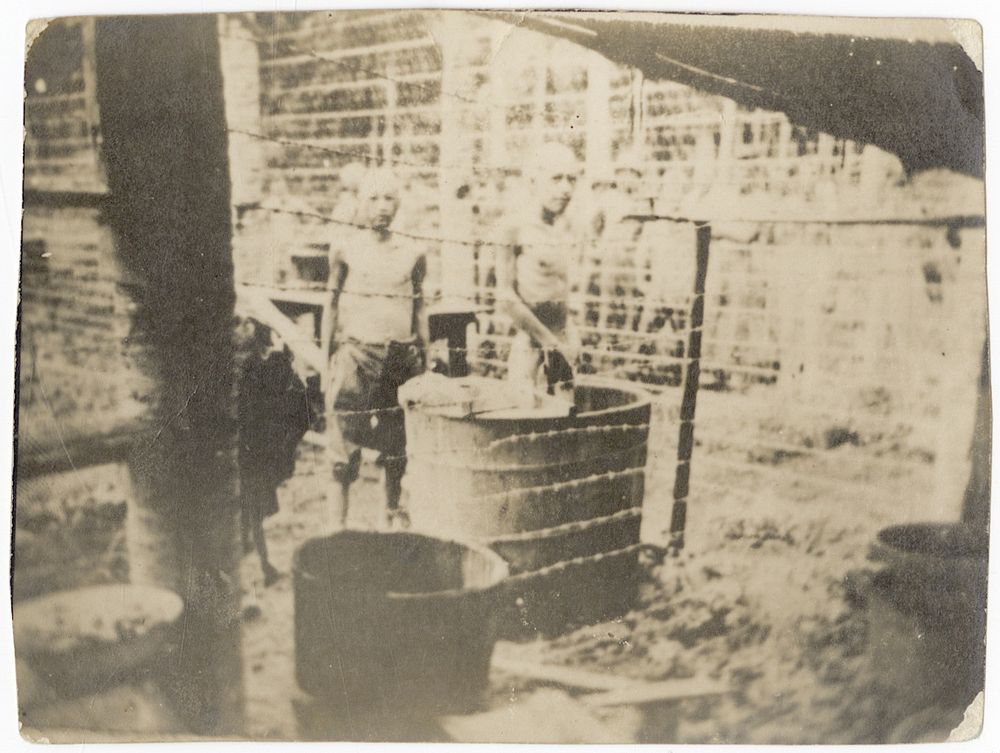
A horrifying photograph of Jews in the Dachau death camp - August 1944 - An extremely rare photograph showing emaciated Jewish prisoners in the area of the “farm building” of the Dachau death camp. August 1944. Described on its verso in handwritten German: “Juden im Wirthſchaftsgebäude des Konzentrationslagers Dachau Aug. 1944” - “Jews in the farm building of the Dachau camp, August 1944.” Photographed by the Nazi camp photography unit. Three starved and severely emaciated Jewish prisoners are seen in the foreground of the photograph (one appears bent over, concealed behind the ladder) in the “farm building” - the area in the camp that served as a kitchen, clothing storage, laundry, and also housed the workshops and the camp administration. The three were apparently photographed while doing laundry. Photographs of Jewish prisoners in Dachau while it was in operation are extremely rare. In August 1944, the typhus epidemic and starvation claimed the lives of thousands of prisoners. During these months of 1944, the number of prisoners in the camp reached its peak with the arrival of transports of Jews from evacuated extermination camps in the East, and the overcrowding led to an increase in the mortality rate. This was the late stage of the war, when the Nazi concentration camp system was under immense pressure due to the advance of the Allies and the transfer of prisoners from other camps. Following the evacuation of camps in Eastern Europe, tens of thousands of new prisoners arrived at Dachau, many of them Jews from Hungary, Poland, and Lithuania. In August 1944, there were more than 60,000 prisoners in Dachau and its subcamps, with the number of Jews rising significantly compared to previous years. Many Jews were transferred to the camp after the liquidation of ghettos and camps in Poland and Hungary. They lived there under extreme overcrowding in the barracks, sometimes hundreds of prisoners in a barrack intended for only dozens. Food rations were minimal and insufficient for basic survival. There was a shortage of water, and they suffered from lice and disease. Many died as a result of forced labor, primarily in the German armaments industry in Dachau’s subcamps - where Jewish prisoners were assigned to the hardest labor, were more exposed to violence from the SS and kapos, and suffered more than others from particularly high mortality rates due to starvation, disease, and abuse; the rate of suicides also increased significantly. In the months that followed, the number of prisoners continued to grow even further due to death marches from other camps. The camp was liberated by the American army on April 29, 1945, when tens of thousands of Jews were still found there alive, many of them in very poor health. 11.5x8.5 cm. Good condition.