Bidspirit auction | ”To My Dear Gloria” –
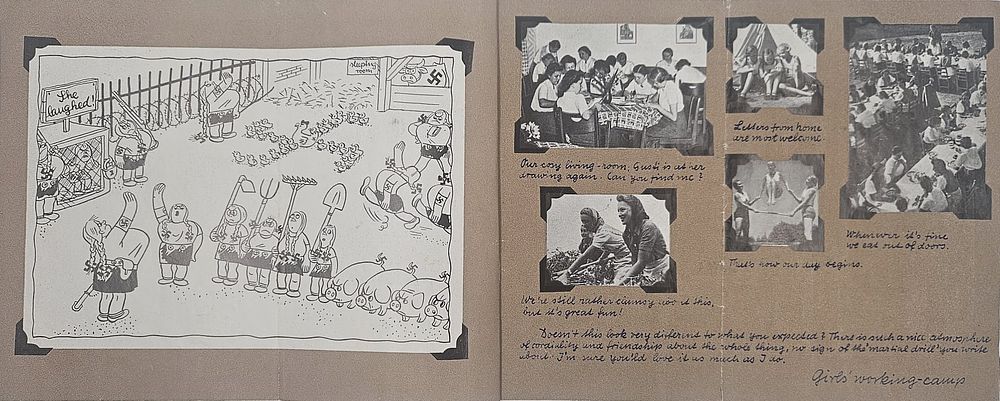
”To My Dear Gloria” – sophisticated propaganda designed to sanitize Nazi Germany’s image, in the form of an illustrated photo album - To My Dear Gloria. A Nazi propaganda album in the form of a photographic correspondence between two girls – one German and one American, intended to present life in Nazi Germany as ideal, in contrast to the way it was portrayed by the Allies. A rare example of messages directed by Nazi propaganda to audiences outside Germany, aiming to present life in Nazi Germany as that of a normal, flourishing state in every respect, concerned for the welfare of its citizens. Nazi Germany, no publisher stated. [1941]. English. Extremely rare. The photo album, titled ”To My Dear Gloria, ” was ostensibly sent by a German girl named Hedwig to her American friend Gloria, with the aim of refuting the way the Allies portrayed what was taking place in Nazi Germany. At the opening of the album, Hedwig “addresses” Gloria: ”My dear Gloria, I was very happy to hear from you!... We were quite astonished at your description of our life here as you imagine it. Who on earth could have given you such strange ideas? One of the girls here, Gusti – a wonderful friend of mine – was kind enough to draw a few pictures of our life in Germany as you see it in the United States. We pasted all these caricatures into a small album, and I am sending you some pictures so that you may see exactly how things are here.” The “album, ” printed in the form of a real photograph album with captions alongside the images, presents at the opening of every double-page spread, on the left, a caricature distributed by the Allies as part of an anti-Nazi postcard series issued in the 1930s, and on the right, the “real life” in Germany through “authentic” black-and-white photographs showing German civilians and uniformed personnel engaged in enjoyable social and work activities in a flourishing Germany. Through this contrast, the booklet attempts to “refute” the threatening image in which Germany was presented by the Allies, by offering a portrayal of normality, family life, and social order during the war. For example, alongside a caricature depicting a girls’ labor camp enclosed in barbed wire and comparing German girls to pigs, photographs are presented documenting “our cozy living room, ” with the description: “Doesn’t this look very different from what you expected? There is such a pleasant atmosphere of warmth and companionship about the whole thing; there is no trace of the drill you write about. I am sure you would love it as much as I do.” Another page presents a caricature of life in the Hitler Youth, in which an instructor strikes a young boy with his fist, alongside “authentic” photographs showing cheerful and happy boys engaged in social activities, with the description: “Fritchen sent me these pictures not long ago. You can see what a good time he is having. He is crazy about camping, and simply enjoys being in the Hitler Youth in any case. If he could read your letter, he would have a good laugh.” Further on, alongside a caricature depicting German children being taken from their parents and stamped with swastikas on their bodies on a conveyor belt for the benefit of the Nazi state, the booklet presents photographs of community activities of “Mother and Child” in Germany, with the description: “They take such good care of the babies all day, and mother can rest completely from the household and the noise.” A caricature depicting the harsh working conditions in German factories is countered by photographs from factory halls: “Bright and well-ventilated rooms make the work far less strenuous, ” along with an idealized story of a German worker who, due to the excellent working conditions, has no desire to go home on leave. On another page appears a caricature in which a Nazi soldier forces Germans to provide money for the economy; beside it are photographs documenting the Germans’ desire to contribute to the national effort in the form of cheerful street collections in which everyone takes part. Alongside a caricature depicting a German “holiday resort” in which vacationers are threatened by cannons, the booklet presents photographs from various leisure events in which everyone is enjoying themselves, with the description: “Our social institutions are a great source of pride for us, and we cannot imagine how anyone could obtain such a distorted picture of them.” Finally, on the last page, the album’s conclusion: “It seems my letter has become long, but I am sure these pictures will give you a much better idea of things than any description I could provide. There was so much I wanted to tell you, dear Gloria, but I am afraid I must finish now, as our gymnastics class will begin in less than five minutes, and I do not want to miss it. Please write back to me soon. Much love to you and your family. From all of us, my dear, Hedwig.” Extremely rare. Only a few copies of the booklet are known worldwide.