Bidspirit auction | ”The Time of Our Freedom
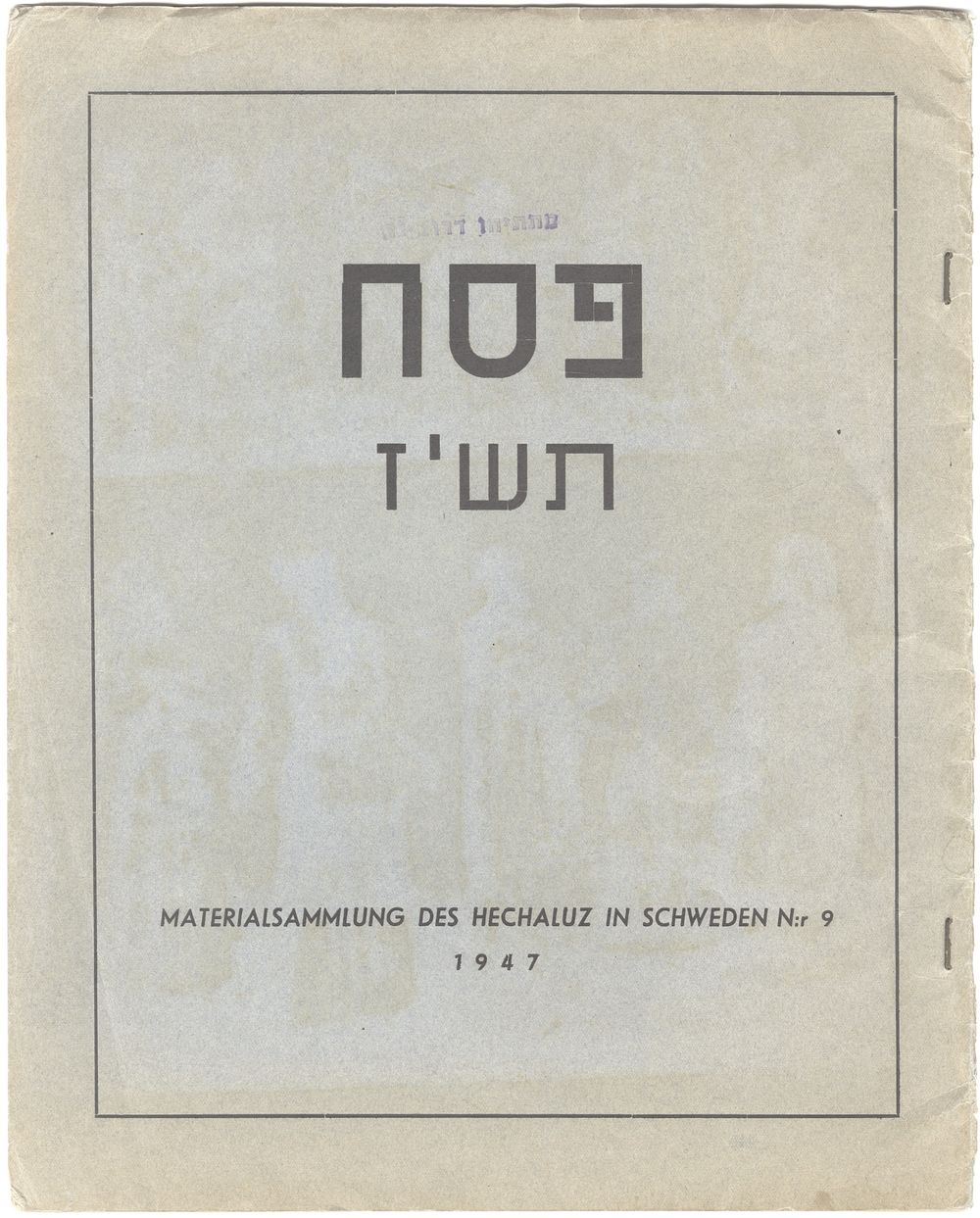
”The Time of Our Freedom – Passover” – a special booklet published for the Passover holiday by HeHalutz in Sweden – 1947 - Zeman Herutenu - ”The Time of Our Freedom – Passover” – a special booklet published for the Passover holiday by HeHalutz in Sweden – 1947. Reading passages written by youths in the ”HeHalutz” movement on themes from the Haggadah, with excerpts from the Passover Haggadah. German, Yiddish, and Hebrew. The booklet opens with passages describing the Exodus from Egypt and the journey through the desert to the Promised Land, written by youths of the ”HeHalutz” movement. Subsequently, under the heading ”Mesubin, ” appears a story about a boy named Michael and the special way in which he celebrated the Seder night with his family. This is followed by reading passages dealing with the ”Simanim” of the Seder night, on the Passover holiday in the Diaspora and in Eretz Israel. Further on, under the heading ”Titchadesh, ” appears an interesting story about a tailor who sewed a suit for a poor boy in honor of Passover, a story about Passover in a remote Jewish village, ”Pesach Zeit” on ”the Time of Our Freedom.” Under the heading ”Towards Freedom” appears Bialik’s poem ”Henenu VeAlinu.” The story ”LaNegev” about the cultivation of the Negev by Jewish settlers, the song ”Echad Mi Yodea” appears in a version dealing with life in the Diaspora and immigration to Eretz Israel, titled ”Eleven -Who Knows, ” and finally the booklet concludes with the passage ”Eliyahu Ba, ” dealing with the redemption of Israel. The activity of the ”HeHalutz” movement in Sweden in 1947 constitutes a unique chapter in the history of revival, in which the northern and neutral country became a logistical and spiritual crossroads for Holocaust survivors on their way to Eretz Israel. In that year, the movement focused on establishing and operating agricultural and vocational training farms for survivors who were beginning their new lives after the war; in these farms, alongside practical training in agricultural and manual labor, great emphasis was placed on emotional rehabilitation, the imparting of the Hebrew language, and ideological education in preparation for immigration. Beyond the educational aspect, Sweden served in 1947 as a strategic rear base for the Mossad LeAliyah Bet, as activists of ”HeHalutz” and the movement’s center in Stockholm managed an extensive network of connections for acquiring ships and coordinating the movement of refugees from Germany and Northern Europe southward toward Mediterranean ports. The presence of emissaries from Eretz Israel in Sweden at that time created a living bridge between the struggling Yishuv and the surviving remnant, turning Sweden into a vital transit station where the determination to reach the shores of the country, despite the British blockade, took shape - transforming personal despair into a shared national vision. 28 pages. 29 cm. good - very good condition.