Bidspirit auction | Hitler Attacks Norway - Early
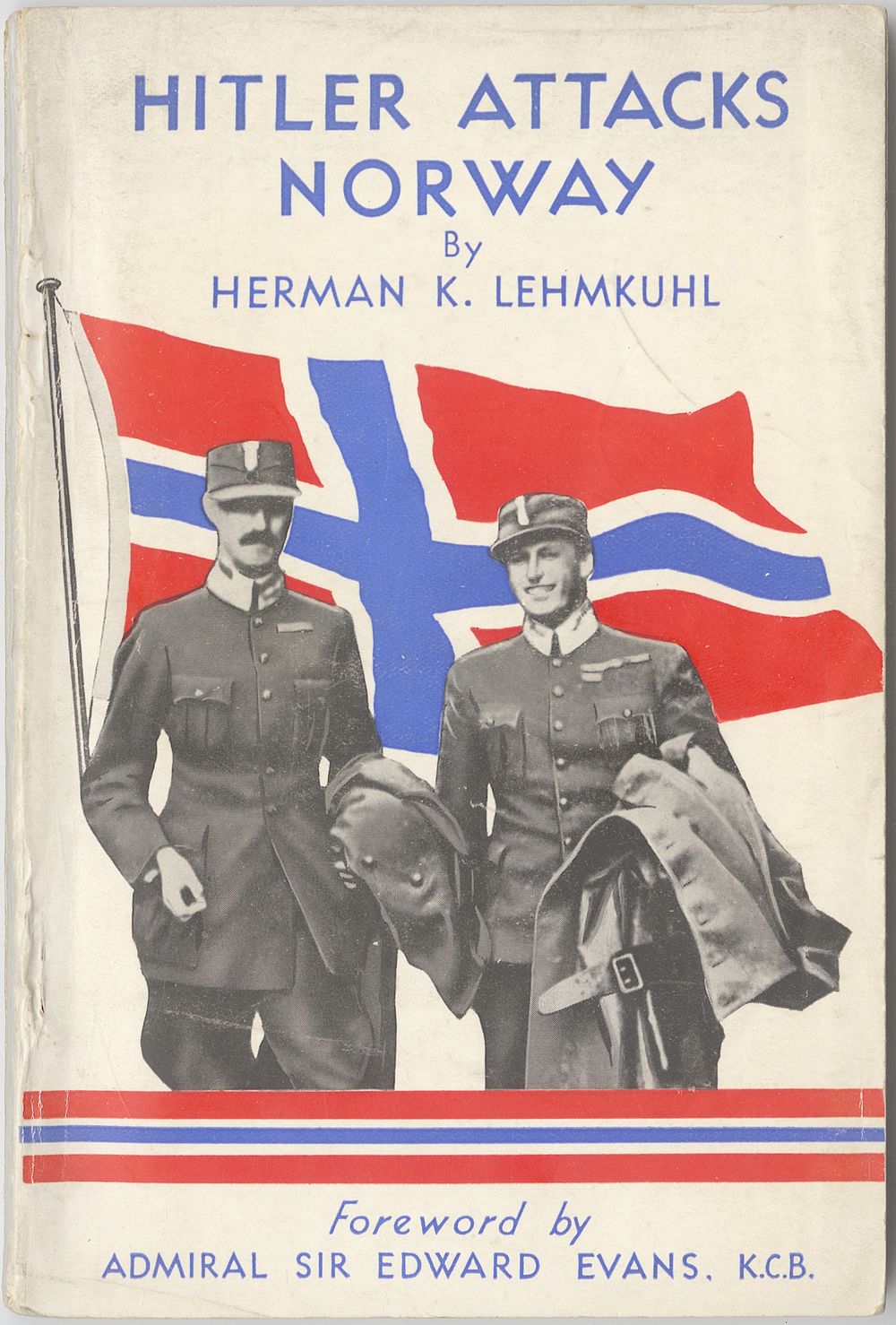
Hitler Attacks Norway - Early real-time publication on the Nazi occupation of Norway - London, 1943 - First edition - Hitler Attacks Norway - by Herman K. Lehmkuhl. On Norway’s attempt to repel the Nazi enemy - written in the midst of the war. Published by The Royal Norwegian Government Information Office, London, 1943 - First edition. Extremely rare. “Today, we Britons come into contact with exiles and those who have fled from Norway. Their stories are shocking; their accounts make one feel that even the terms of an armistice with Germany must not be considered until every hated Nazi - every German man, woman, and child - has left the northern land and every Quisling has been killed… Norway will not despair. How could it? When its hero - the King and his loyal and steadfast government, and the sailors, soldiers, and airmen - will never cease in their efforts to help their oppressed countrymen and to advance the cause of the Allies.” An important publication written in the midst of the war, intended to explain to the British and international public the course of events in Norway in real time under Nazi occupation, and to emphasize the efforts of the Norwegian army and people in the face of Nazi aggression. The book also contains extensive early documentation of the Norwegian campaign, which began on April 9, 1940 under the code name “Operation Weserübung, ” and is considered one of the most daring and complex operations carried out by the Wehrmacht, as it involved a coordinated and simultaneous assault by land, sea, and air forces. “The attack was well planned. German agents in various disguises assisted in the preparations. All kinds of stratagems were employed. Military supplies, even troops, were smuggled in advance into several of the attacked ports, hidden in the holds of ordinary merchant ships. Within less than 12 hours, the Germans controlled Oslo and all the most important ports - Kristiansand, Arendal, Egersund, Stavanger, Bergen, Trondheim, and Narvik; they seized all the airfields; and within a few days all railway connections with Sweden were in their hands. The attack on Norway was as cunning and as ruthless as any attack in history…” (from the book). The book describes in detail how, by 1943, the Norwegian resistance had developed into a sophisticated military force known as “Milorg.” Members of the underground, operating under extreme mountainous conditions and under constant threat from the Gestapo, established intelligence networks that provided the British with vital information on the movements of German warships in the fjords. The book closely describes how, by 1943, the Norwegian resistance had matured into a sophisticated military force known as “Milorg.” Members of the underground, who operated under extreme mountainous conditions and under constant terror from the Gestapo, established intelligence networks that provided the British with vital information on the movements of German warships in the fjords. The Norwegian response to the Nazi invasion and occupation up to 1943 was characterized by a rapid transition from initial military shock to a multi-layered struggle combining frontline combat, government-in-exile activity, and steadfast civilian resistance, all of which are described in the book. With the evacuation of Allied forces and the surrender of the army in June 1940, the center of gravity shifted to London and to the local underground. The King and the government-in-exile refused to recognize the legitimacy of the Quisling regime and turned London into the nerve center of the fighting Norwegian state, where they established an information apparatus aimed at maintaining civilian morale at home and strengthening international recognition of the justice of their cause. Within Norway itself, civilian resistance was unprecedented; teachers, clergy, and professionals conducted strikes and quiet protests against Nazi attempts to infiltrate the education and religious systems, while the Norwegian merchant fleet - one of the largest in the world at the time - was almost entirely mobilized for the Allied cause and became a critical strategic asset in the Battle of the Atlantic. Herman K. Lehmkuhl was a Norwegian journalist who served as a public relations officer for the Norwegian government-in-exile in London. The book includes a foreword by Admiral Sir Edward Evans, a senior British military figure involved in efforts to assist Norway. The foreword was written by Admiral Sir Edward Evans, “K.C.B.” (Knight Commander of the Order of the Bath). On the back cover is a color map of the occupations. Extremely rare. Only one copy is recorded in the WorldCat global library catalog, in a library in Leipzig, Germany. 99 [1] pages. Good - very good condition.