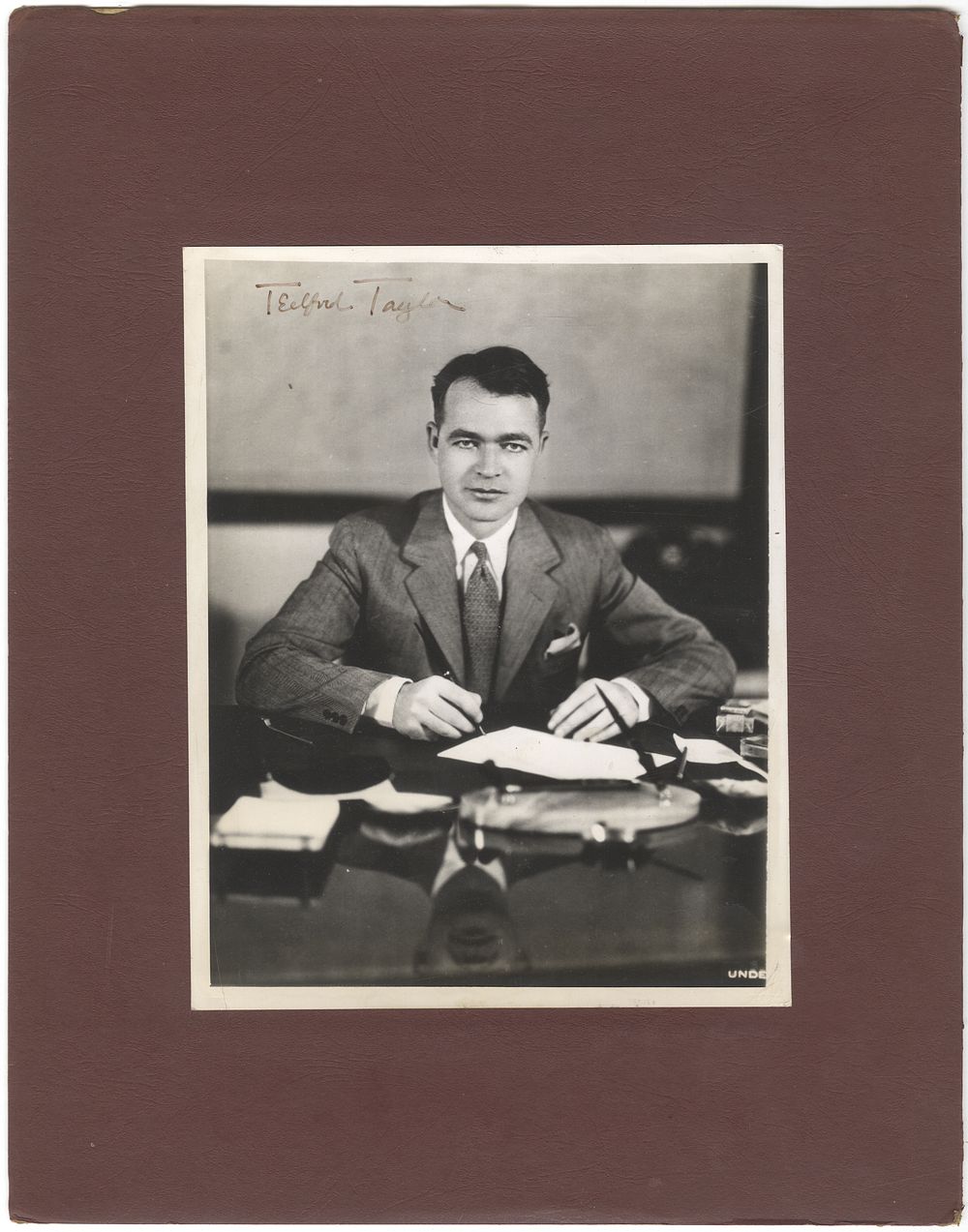
Bidspirit auction | Early photograph of the Chief
Early photograph of the Chief Prosecutor at the Nuremberg Trials - Telford Taylor - signed - Early photograph of the Chief Counsel in the prosecution of Nazi war criminals, Telford Taylor, from the period of his service as General Counsel of the Federal Communications Commission. Signed by Taylor at the upper left. Taylor was appointed General Counsel of the Federal Communications Commission in early 1940, when he was only 32 years old - an exceptionally young age for such a senior position - and it was during this period that the present photograph was taken. Taylor concluded his role in June 1942, when he left the Commission to enlist in the United States Army during the Second World War, where he initially served as an intelligence officer before becoming the well-known key figure from the Nuremberg Trials. Telford Taylor [1908–1998] is best known for his role as Chief Counsel in the prosecution of war criminals after the Second World War at the Nuremberg Trials. Taylor served as Chief Counsel for the prosecution in the twelve subsequent Nuremberg Trials, as part of the team of Robert H. Jackson, which helped formulate the London Charter of the International Military Tribunal, forming the legal basis for the Nuremberg Trials. Taylor worked extensively to have the German Army General Staff and the High Command of the Armed Forces recognized as criminal organizations. He regarded the Nuremberg Trials as a success because they established a precedent and defined a legal foundation for crimes against peace and humanity. Taylor was not only a brilliant jurist, but also the moral architect who transformed the Nuremberg Trials from a legal precedent into a universal dictate of conscience. While the main trial focused on the leaders of the regime, Taylor was the one who led the twelve additional trials, מתוך a deep understanding that evil did not operate in a vacuum, but relied on the most professional systems - the Nazi doctors who carried out experiments, the German judges who trampled justice, and the industrialists who financed the machine. In his incisive speeches, he insisted that international law must penetrate the veil of national sovereignty and impose personal responsibility on every individual, regardless of rank. Taylor succeeded in turning vast quantities of documents and forensic evidence into an irrefutable historical narrative, thereby ensuring that memory would not remain merely the testimony of survivors, but would become a definitive legal fact. His intellectual integrity continued to guide him after the war, when he stood as a courageous voice against political persecutions within the United States, מתוך a consistent belief that justice is not the privilege of the victors but an obligation of civilized society. In his later writings, he established the principle that law is not a tool for revenge, but the final safeguard of humanity against barbarism, demonstrating that even within the deepest moral abyss, it is possible to set a standard of justice that will guide future generations. Photograph: 22x18 cm. Mounted on a rigid backing (leather-like): 27x35 cm. Very good condition.