Bidspirit auction | The transfer of the remains
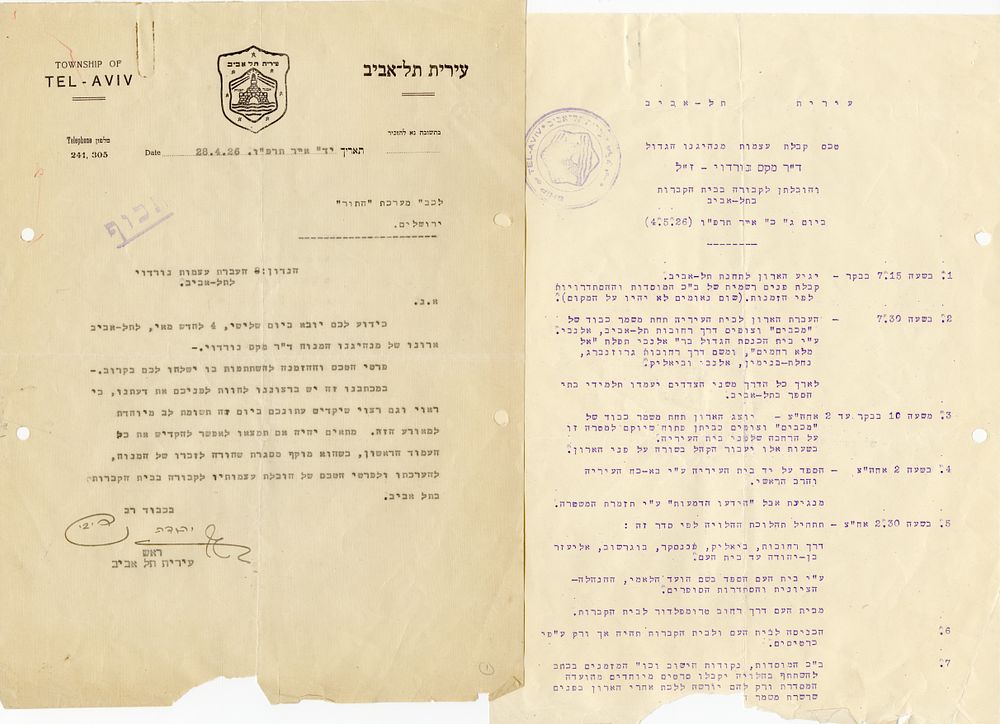
The transfer of the remains of Dr. Max Nordau for burial - a document signed by the Secretary of the City of Tel Aviv and a detailed program of the day of burial - Tel Aviv, 1926 - Two historical documents from the events surrounding the transfer of the coffin of Dr. Max Nordau for burial in the Trumpeldor Cemetery in Tel Aviv. April–May 1926. A letter signed by the Secretary of the City of Tel Aviv, Yehuda Nedivi, to the editorial staff of the newspaper “HaTor, ” ahead of the transfer of Nordau’s remains to Tel Aviv, dated April 28, 1926. In his letter, he requests that the newspaper publish notice of the event (which took place a week later), and specifies: “It would be appropriate if you could devote the entire front page, bordered in black, to the memory of the deceased, in appreciation of him and to the details of the ceremony of conveying his remains for burial in the cemetery in Tel Aviv.” The letter is marked “urgent, ” printed on official City of Tel Aviv letterhead, and signed in his own hand. Filing holes. Good condition. The official program of the “Ceremony for the Reception of the Remains of our great leader Dr. Max Nordau, of blessed memory, and their conveyance for burial in the cemetery in Tel Aviv on Tuesday, 20 Iyar 1926 (May 4, 1926).” The program details the timetable of the event; among other things, it specifies that the coffin will be accompanied by an honor guard of “Maccabim” and scouts, and lists the streets of Tel Aviv through which the coffin will pass. Thereafter, following eulogies in the presence of the Chief Rabbi and the Mayor, the funeral procession will proceed to Beit Ha’am, and from there to burial in the Trumpeldor Cemetery. “Entry to Beit Ha’am and to the cemetery will be by ticket only.” [1] leaf. Trimmed at the lower part with slight loss to the final line. Filing holes. Good condition. Max Nordau – one of the founders of the Zionist movement and the right-hand man of Theodor Herzl – died in 1923 while visiting Paris, leaving behind his wife, Anna-Elizabeth Dons, and their daughter, Maxa. Alexander Marmorek, his colleague in the Zionist movement for some twenty-five years, obtained the consent of Nordau’s wife for a funeral and burial according to Jewish law, and he was buried on Sunday, January 28, 1923, in the Jewish section of the Montparnasse Cemetery in Paris. None of the members of the Zionist Executive attended the funeral, and the leadership sufficed with a telegram of condolences and speeches delivered at memorial assemblies in Berlin and London. At that time, the leaders of the World Zionist Organization discussed proposals to transfer the remains of Zionist leaders who had died and been buried abroad, but Nordau was not included on the list. In the biography written by Nordau’s wife and daughter, they noted that his friend Meir Dizengoff requested to bring Nordau’s remains for burial in Tel Aviv, arguing that Nordau saw Tel Aviv as a symbol of the future urban life in the “new-old land, ” and that he had expressed his wish to live in Tel Aviv during the winter months and reside in Paris in the summer. The family agreed, and in 1926 his remains were brought for burial in Eretz Israel at the Trumpeldor Cemetery in Tel Aviv, as described in the documents before us. The signatory of the document, Yehuda Nedivi (Frankel) [1899–1981], was among the members of the Second Aliyah. He was the right-hand man of Meir Dizengoff in handling the evacuees of Tel Aviv during World War I. He served as Secretary of the Tel Aviv Municipality for 40 years and was honored as a distinguished citizen of Tel Aviv–Jaffa. Among other roles, he was sent, with the support of Pinhas Rutenberg, to London to persuade the British to establish the planned airport near Tel Aviv. During World War II, he volunteered for the British Army and served as a liaison officer, with the rank of captain, between the British command and the volunteers for the British Army. In 1946, he was discharged and returned to his position in the Tel Aviv Municipality.