Bidspirit auction | The Address of Chaim Weizmann
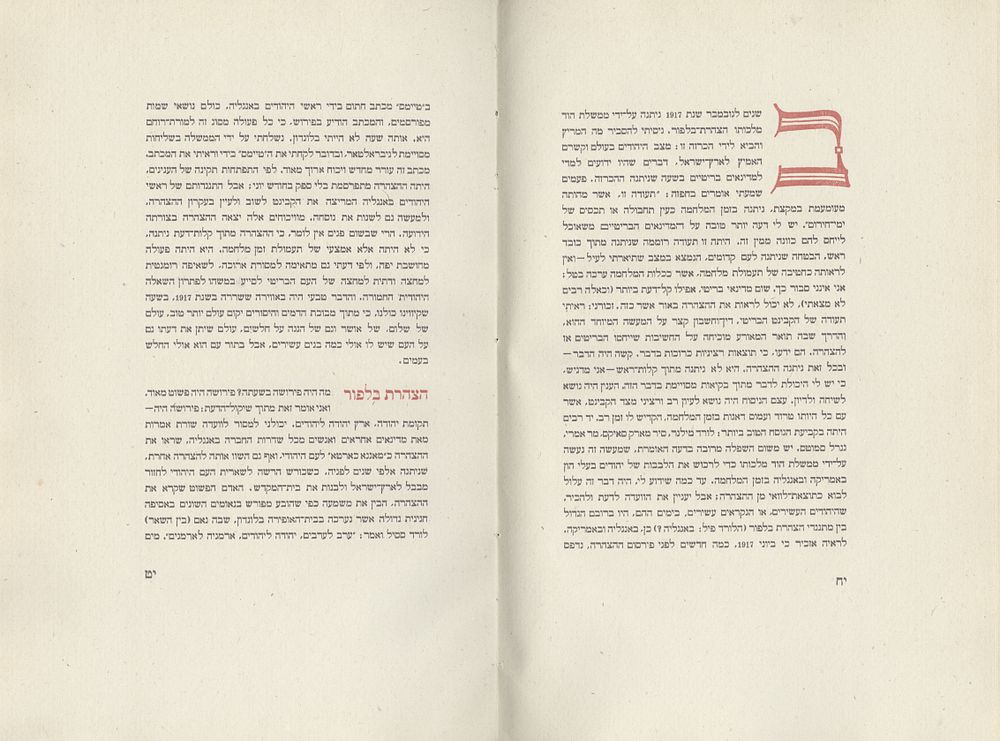
The Address of Chaim Weizmann before the Royal Commission for Palestine - a limited edition of 300 copies - The Address of Chaim Weizmann before the Royal Commission for Palestine on 11 Kislev 1936 in Jerusalem. Bialik Institute Publishing, Jerusalem, 1945. Printed in 300 numbered copies on thick, high-quality paper produced in Eretz Israel. Black and red ink. This copy is number 11. A special printing of Weizmann’s address as delivered before the British Commission. Weizmann appeared before the Commission on 11 Kislev 1936 (November 1936), and in his remarks presented a clear Zionist line, yet also a highly realistic one. He emphasized first and foremost the plight of the Jews in Europe, especially following the rise of the Nazis, arguing that the Jewish problem was not theoretical but urgent and existential. One of the well-known statements reflecting the spirit of his words was that “there are places in the world where Jews cannot live, and places where they cannot enter” – a sharp description of the condition of Jewish refugees at that time. He presented Eretz Israel as the only solution of historical and national significance for the Jewish people, emphasizing the deep historical connection of the Jewish people to the land. At the same time, he sought to persuade the British that the Zionist enterprise also benefited the Arab population – through economic development, agriculture, industry, and infrastructure. Weizmann did not ignore the conflict with the Arabs, but argued that this was not a conflict between equals in national-historical terms, but rather a process of Jewish national construction taking place alongside a broader Arab population in the region. He also hinted at a willingness for political compromise, provided that a genuine foundation for a Jewish national home would be secured. This testimony was among the most important presented before the Commission and influenced its conclusions – which ultimately led to the first proposal for the partition of the land (the Peel Plan in 1937). It is generally accepted that this is the first publication produced entirely from Eretz Israel-made materials. 32 [1] pages. Very good condition.